AP European History Score Calculator
 Modern scientific illustration of AP European History Score Calculator
AP European History Score Calculator: Predict Your 1-5 Score
The AP European History exam covers a large timeline, from the Renaissance (c. 1450) to the present, and includes cultural, diplomatic, economic, and intellectual history. After studying the Peace of Westphalia, the French Revolution, and the Cold War, figuring out the grading math is one more thing to worry about.
This guide explains how the calculator works, breaks down the exam structure, and covers how to secure a 5.
What Is the AP European History Score Calculator?
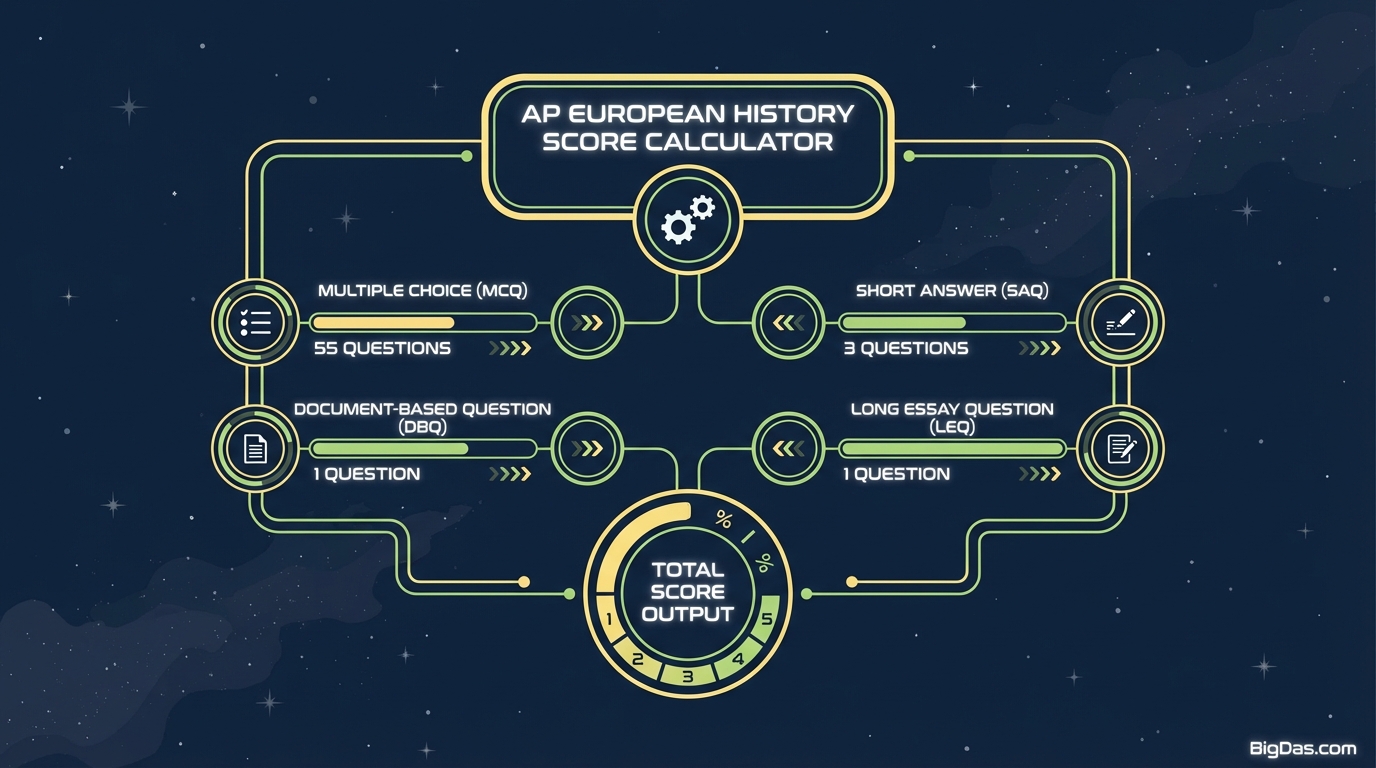
The AP European History Score Calculator simulates the College Board's grading algorithm. It takes your raw scores from the four sections, Multiple Choice (MCQ), Short Answer (SAQ), Document-Based Question (DBQ), and Long Essay (LEQ), converts them into a composite score, and applies a standardized curve to predict your final AP score (1 to 5).
The Complexity of AP Euro Grading
You can't just add up your points. The AP Euro exam uses a weighted scoring system where sections account for different percentages of your final grade:
- Section I, Part A (MCQ): 55 Questions | 40% of Score
- Section I, Part B (SAQ): 3 Questions | 20% of Score
- Section II, Part A (DBQ): 1 Question | 25% of Score
- Section II, Part B (LEQ): 1 Question | 15% of Score
The calculator applies these weightings automatically.
Key Features
1. Dynamic Weighting Algorithms
The tool uses the precise percentages assigned by the College Board. A point in the DBQ affects your final score differently than a point in the MCQ.
2. Updated Rubric Alignment
The College Board occasionally adjusts rubrics for the DBQ and LEQ. The calculator reflects the current 7-point DBQ scale and 6-point LEQ scale.
3. "What-If" Scenario Testing
You can input hypothetical scores to see what you need to reach your goal.
- Can you get a 5 if you miss the complexity point on the DBQ?
- How many multiple-choice questions can you miss and still pass with a 3?
4. Instant Feedback
No sign-ups or loading screens. Enter your data, and the calculator generates your composite score and estimated final AP score immediately.
Step-by-Step Guide: How to Use the Calculator
For the most accurate prediction, use results from a practice exam or an estimate of your average performance.
Step 1: Enter Multiple Choice (MCQ) Data
Input the number of questions you answered correctly out of 55.
- Tip: There is no penalty for guessing. If estimating, assume a 25% success rate on guessed answers.
Step 2: Input Short Answer (SAQ) Scores
The SAQ section has three questions, each worth 3 points, for a total of 9 raw points.
- Note: Question 1 and 2 are required; you choose between Question 3 or 4. The calculator aggregates these into a total raw score out of 9.
Step 3: Grade Your Document-Based Question (DBQ)
Enter your score based on the 7-point rubric:
- Contextualization (1 pt)
- Thesis/Claim (1 pt)
- Evidence from Documents (0-2 pts)
- Evidence beyond Documents (1 pt)
- Sourcing/HIPP (1 pt)
- Complexity (1 pt)
Step 4: Grade Your Long Essay Question (LEQ)
Enter your score based on the 6-point rubric. The LEQ tests your ability to formulate historical arguments using CCOT (Continuity and Change Over Time), Comparison, or Causation reasoning.
Step 5: Analyze Your Results
Hit "Calculate." You will see:
- Composite Score: Your weighted total.
- Estimated AP Score: Your final 1, 2, 3, 4, or 5.
Strategic Use Cases
Calculating your score is about resource allocation. AP European History requires memorizing a lot of information, so the tool helps you decide what to study.
1. The "Safety Net" Strategy
Simulate a "disaster scenario" to reduce test anxiety.
- Example: If you only get a 4/7 on the DBQ, a strong MCQ performance keeps you in the "4" range.
2. Identifying Your ROI (Return on Investment)
If you score 45/55 on Multiple Choice but only 2/7 on the DBQ, the calculator shows that studying DBQ rubric mechanics offers a higher ROI than perfecting your MCQ knowledge. Gaining 3 points on the DBQ moves the needle more than getting 3 more MCQs right.
3. Setting Realistic Goals
Teachers use this tool to show students that a perfect score isn't necessary for a 5. Getting about 70-75% of the total composite points usually yields a 5.
How to Get a 5: Data-Driven Tips
Master the "Easy" Points in Writing
The DBQ and LEQ have points that are straightforward to earn.
- Thesis & Contextualization: These account for 2 points in both essays. They are structural, so if you know the formula, you get the points. Secure these 4 raw points across both essays.
- Evidence: Using the provided documents correctly is easier than recalling obscure facts. Prioritize document usage if you're pressed for time.
The 60% MCQ Rule
If you consistently answer 60% to 70% of the Multiple Choice questions correctly, you're set up for a passing score (3+), provided your writing is average. Use the calculator to see how much pressure a strong MCQ section takes off your essay writing.
Don't Obsess Over "Complexity"
The "Complex Understanding" point on the DBQ is difficult to earn. If you're running out of time, skip it. The calculator shows that a 6/7 on the DBQ is almost always sufficient for a top-tier score.
Frequently Asked Questions (FAQ)
What is a good score for AP European History?
A score of 3 is passing and is accepted by many public universities for credit. A score of 4 or 5 is often required by more competitive private universities to grant course credit.
How accurate is this calculator?
The calculator uses the official weighting percentages provided by the College Board. However, exact curve cutoffs vary slightly from year to year based on exam difficulty. The tool uses a composite average of recent curves to provide a reliable estimate.
Does the calculator account for the different LEQ prompts?
The calculator focuses on the rubric score (0-6). Regardless of which LEQ prompt you choose, the grading rubric remains the same, so simply input your estimated rubric score.
What percentage do I need to get a 5?
Historically, students need to earn approximately 72-75% of the total available composite points to secure a 5. Use the calculator to tweak section scores and find the exact combination that gets you to that percentage.
Summary
Mastering AP European History is a large task that requires analyzing complex narratives and historical trends. Understanding the grading scale helps reduce stress and lets you study strategically. The AP European History Score Calculator lets you move from passive studying to active strategizing, so you know the format before walking into the testing room.
Disclaimer: This tool is not officially affiliated with the College Board. AP® is a trademark registered by the College Board, which is not affiliated with, and does not endorse, this product.