AP World History Score Calculator
 Modern scientific illustration of AP World History Score Calculator
Predict Your Score on the AP World History Exam
Every May, high school students face AP Exam season. AP World History: Modern (WHAP) is one of the most content-heavy and methodologically complex courses the College Board offers.
You've memorized the time periods, drilled the acronyms (SPICE-T), and practiced thesis statements. The real question is: what score will all that work earn you?
AP World History grading is opaque. It isn't a simple percentage calculation; it's a weighted formula across Multiple Choice (MCQ), Short Answer (SAQ), Document-Based Questions (DBQ), and Long Essay Questions (LEQ).
The AP World History Score Calculator applies the current College Board weighting and scoring curves to your raw section scores and projects a final 1-5 score. This guide explains how the tool works, breaks down the exam's grading rubric, and shows how to use score prediction to plan your studying and earn college credit.
What Is the AP World History Score Calculator?
The AP World History Score Calculator is an algorithmic tool that mimics the College Board's grading scale.
A common student mistake is treating AP scores as a straight percentage: getting 70% of questions right does not mean a 70. The exam uses a Composite Score system, where raw points are converted to a 1-5 scale using a curve that shifts slightly each year based on question difficulty.
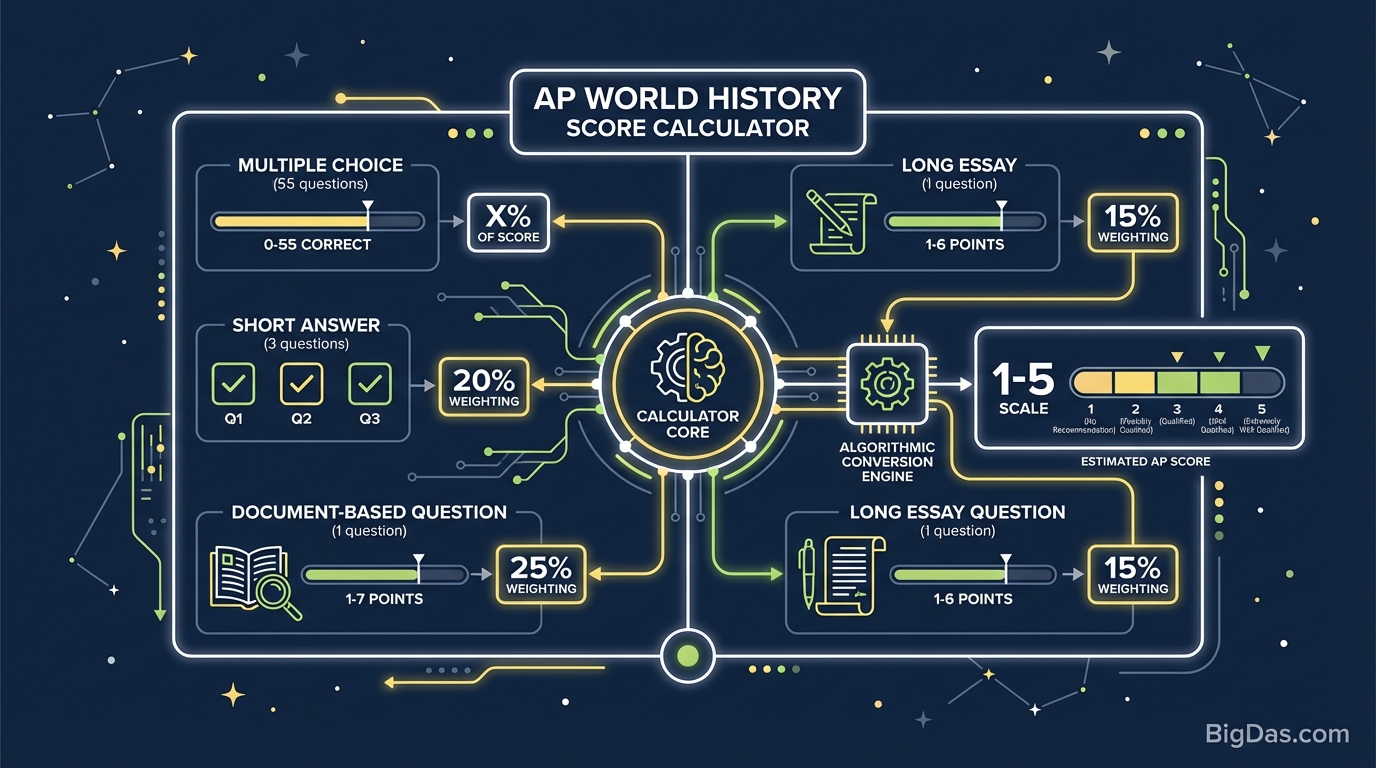
The calculator accepts raw score estimates for the MCQ, SAQ, DBQ, and LEQ, applies the official section weights, and outputs a projected score on the 1-5 spectrum.
Why "Guesstimating" Doesn't Work
Each section is weighted differently:
- Section I, Part A (MCQ): 40% of the total score.
- Section I, Part B (SAQ): 20% of the total score.
- Section II, Part A (DBQ): 25% of the total score.
- Section II, Part B (LEQ): 15% of the total score.
A missed point on the DBQ affects your final grade differently than a missed MCQ question. The calculator runs that math instantly.
How the AP Exam is Graded
The calculator is built on the rubrics and section weights published by the College Board.
1. Multiple Choice
55 questions in 55 minutes. This section is 40% of your grade. There is no guessing penalty, so leave no bubble blank. The calculator takes your correct count out of 55 to score this portion.
2. Short Answer Questions
3 questions, scored 0-3 each, for 9 raw points total. The first two are required; you pick one of the remaining two for the third. Only 9 points, but at 20% of the total, each point matters.
3. The DBQ
The Document-Based Question is the heaviest single writing task: 0-7 on the rubric, 25% of your score. Points come from:
- Thesis/Claim (1 pt)
- Contextualization (1 pt)
- Evidence from Documents (2 pts)
- Evidence beyond the Documents (1 pt)
- Sourcing (1 pt)
- Complexity (1 pt)
4. The LEQ
The Long Essay Question is 0-6 and 15% of the score. With no documents provided, it draws entirely on memorized content and is often the weakest section for students.
Key Features
1. Section-Based Weighting
The calculator applies the official weights: a 5/7 on the DBQ counts more than a 5/6 on the LEQ, and a 45/55 on the MCQ counts more than either.
2. "What-If" Scenarios
Run different combinations to map out your score:
- Scenario A: Strong MCQ, weak LEQ.
- Scenario B: Perfect DBQ, 50% on MCQs.
This surfaces your Minimum Viable Score, the raw numbers needed to land a 3, 4, or 5.
3. Simple Interface
No spreadsheets or manual math. The form is clean, mobile-friendly, and works between classes.
4. Current Scoring Data
The College Board periodically adjusts rubrics (including recent DBQ/LEQ updates). The calculator reflects the most current AP World History: Modern standards.
How to Use the Calculator
Step 1: Gather Your Data
Use practice exam scores if you have them. Otherwise, estimate from class quizzes and graded writing assignments.
Step 2: Enter the MCQ
Input the number of correct answers out of 55.
- Tip: Be realistic. If you usually get 40/55, enter 40 for a safe baseline.
Step 3: Enter the SAQ
Input your raw score out of 9.
- Three questions, three points each.
Step 4: Enter the DBQ and LEQ
- DBQ: 0 to 7, based on the rubric (Thesis, Contextualization, Evidence, etc.).
- LEQ: 0 to 6.
Step 5: Read the Result
Click "Calculate." The tool shows your estimated Composite Score and final AP Score (1-5).
Strategic Use Cases
AP World History covers thousands of years of content. You can't cram all of it, so you need a strategy.
For the "Borderline" Student
If you're hovering between a 2 and a 3, the calculator shows whether a few targeted points are enough to pass.
- Strategy: Test whether 2 extra DBQ points push you into the passing range without mastering the rest of the course.
For the Perfectionist (Aiming for a 5)
A 5 doesn't require 100%. A composite around 72-75% typically secures one.
- Strategy: Find out how many MCQs you can miss and still earn a 5. Seeing that buffer cuts down on test-day anxiety.
For the "Bad Writer"
Strong memorizers with weak essays can check whether their MCQ score carries their writing score.
- Strategy: Input a high MCQ and a low writing score. If the result falls short, the calculator shows exactly how much the essays need to improve.
How to Improve Your Projected Score
Three tips based on the calculator's weighting logic:
1. Target Easy Points in Writing
- Thesis (1 pt) and Contextualization (1 pt) are the easiest to grab. Master the formula and you start every essay with 2 points.
- Complexity (1 pt) is the hardest. Don't chase it until the easy points are locked in.
2. The MCQ "Rule of Two"
On most MCQs, two answers are clearly wrong. That leaves a 50/50 shot. Eliminating two consistently raises your expected score.
3. Don't Skip the SAQ
The SAQ is 20% of your score, more than the LEQ. The questions are short and specific, which makes them faster to study than long essays. Pushing your SAQ score up is the quickest way to improve your composite.
Frequently Asked Questions (FAQ)
1. Is there a penalty for wrong answers on the AP World History exam?
No. The College Board removed the guessing penalty years ago. You lose nothing for a wrong answer. Answer every MCQ, even on a guess.
2. What is the cutoff score for a 5?
Cutoffs shift year to year, but historically roughly 72-75% of total composite points earns a 5. Around 60-62% earns a 4, and around 48-50% earns a 3.
3. How accurate is this calculator?
It uses the College Board's published section weights, so the math is exact. The final curve is set by the College Board after grading, which introduces some uncertainty. Treat the result as a close estimate, not a guarantee.
4. Do colleges accept a score of 3?
Many public universities grant credit for a 3. Selective private universities and Ivy League schools typically require a 4 or 5. Check each college's AP credit policy directly.
Conclusion
The AP World History exam rewards endurance, memory, and analytical skill. Knowing how the score is built shouldn't be a mystery.
The AP World History Score Calculator turns your practice scores into a projected 1-5, which lets you focus your remaining study time where it actually pays off. Whether you're trying to pass or chasing a 5, knowing your numbers is where a real study plan starts.