Dirt & Volume Calculator
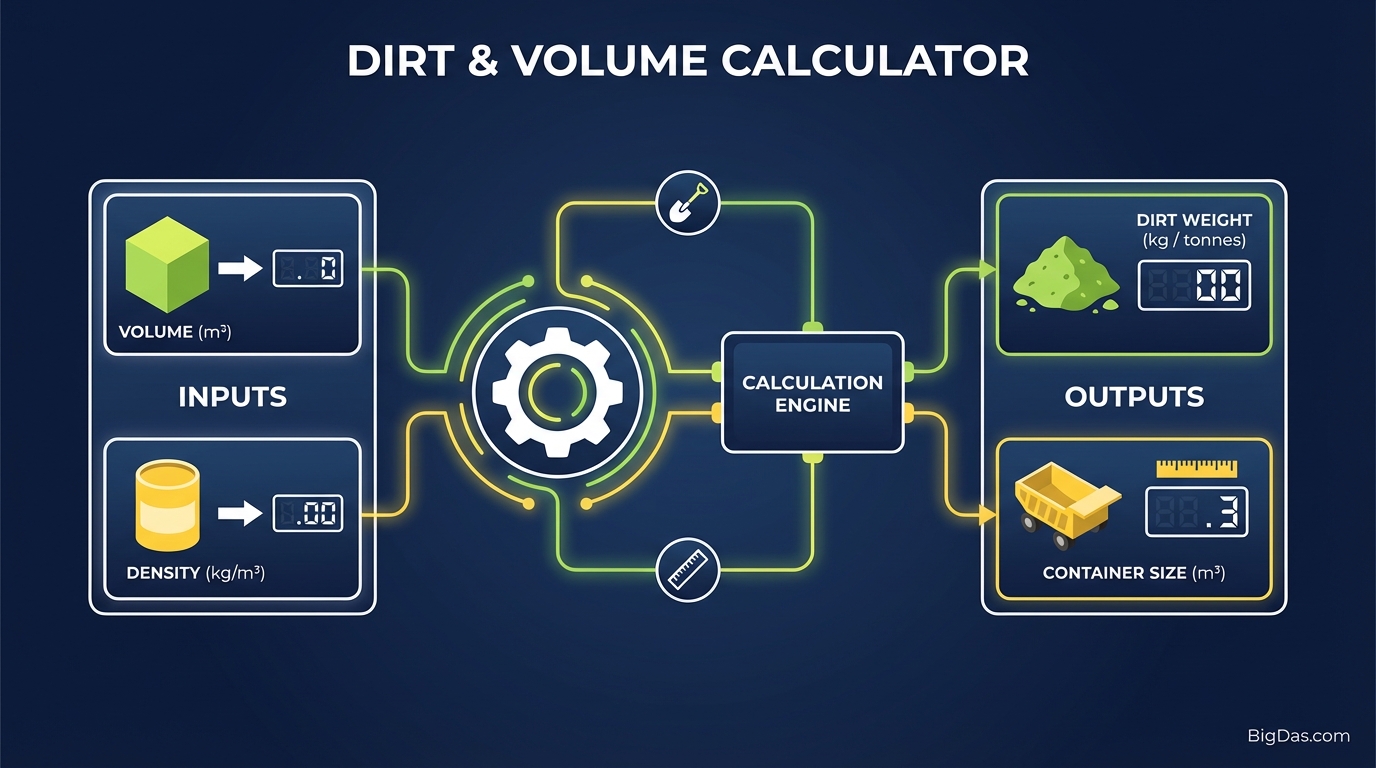 Modern scientific illustration of Dirt & Volume Calculator
Master Your Landscaping Project: The Ultimate Dirt & Volume Calculator Guide
Stop guessing. Stop wasting money. Start calculating with precision.
There is a specific kind of anxiety that comes with ordering bulk materials for a landscaping project. It is the "Goldilocks" dilemma of the DIY enthusiast and the professional contractor alike:
- Order too little, and your project grinds to a halt. You are left with a half-filled raised bed or a gravel driveway that ends three feet short of the garage. You face additional delivery fees, project delays, and the frustration of breaking your workflow.
- Order too much, and you are literally throwing money into a pile in your yard. Now you have a mound of leftover fill dirt or mulch killing your grass, requiring you to pay someone to haul it away or spend your weekend wheelbarrowing it to neighbors who don't want it.
Landscaping isn't just about aesthetics; it is about geometry and logistics. Whether you are laying a foundation, filling raised garden beds, or spreading fresh mulch, the success of your project hinges on one critical metric: Volume.
Enter the Dirt & Volume Calculator—the best-in-class digital tool designed to bridge the gap between your project’s dimensions and the material supplier’s order form. This guide will walk you through exactly how to use this tool, the science behind the calculation, and expert tips to ensure your project lands exactly on target.
What is the Dirt & Volume Calculator?
At its core, the Dirt & Volume Calculator is a precision estimation engine. It takes the linear dimensions of your project area (length, width, and depth) and converts them into a three-dimensional volume measurement, typically expressed in Cubic Yards.
While the name suggests it is strictly for dirt, this is a multi-functional aggregate calculator. It is the industry-standard solution for estimating:
- Topsoil & Fill Dirt
- Mulch & Compost
- Gravel, Crushed Stone, & Pea Gravel
- Sand & Concrete
The Math Behind the Magic
Why can’t you just use square footage? Because landscaping happens in 3D.
If you buy carpet, you need Area (Length $\times$ Width). But if you buy soil, you need Volume (Length $\times$ Width $\times$ Depth).
The industry standard unit for bulk material delivery is the Cubic Yard. One cubic yard is a volume of material that fits in a space 3 feet wide, 3 feet long, and 3 feet deep. This equals 27 cubic feet.
Doing this math manually is prone to error, especially when your measurements are mixed (e.g., a driveway that is 50 feet long but requires 4 inches of gravel). Our Dirt & Volume Calculator handles these unit conversions instantly, ensuring that you don't make a decimal point error that costs you hundreds of dollars.
Key Features & Benefits
Why is this tool considered the best in its class? Because it moves beyond simple multiplication to offer professional-grade utility.
1. Pinpoint Accuracy across Units
Most homeowners measure length in feet but depth in inches. Our calculator automatically harmonizes these inputs. You don't need to convert 4 inches to 0.33 feet in your head before starting; the tool does the heavy lifting for you.
2. Shape Versatility
Nature rarely deals in perfect squares. A robust Dirt & Volume Calculator allows you to estimate for:
- Rectangular Areas: (e.g., driveways, raised beds).
- Circular Areas: (e.g., flower beds around trees, fire pit bases).
- Triangular Areas: (e.g., corner garden plots).
3. Immediate Cost Savings
Aggregate materials are expensive. High-quality topsoil or decorative river rock can cost upwards of $50 to $100 per yard, not including delivery. By calculating the exact amount needed, you eliminate the "fear tax" of ordering extra just to be safe.
4. Project Logistics Planning
Knowing the volume helps you plan the labor. One cubic yard of dirt weighs roughly 2,000 to 2,500 lbs. If the calculator tells you that you need 10 cubic yards, you know you are moving 25,000 lbs of material. This information is vital for deciding whether you can use a wheelbarrow or if you need to rent a skid steer.
Step-by-Step Guide: How to Use the Calculator
Using the Dirt & Volume Calculator is intuitive, but following these steps ensures you get the most precise results for your specific terrain.
Step 1: Measure Your Area
Grab a tape measure. You need three numbers:
- Length: The longest side of the project.
- Width: The shorter side of the project.
- Depth: How thick you want the material layer to be.
Pro Tip: If your area is irregular (like a kidney-bean-shaped garden), break it down into smaller rectangles or circles, measure those individually, and add the totals together.
Step 2: Determine Desired Depth
The depth depends entirely on the material and the application:
- Mulch: Standard application is 2 to 3 inches.
- Topsoil for Turf: Usually 4 to 6 inches.
- Gravel Driveways: typically 4 to 8 inches (applied in layers).
- Raised Garden Beds: Measure from the bottom of the box to 2 inches below the rim.
Step 3: Input Data into the Calculator
Select the shape of your area. Enter your Length, Width, and Depth into the corresponding fields. Ensure you select the correct units (e.g., Feet for length, Inches for depth).
Step 4: Calculate and Review
Hit the "Calculate" button. The tool will output your requirement in Cubic Yards and usually Cubic Feet.
- Small projects (bagged material): Use Cubic Feet.
- Large projects (truck delivery): Use Cubic Yards.
Step 5: Apply the "Compaction Factor"
This is where the professionals separate themselves from the amateurs. Most loose materials settle. (See the "Expert Advice" section below for details).
Why You Need This Tool: Common Use Cases
The Dirt & Volume Calculator is versatile enough for almost any outdoor renovation. Here are the most common scenarios where this tool is indispensable.
1. Filling Raised Garden Beds
The Problem: You built three beautiful cedar raised beds (8ft x 4ft x 12in). Buying bags of potting mix from the hardware store is astronomically expensive. The Solution: Input the dimensions. The calculator shows you need roughly 3.5 cubic yards total. You can now order a bulk delivery of a 50/50 compost-topsoil blend, saving roughly 40% compared to bagged soil.
2. Installing a Gravel Driveway
The Problem: You need to refresh your gravel driveway. It looks simple, but if the gravel layer is too thin, it will wash away; too thick, and your car will sink. The Solution: You measure a 50ft x 10ft driveway and want 4 inches of coverage. The calculator indicates roughly 6.2 cubic yards. Knowing this, you order 7 yards to account for compression, ensuring a solid, long-lasting surface.
3. Laying Mulch for Spring
The Problem: You want to spruce up your flower beds. In previous years, you bought 20 bags and had to go back to the store three times. The Solution: Measure your total square footage. The calculator determines you need 2 cubic yards. Since one cubic yard is roughly 13.5 bags (2 cubic foot bags), you know exactly how many to buy—or that it's cheaper to get a pickup truck load.
4. Leveling a Yard (Fill Dirt)
The Problem: Your lawn has a depression that collects water. You need to raise the grade. The Solution: This is tricky because the depth varies. Estimate the average depth of the depression. The calculator gives you a baseline for the fill dirt needed to solve your drainage issues effectively.
Expert Advice: Getting the Most Out of the Tool
To truly leverage the power of the Dirt & Volume Calculator, you must understand the physical properties of the materials you are working with. The calculator gives you the mathematical volume, but the practical volume requires a few adjustments.
The Compaction Factor (The +10% Rule)
When soil, gravel, or mulch is loaded into a truck, it is "fluffed" or loose. Once you spread it and it gets rained on, it settles and compacts.
- Dirt/Soil: Settles by about 10-20%.
- Gravel: Settles by about 5-10%.
- Mulch: Decomposes and settles significantly over time.
Recommendation: Always add 10% to the calculator's final number. If the calculator says you need 5 yards, order 5.5 yards. It is always better to have a wheelbarrow of extra soil for potted plants than to be short.
Measuring Depth for Uneven Ground
Ground is rarely perfectly flat. If you are filling an area with varying depths:
- Take depth measurements at 5 different spots.
- Add them up and divide by 5 to get the average depth.
- Use this average in the calculator.
Understanding Weight
The calculator gives you volume, but your truck has a weight limit.
- 1 Cubic Yard of Mulch: ~800 lbs (Light enough for a standard pickup).
- 1 Cubic Yard of Topsoil: ~2,200 lbs (Requires a heavy-duty trailer or dump truck).
- 1 Cubic Yard of Gravel: ~2,700 lbs (Definitely requires a dump truck).
Always cross-reference the calculated volume with the payload capacity of your vehicle if you are hauling it yourself.
Frequently Asked Questions (FAQ)
Q: How many bags of mulch are in a cubic yard?
A: This is a very common question. Most bagged mulch comes in 2-cubic-foot bags. Since there are 27 cubic feet in a cubic yard, you need 13.5 bags to equal 1 cubic yard.
Q: Can I use this calculator for concrete?
A: Yes. Concrete is ordered by the cubic yard. However, for concrete projects, it is recommended to add a slightly lower buffer (5%) as precise forms prevent the material from spreading as much as loose dirt.
Q: What is the difference between "Topsoil" and "Fill Dirt"?
A: Fill Dirt is subsoil, often containing clay and rocks. It doesn't compress much and is used for shaping landscapes or filling deep holes. Topsoil contains organic matter and nutrients; it is softer, compresses more, and is used for the top 4-6 inches where plants grow. The calculator works for both, but remember topsoil shrinks more!
Q: My area is an L-shape. How do I calculate it?
A: Divide the L-shape into two separate rectangles. Calculate the volume for Rectangle A and Rectangle B separately, then add the total cubic yards together for your final order.
Conclusion
A successful landscaping project is built on a foundation of good planning. The difference between a professional-looking job and a chaotic struggle often comes down to the accuracy of your materials order.
The Dirt & Volume Calculator is more than just a math tool; it is your project manager. It saves you money by preventing over-ordering, saves you time by preventing under-ordering, and helps you visualize the scope of labor required.
Whether you are laying the groundwork for a new patio, revitalizing your garden beds, or grading your lawn, start with the numbers.
Ready to start your project? Scroll up to the calculator, input your measurements, and take the guesswork out of your landscaping today. Get your estimate, call your supplier, and get to work with confidence.