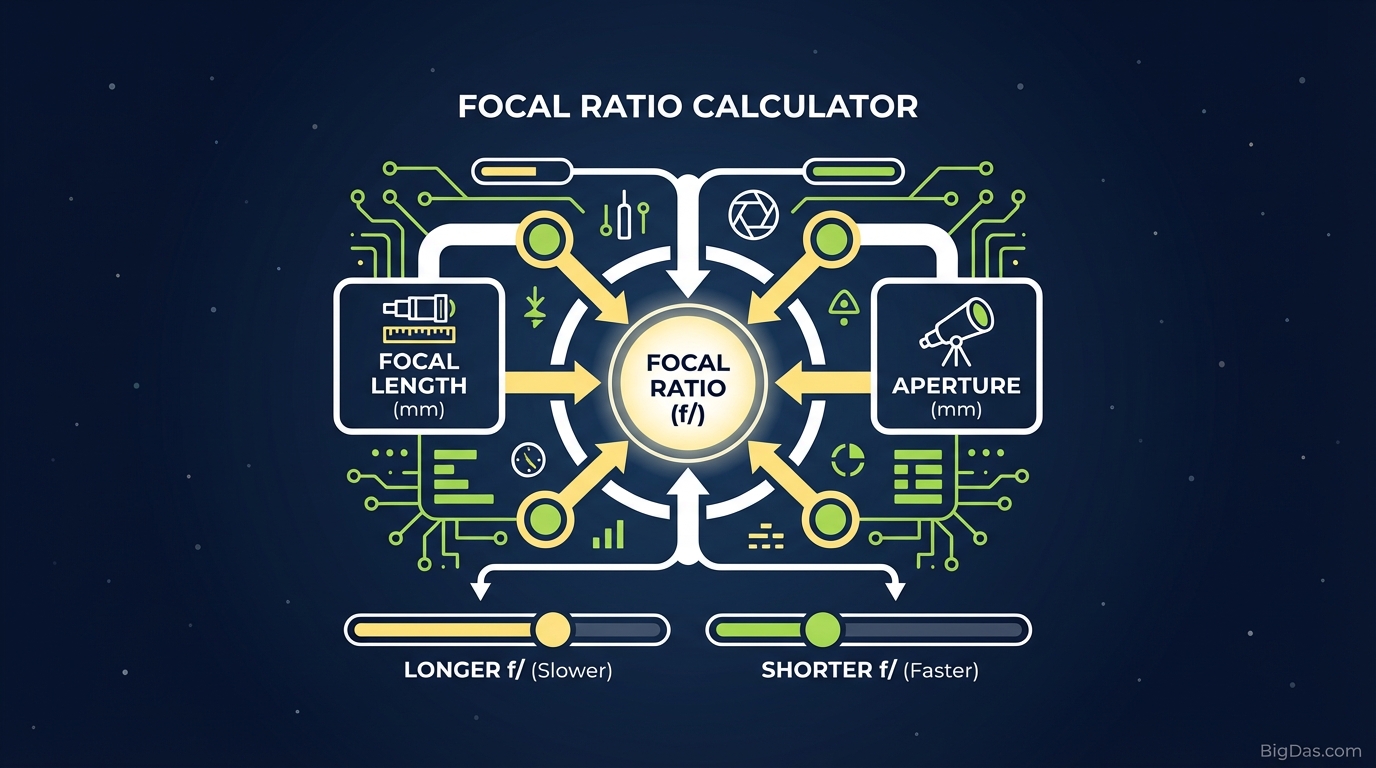
Focal Ratio Calculator
 Modern scientific illustration of Focal Ratio Calculator
Master Your Telescope’s Performance: The Ultimate Focal Ratio Calculator Guide
Whether you are an amateur stargazer unboxing your first Newtonian reflector or a seasoned astrophotographer fine-tuning a dedicated imaging rig, understanding your equipment’s optics is the difference between a blurry grey smudge and a crisp, breathtaking view of the Orion Nebula.
At the heart of this optical understanding lies one critical number: The Focal Ratio (f-number).
However, telescope manufacturers often bury this spec, or users modify their optical trains with reducers and Barlow lenses, changing the effective speed of the system. This is where the Focal Ratio Calculator becomes your most valuable asset.
In this guide, we will explore exactly what focal ratio is, why it dictates your observing experience, and how to use our Focal Ratio Calculator to unlock the full potential of your telescope.
What is the Focal Ratio Calculator?
At its core, a Focal Ratio Calculator is a precision tool designed to determine the "speed" of your telescope's optics. While the math may seem simple on the surface, the implications of the result are significant for both visual astronomy and astrophotography.
The calculator derives the focal ratio (often denoted as f/) based on the physical dimensions of your optical tube assembly (OTA). It answers the fundamental question: How strictly is the light cone converged before it hits your eye or camera sensor?
The Physics Behind the Numbers
To understand the tool, you must understand the formula. The focal ratio is calculated using two primary variables:
- Focal Length (F): The distance (usually in millimeters) from the primary lens or mirror to the point where the image is brought into focus.
- Aperture (D): The diameter of the primary lens or mirror (the light-gathering bucket).
The formula used by our calculator is:
$f = (F/D)$
For example, a telescope with a focal length of 1000mm and an aperture of 100mm has a focal ratio of f/10.
While you can do this math on a napkin, our Focal Ratio Calculator handles complex scenarios, including unit conversions (inches to mm) and the integration of optical modifiers, ensuring you have the exact specifications of your active setup.
"Fast" vs. "Slow" Telescopes
The calculator categorizes your scope into two main camps:
- Fast Telescopes (f/4 to f/6): These offer a wide field of view and lower magnification per eyepiece focal length. In photography, they require shorter exposure times to capture the same amount of light.
- Slow Telescopes (f/10 to f/15): These provide higher magnification and a narrower field of view, making them ideal for planetary and lunar observation where brightness is abundant, but detail is key.
Key Features & Benefits of Our Tool
Why use our specific Focal Ratio Calculator rather than a generic calculator app? We have designed this tool specifically for the nuances of astronomy.
1. Precision Unit Conversion
Telescope specs are a chaotic mix of metric and imperial units. You might have an 8-inch Schmidt-Cassegrain with a 2032mm focal length. Our tool automatically standardizes these units, preventing the math errors that lead to bad equipment purchases.
2. Optical Modifier Integration
Rarely do intermediate or advanced astronomers use a telescope "native." You likely use:
- Focal Reducers: To speed up the scope for photography.
- Barlow Lenses: To increase magnification for planetary viewing.
Our tool allows you to input these modifiers to calculate the Effective Focal Ratio, giving you the true speed of your current optical train.
3. Exposure Factor Estimation
For astrophotographers, knowing the f-ratio is about saving time. The tool provides context on how your f-ratio affects light gathering. For instance, moving from f/8 to f/4 cuts your required exposure time by a factor of four. Our calculator highlights these efficiency gains.
4. Eyepiece Matching Logic
Based on your calculated focal ratio, the tool helps you understand which eyepieces will function best. A "fast" f/4 scope requires high-quality, well-corrected eyepieces to avoid edge distortions (coma), whereas a "slow" f/10 scope is more forgiving with cheaper glass.
Step-by-Step Guide: How to Use the Focal Ratio Calculator
Using the calculator is intuitive, but following these steps ensures you get data you can actually use to improve your observing sessions.
Step 1: Identify Your Aperture
Find the diameter of your primary objective. This is usually printed on the ring around the front lens or on a sticker near the focuser.
- Input: Enter the value (e.g. 200) and select the unit (mm or inches).
Step 2: Identify Your Focal Length
Locate the focal length specification. Note that on some Catadioptric scopes (like Maksutov-Cassegrains), the focal length is much longer than the physical tube length.
- Input: Enter the value (e.g. 1200) and select the unit (usually mm).
Step 3: Account for Modifiers (Optional but Recommended)
Are you using a 0.7x Focal Reducer? Or a 2x Barlow Lens?
- Action: Toggle the "Optical Modifiers" switch on the calculator and input the multiplication factor (e.g. 0.7 or 2.0).
Step 4: Analyze the Results
Click Calculate. The tool will generate:
- Native Focal Ratio: The speed of the bare telescope.
- Effective Focal Ratio: The speed with your modifiers attached.
- Scope Classification: A label identifying the scope as "Fast," "Mid-range," or "Slow."
Why You Need This Tool: Critical Use Cases
Why does this number matter? Why shouldn't you just look through the eyepiece and ignore the math? Here is why the Focal Ratio Calculator is an essential part of your toolkit.
1. The Astrophotographer’s Exposure Triangle
In terrestrial photography, you can change your aperture with a dial. In astrophotography, your telescope IS your aperture, and it is fixed.
Knowing your precise focal ratio is the only way to calculate exposure times. If you are imaging the Andromeda Galaxy:
At f/5, you might need 3 hours of total integration time.
At f/10, you would need 12 hours to get the same signal-to-noise ratio.
Value: Use the calculator to determine if you need a focal reducer to make your project feasible within a single night.
2. Purchasing the Right Optical Tube
Are you looking to buy a new telescope? Don't rely on marketing fluff. Run the numbers.
If you want to view faint, deep-sky objects (Nebulae, Galaxies), you need a low f-number (f/4 - f/6).
If you want to split double stars or view Jupiter’s cloud bands, you want a high f-number (f/10+).
Value: The calculator acts as a sanity check before you spend thousands of dollars on a scope that is ill-suited for your targets.
3. Matching Pixel Scale (Sampling)
For advanced imagers, the focal ratio helps determine if your camera is a good fit for your telescope. You want to avoid "undersampling" (blocky stars) or "oversampling" (bloated stars). The f-ratio is a key variable in calculating the resolution per pixel (arcseconds/pixel).
4. Visual Observing and Exit Pupil
The focal ratio dictates the Exit Pupil, the width of the beam of light hitting your eye.
$Exit Pupil = Eyepiece Focal Length / Telescope Focal Ratio$
If your exit pupil is larger than 7mm, light is being wasted (blocked by your iris).
Value: By knowing your exact f-ratio, you can avoid buying low-power eyepieces that your eye literally cannot fully utilize.
Expert Advice: Getting the Most Out of Your Optics
The "Fast" Telescope Tolerance Trap: If the calculator tells you that you have a "Fast" scope (f/5 or lower), be aware that optical collimation (alignment) becomes critical. An f/4 Newtonian requires precise alignment; being off by a millimeter will destroy image sharpness. Conversely, an f/10 Schmidt-Cassegrain is much more forgiving of slight misalignment.
Use the calculator to manage your expectations. If you calculate an f/4 ratio, know that you must also invest in a good collimation tool and perhaps a Coma Corrector.
Frequently Asked Questions (FAQ)
1. Is a higher or lower focal ratio better?
Neither is "better", they serve different purposes. A lower focal ratio (f/4) is "faster," meaning it is better for wide-field views and deep-sky photography. A higher focal ratio (f/10+) is "slower," offering higher contrast and magnification for planets, the Moon, and double stars.
2. Does focal ratio affect the magnification?
Indirectly. Magnification is determined by Focal Length / Eyepiece Focal Length. However, telescopes with high focal ratios usually have long focal lengths, which inherently makes it easier to achieve high magnification.
3. How does a Barlow lens affect my focal ratio?
A Barlow lens increases the effective focal length of your telescope. A 2x Barlow doubles your focal length, which effectively doubles your focal ratio. For example, an f/5 scope becomes an f/10 scope. This is excellent for planetary viewing but makes deep-sky photography much more difficult due to the longer exposure times required.
4. Can I change the focal ratio of my telescope?
Yes, optically. You cannot change the physical mirror, but you can use:
- Focal Reducers: To lower the f-number (widen the view).
- Barlow Lenses/Extenders: To raise the f-number (narrow the view).
Use our calculator to see exactly how these accessories change your specific setup.
5. Why do large observatories use "slow" f-ratios?
Actually, many professional research telescopes are incredibly fast (f/1 to f/3) to gather light quickly. However, amateur scopes designed for high-resolution planetary work are often slow (f/15) to reduce optical aberrations like chromatic aberration (color fringing) without using expensive exotic glass.
Conclusion
Astronomy is a hobby of precision. Whether you are hunting for faint fuzzies in the Virgo Cluster or trying to snap a high-definition image of Saturn's rings, knowing your numbers is the first step toward success.
The Focal Ratio is the speedometer of your telescope. It dictates your field of view, your exposure time, and your equipment compatibility. Don't guess, and don't rely on rounded manufacturing numbers.
Scroll up and use the Focal Ratio Calculator now. Input your specs, apply your modifiers, and get the precise data you need to explore the universe with clarity and confidence.
Disclaimer: Always ensure your measurements are accurate. For astrophotography, remember that while focal ratio determines speed, total aperture determines resolution.