Michigan Income Calculator
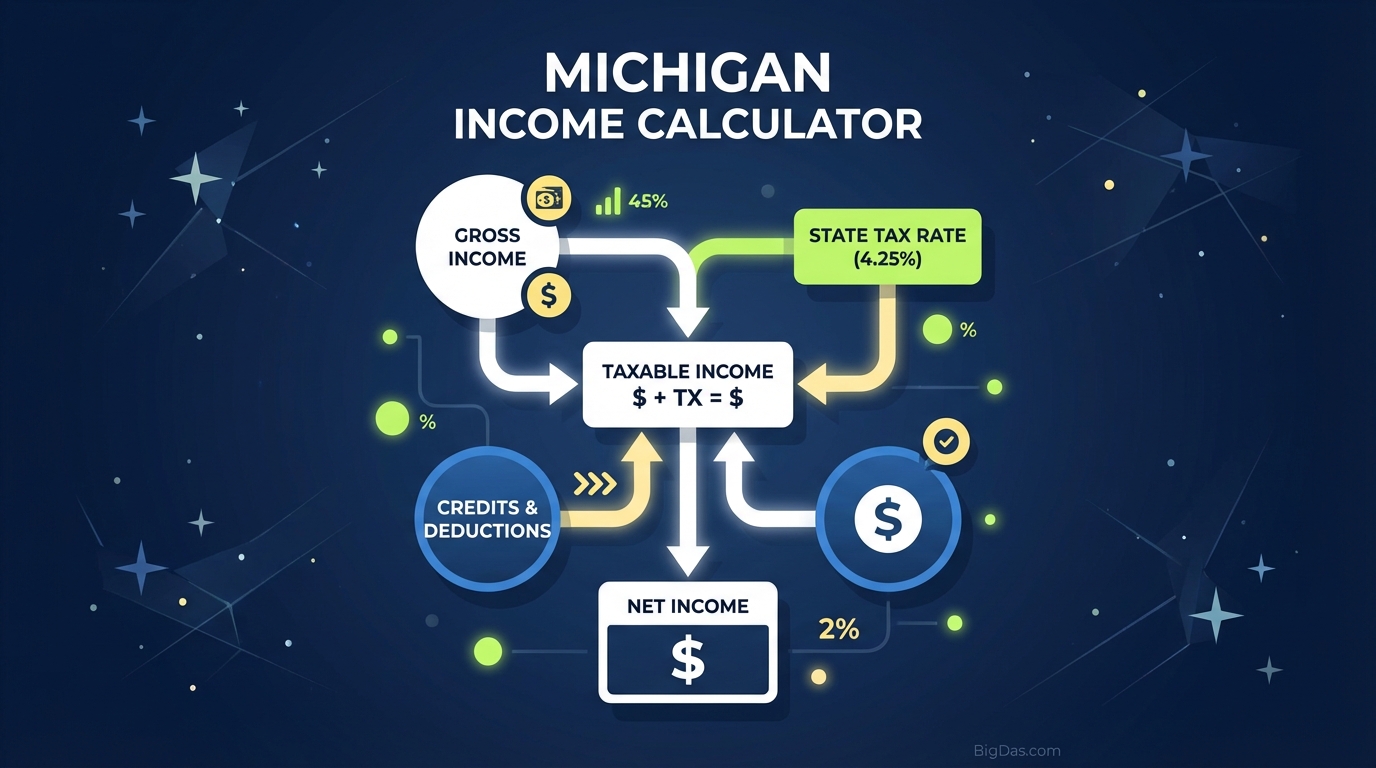 Modern scientific illustration of Michigan Income Calculator
Michigan Income Calculator: Estimate Your True Take-Home Pay in Seconds
Is your paycheck telling the whole story?
You negotiated your salary, signed the offer letter, and did the mental math. But when that first direct deposit hits your account, the number often looks significantly different than what you expected. Between federal withholdings, FICA, the Michigan flat tax, and the complex web of local city taxes, understanding exactly how much money lands in your pocket can feel like solving a riddle.
Whether you are relocating to the Great Lakes State, eyeing a promotion, or simply trying to budget better for the coming year, guessing your net income isn’t enough. You need precision.
Enter the Michigan Income Calculator. This isn't just a generic arithmetic tool; it is the best-in-class financial utility designed specifically for Michiganders. By accounting for the unique nuances of Michigan's tax code—including reciprocity agreements and specific city levies—this tool bridges the gap between your gross salary and your actual spending power.
In this guide, we will dive deep into how this calculator works, why Michigan’s tax system requires a specialized tool, and how you can use it to master your financial planning.
What Is the Michigan Income Calculator?
At its core, the Michigan Income Calculator is a sophisticated digital utility that computes your "net pay" (take-home pay) by deducting all applicable taxes from your "gross pay."
While that sounds simple, the engine behind the tool is complex. Unlike states with zero income tax (like Florida) or states with progressive tax brackets (like California), Michigan operates on a unique flat tax rate system. However, the complexity in Michigan often lies in what comes after the state tax.
This tool automatically processes the following layers of taxation:
- Federal Income Tax: Based on the IRS progressive tax brackets and your filing status.
- FICA Taxes: The mandatory 6.2% for Social Security and 1.45% for Medicare.
- Michigan State Tax: Calculates the current flat percentage rate mandated by the Michigan Department of Treasury.
- Local City Taxes: This is the game-changer. Michigan has over 20 cities (including Detroit, Grand Rapids, and Lansing) that levy their own income tax on top of state and federal taxes. This calculator identifies these based on your input to ensure accuracy.
By synthesizing these variables, the Michigan Income Calculator provides a pixel-perfect snapshot of your financial reality before the money ever leaves your employer's payroll system.
Key Features & Benefits: Why This Tool is Best-in-Class
There are dozens of generic paycheck calculators on the web. However, most of them fail when applied to specific state intricacies. Here is why our Michigan Income Calculator stands above the rest:
1. Local Tax Database Integration
The most common error in calculating Michigan paychecks is ignoring city income taxes. If you live or work in Detroit, for example, the tax implications are significant (up to 2.4% for residents). Generic calculators miss this. Our tool incorporates the specific rates for both residents and non-residents of Michigan taxing cities.
2. Real-Time Tax Rate Updates
Tax laws change. Michigan’s personal income tax rate has been subject to triggers that can lower it based on the state’s general fund surplus. This tool is updated in real-time to reflect the current effective tax rate, ensuring you aren't using outdated percentages from three years ago.
3. Reciprocity Awareness
Do you live in Michigan but work in a reciprocal state (like Illinois, Indiana, Kentucky, Minnesota, Ohio, or Wisconsin)? This tool understands the tax reciprocity agreements, helping you avoid miscalculations regarding double taxation.
4. Pre-Tax and Post-Tax Deduction Customization
Your take-home pay isn't just about taxes; it's about benefits. The calculator allows you to input:
- 401(k) / 403(b) contributions
- Health insurance premiums
- HSA/FSA contributions This ensures the final number reflects your actual bank deposit, not just a tax estimate.
Step-by-Step Guide: How to Use the Michigan Income Calculator
Using the calculator is intuitive, but to get the most precise results, you should input your data carefully. Follow this workflow:
Step 1: Enter Your Gross Income
Input your salary amount. You can enter this as:
- Annual Salary: (e.g., $75,000)
- Hourly Rate: (e.g., $35/hour)
- Per Pay Period: (e.g., $2,500)
Step 2: Select Your Pay Frequency
How often do you get paid? This affects the withholding calculation for each check.
- Weekly (52 checks)
- Bi-weekly (26 checks – most common)
- Semi-monthly (24 checks)
- Monthly (12 checks)
Step 3: Choose Your Filing Status
Select whether you are Single, Married Filing Jointly, or Head of Household. This drastically changes your Federal withholding amounts and standard deductions.
Step 4: Input Location (Crucial for Michigan)
Enter your work location and your home location.
- Why? If you live in a city like Pontiac or Saginaw, you are subject to local income tax. Even if you don't live there but work there, a non-resident tax usually applies (often half the resident rate). The calculator needs this data to apply the correct local surcharge.
Step 5: Add Deductions
- Federal Allowances: Enter the number from your W-4.
- Pre-Tax Deductions: Enter percentages or fixed dollar amounts for retirement (401k) or medical insurance.
- Post-Tax Deductions: Enter garnishments or Roth IRA contributions.
Step 6: Hit Calculate
Instantly view a breakdown of your taxes and your final Net Pay.
Why You Need This Tool: Top Use Cases
Why should you bookmark this page? Here are the scenarios where the Michigan Income Calculator becomes indispensable.
1. Job Offer Negotiation
You just received an offer for $85,000 in Detroit. Sounds great, right? But between the federal tax and Detroit’s 2.4% resident tax, your take-home pay might be lower than a $80,000 offer in a township with no local tax. Use the calculator to compare offers "apples to apples" based on net income, not gross salary.
2. Relocation Planning
Moving to Michigan from a state with no income tax (like Texas or Tennessee)? The 4.25% flat tax plus potential local taxes will be a shock if you aren't prepared. Use the tool to adjust your budget requirements before you hire the movers.
3. Adjusting Your W-4
If you received a massive tax refund last year, you essentially gave the government an interest-free loan. If you owed money, you might have faced penalties. Use the calculator to tweak your withholdings so you break even at tax time, maximizing your monthly cash flow.
4. Freelance and Contract Work
If you are a 1099 contractor in Michigan, no one is withholding taxes for you. This tool helps you estimate exactly how much you need to set aside in a savings account to cover your quarterly estimated tax payments, keeping you safe from the IRS and the Michigan Treasury.
Deep Dive: Understanding the Michigan Tax Landscape
To get the most out of the Michigan Income Calculator, it helps to understand the underlying logic of the state's tax structure.
The Flat Tax System
Unlike the federal government, which uses tax brackets (where higher income equals a higher percentage), Michigan uses a flat rate. Historically, this has hovered around 4.25%.
- Note: Recent legislation involving "triggers" based on state revenue surpluses can temporarily lower this rate (e.g., to 4.05%). Our calculator automatically updates to reflect the currently legislated rate.
The City Tax Factor
This is where Michigan is unique. While most states only have state and county taxes, Michigan allows cities to impose income taxes.
- Residents: Usually pay 1.0% (Detroit is an outlier at 2.4%).
- Non-Residents: Usually pay 0.5% (Detroit is approx 1.2%) if they work in the city but live elsewhere.
- Exemptions: Some cities offer specific exemptions for dependents that differ from federal standards.
The calculator handles the math, but knowing why your check looks the way it does empowers you to make smarter decisions about where you choose to live and work.
FAQ: Common Questions About Michigan Paychecks
1. What is the current income tax rate for Michigan?
As of the most recent standard update, the rate is generally 4.25%. However, due to state revenue triggers, this can fluctuate slightly year-to-year. The calculator on this page is always updated with the latest effective rate enforced by the Michigan Department of Treasury.
2. Do I have to pay city tax if I don't live in the city?
Yes, usually. If you work in a city that levies an income tax (like Grand Rapids, Lansing, or Flint) but live in a suburb, you will typically pay a "non-resident" rate, which is often half of the resident rate.
3. How does the calculator handle 401k contributions?
401k contributions are "pre-tax." When you enter a 401k percentage in the calculator, the tool subtracts that money from your gross pay before calculating Federal and State income taxes. This lowers your taxable income, showing you the tax-saving benefit of contributing to your retirement.
4. Why is my take-home pay different from what the calculator says?
While our tool is highly accurate, small discrepancies can occur due to:
- Company-specific payroll software rounding methods.
- Benefit costs (health insurance) that vary by provider.
- Specific deductions you may have missed (like union dues or uniform fees). Use the result as a highly accurate estimate (within a few dollars) rather than a penny-perfect guarantee.
5. Does Michigan tax Social Security benefits?
Generally, no. Michigan has made significant moves to repeal the "pension tax," meaning Social Security benefits are largely exempt from Michigan income tax. However, this calculator focuses primarily on earned income (wages/salary).
Conclusion
Financial clarity is the foundation of wealth building. Whether you are earning $40,000 or $400,000, knowing exactly where every dollar goes is the only way to budget effectively and plan for the future.
Michigan’s tax landscape, with its mix of flat state rates and variable local city levies, requires more than a napkin calculation. It requires the precision of the Michigan Income Calculator.
Ready to see your true earning power?
Scroll to the top of the page, input your details, and eliminate the guesswork from your paycheck today. Don’t let tax season be a surprise—plan smarter with the best tool in the industry.
Disclaimer: This content and the associated tool are for informational purposes only. While we strive for maximum accuracy, tax laws are subject to change. For complex financial situations, always consult with a certified public accountant (CPA) or tax professional.