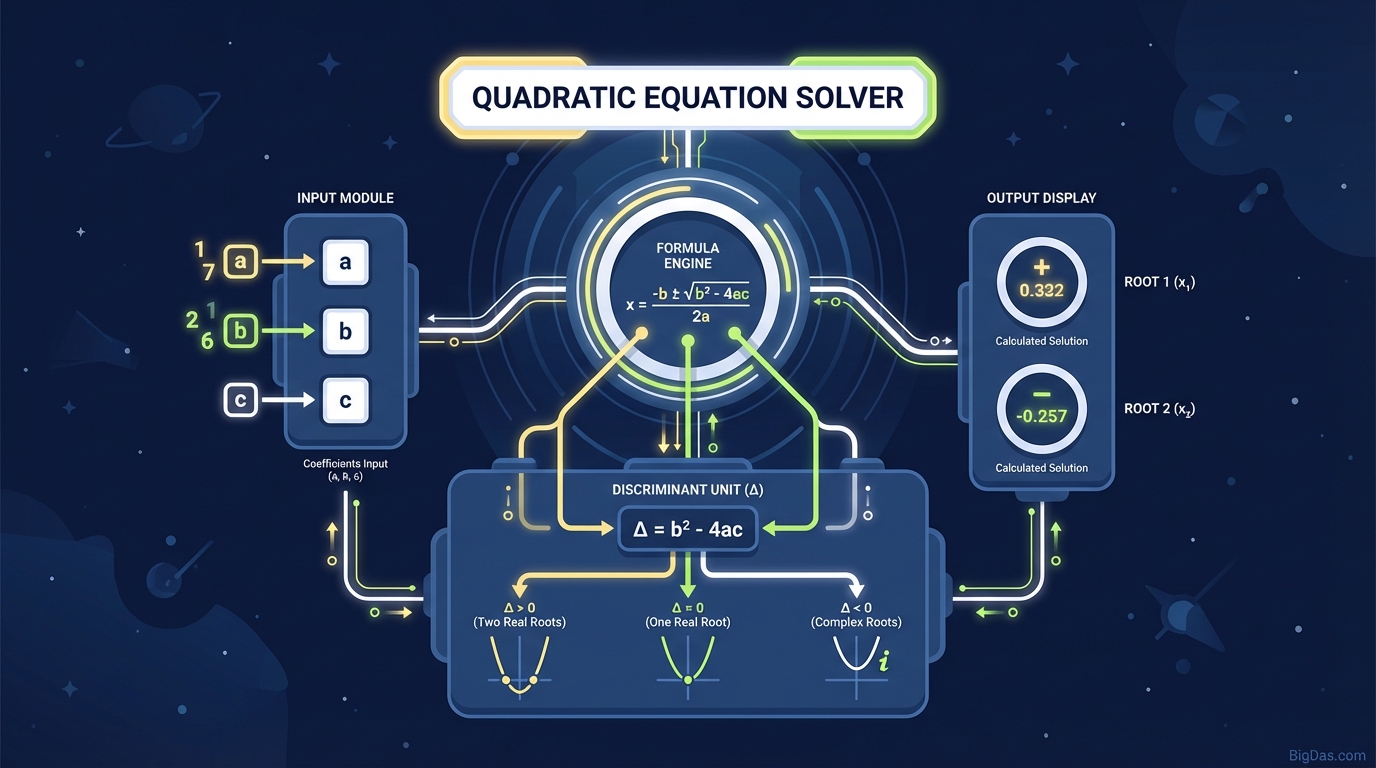
Quadratic Equation Solver
 Modern scientific illustration of Quadratic Equation Solver
Master Algebra Instantly: The Quadratic Equation Solver & Grapher
Category: Education / Math Tools Reading Time: 8 Minutes
Quadratic equations show up in physics, economics, and basic algebra classes. The standard form $ax^2 + bx + c = 0$ is one of the most common problems you'll encounter.
Solving these by hand takes time and invites sign errors. This Quadratic Equation Solver computes roots, calculates the discriminant, and graphs the parabola for any input you provide.
This guide covers how the tool works, the math behind it, and how to use it efficiently.
What Is the Quadratic Equation Solver?
The Quadratic Equation Solver is a computational tool for second-degree polynomials. It calculates the roots of $ax^2 + bx + c = 0$ and provides a graph of the corresponding parabola.
When you input $a$, $b$, and $c$, the tool returns the values of $x$ that satisfy the equation.
The Mathematical Foundation
The solver uses the quadratic formula:
$$x = \frac{-b \pm \sqrt{b^2 - 4ac}}{2a}$$
You can apply this formula by hand, but the tool eliminates sign errors and handles the arithmetic for you.
Real and Complex Roots
If the parabola does not cross the x-axis, the roots are complex. The solver handles these cases and returns results in the form $a + bi$ when applicable.
Key Features
1. Instant Root Calculation (Real & Complex)
The solver returns two distinct real roots, one repeated real root, or two complex conjugate roots depending on the discriminant. It classifies the roots automatically.
2. Dynamic Parabola Graphing
The tool plots the parabola $y = ax^2 + bx + c$.
- Visual Verification: See where the curve crosses the x-axis (the roots) and the y-axis.
- Concavity: The graph shows whether the parabola opens upward ($a > 0$) or downward ($a < 0$).
3. Vertex and Axis of Symmetry
For optimization problems, the vertex coordinates $(h, k)$ are calculated automatically. This removes the need to complete the square manually.
4. Discriminant Analysis
The solver displays the discriminant $\Delta = b^2 - 4ac$. This value tells you the nature of the roots before you look at the answers themselves.
5. Graph-Root Correlation
By showing the graph next to the roots, the tool makes it clear how the algebraic solution relates to the geometric x-intercepts.
How to Use the Quadratic Equation Solver
Step 1: Standardize Your Equation
Rearrange the equation into standard form:
$$ax^2 + bx + c = 0$$
For example, $2x^2 = 5x - 3$ becomes:
$$2x^2 - 5x + 3 = 0$$
Tip: If a term is missing (e.g., $x^2 - 9 = 0$), set the missing coefficient to zero ($b = 0$).
Step 2: Identify Coefficients
Extract the values for $a$, $b$, and $c$:
- $a$: The coefficient of $x^2$. (Note: $a$ cannot be 0.)
- $b$: The coefficient of $x$.
- $c$: The constant term.
Warning: Watch the signs. In $x^2 - 4x - 5 = 0$, $b$ is $-4$ and $c$ is $-5$.
Step 3: Input Data
Enter the values into the corresponding fields.
Step 4: Analyze the Results
The tool displays:
- The Roots ($x_1$, $x_2$): The values of $x$ that solve the equation.
- The Discriminant: Tells you the nature of the roots.
- The Graph: A plot of the parabola.
The "Nature of Roots": A Closer Look
The discriminant determines which of three cases applies:
Scenario A: Two Distinct Real Roots ($\Delta > 0$)
The graph crosses the x-axis at two points. Common in textbook problems.
- Example: Calculating when a projectile hits the ground.
Scenario B: One Repeated Real Root ($\Delta = 0$)
The vertex touches the x-axis at exactly one point. This is a perfect square trinomial.
- Example: Finding the peak of a projectile that lands at the same height it was launched from.
Scenario C: Two Complex Roots ($\Delta < 0$)
The graph never touches the x-axis. The solver returns answers involving $i$.
- Example: AC circuit analysis in electrical engineering.
Real-World Use Cases
1. Students
- Homework Verification: Solve by hand, then check against the tool. If answers differ, the graph shows where the work went wrong.
- Exam Prep: Test how changing $a$ affects the roots (steeper vs. wider parabola).
2. Educators
- Visual Aids: Use the graph during screen shares or lectures to show roots as x-intercepts.
- Problem Generation: Create equations with clean integer answers by reverse-engineering from a graph.
3. STEM Professionals
- Trajectory Calculation: Position over time follows $s = ut + \frac{1}{2}at^2$. Engineers use the solver to find when a projectile hits a target.
- Structural Architecture: Suspension bridges approximate parabolic curves. The solver helps calculate load distribution points.
4. Business and Economics
- Profit Maximization: Revenue functions often form downward parabolas. The vertex gives the maximum profit and optimal price point.
Frequently Asked Questions (FAQ)
Q1: Can this tool solve for x if the coefficient a is negative?
Yes. A negative $a$ value (e.g., $-2x^2 + 4x + 10 = 0$) means the parabola opens downward. The solver handles this and graphs the inverted parabola.
Q2: What if my equation doesn't have a bx term?
Enter 0 for $b$. For $x^2 - 16 = 0$, the inputs are $a = 1$, $b = 0$, $c = -16$.
Q3: Does the solver support decimal or fractional coefficients?
Yes. Real-world problems rarely use integers. Decimals (e.g., $4.5x^2$) and fractions are supported.
Q4: Why does the graph sometimes not touch the horizontal axis?
The discriminant is negative, meaning the roots are imaginary. The graph correctly shows that the parabola does not intercept the x-axis.
Q5: Can I use this for inequalities (e.g., ax² + bx + c > 0)?
The tool solves for the equality ($= 0$). For inequalities, use the graph. The portions of the curve above the x-axis satisfy $> 0$, and the portions below satisfy $< 0$.
Conclusion
The Quadratic Equation Solver handles the arithmetic and graphing so you can focus on the problem itself. Input your coefficients and get the roots, discriminant, and graph in one step.
Scroll up, enter your coefficients, and solve.
Disclaimer: This tool is intended for educational and professional verification. Students should still learn the manual derivation of the quadratic formula to understand the underlying concepts.