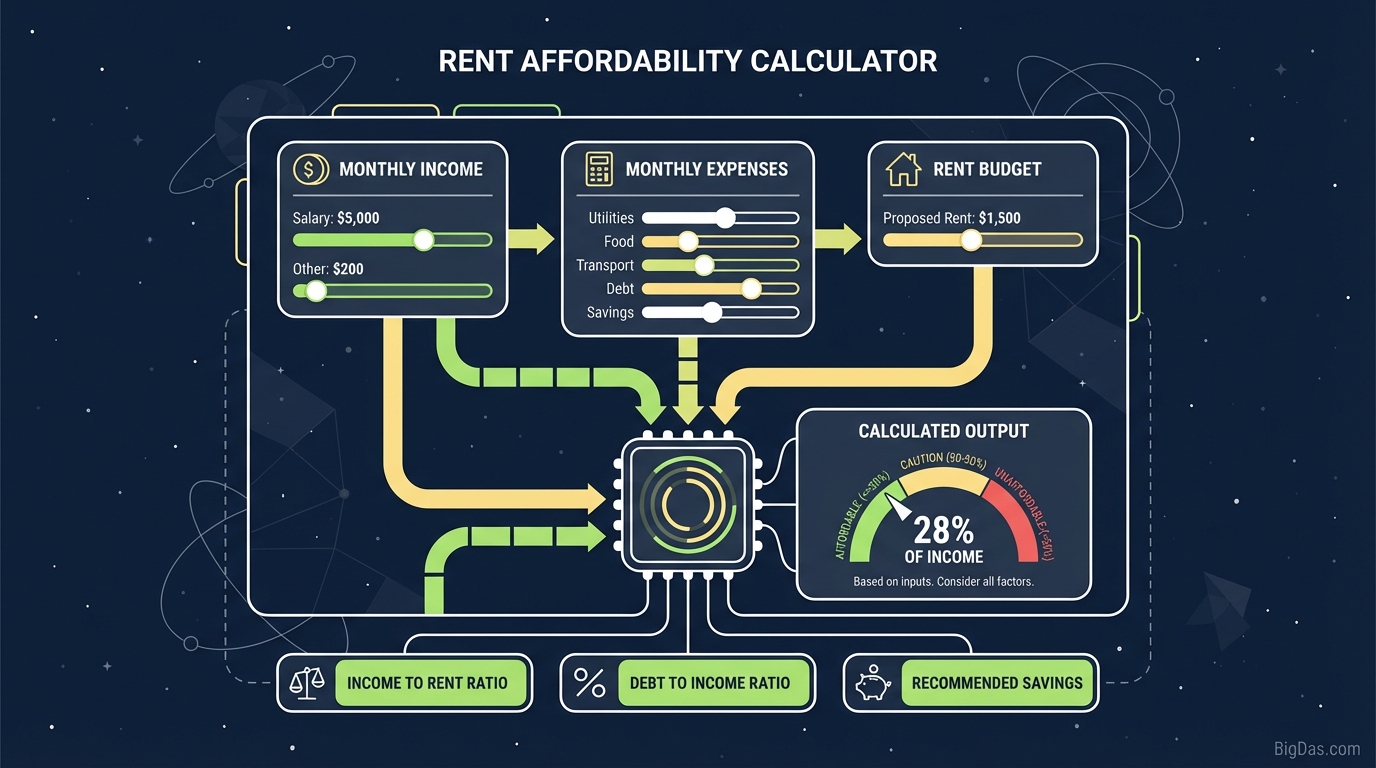
Rent Affordability Calculator
 Rent Affordability Calculator
How Much Rent Can You Afford?
Moving into a new apartment brings a fresh start, a new neighborhood, and often a step up in your lifestyle. But the rental market and the cost of living move fast, and the most important question is simple: Can you actually afford this apartment without eating ramen every night?
A Rent Affordability Calculator handles that question. Financial stress usually traces back to one decision: overspending on housing. Since rent is your largest monthly expense, it shapes the rest of your budget.
What is a Rent Affordability Calculator?
A Rent Affordability Calculator is a financial tool that calculates the maximum amount you should spend on monthly rent based on your income.
You could do rough math on a napkin, but the tool removes the guesswork. It takes the emotion out of the decision and replaces it with numbers. Enter your gross or net income, and the calculator applies financial standards, most commonly the 30% Rule, to return a specific dollar amount.
Why Mental Math Falls Short
Many renters check their bank account balance today and assume they can afford a high rent tomorrow. They forget about:
- Taxes and deductions.
- Variable utility costs (heating in winter, A/C in summer).
- Debt repayments (student loans, credit cards).
- Savings goals.
The calculator acts as a buffer, returning a "sustainable rent", a number that lets you pay for housing and maintain a reasonable lifestyle.
The 30% Rule
To use the calculator well, you need to understand the logic behind it. The standard benchmark for rental affordability is the 30% Rule.
Background
The 30% threshold originated in United States public housing regulations in the 1980s. It recommends spending no more than 30% of your gross annual income (income before taxes) on housing costs.
Example
- Annual Income: $60,000
- Monthly Gross: $5,000
- 30% Cap: $1,500/month for rent.
When to Customize
The 30% rule is a baseline, not a law. The calculator lets you adjust the percentage:
- High Cost of Living Areas (NYC, SF, London): You may need 40% or 50% just to secure housing.
- Aggressive Savers: If you are saving for a house down payment or following the FIRE (Financial Independence, Retire Early) movement, 15-20% may be more appropriate.
Key Features
1. Precision Inputs
Unlike basic tools that only ask for "Salary," the calculator accepts different pay frequencies (hourly, monthly, annually) so the math matches your actual paycheck cycle.
2. Flexible Ratios
The 30% default is adjustable. You can see how your budget changes at 25% versus 35% of your income.
3. Instant Visualization
The calculator shows your remaining budget after rent, how much is left for food, transport, and savings.
4. Privacy Focused
No email required, no data harvesting. Calculations run in the browser, so your salary details stay on your device.
Step-by-Step Guide
Step 1: Determine Your Income Basis
Gather your pay stubs. Decide whether to calculate based on Gross Income (used by landlords) or Net Income (used for personal budgeting).
- Tip: Landlords typically qualify you at 40x the monthly rent.
Step 2: Input Your Earnings
Enter your income and select the correct frequency (Annual, Monthly, Bi-weekly, or Hourly).
- Example: If you make $25/hour and work 40 hours a week, select "Hourly."
Step 3: Select Your Affordability Percentage
The default is 30%.
- Keep it at 30% if you have average debt and want a standard lifestyle.
- Lower it to 20-25% if you have high student loan payments or credit card debt.
- Raise it to 35-40% if you live in a major metropolitan area and don't own a car.
Step 4: Analyze the Output
The calculator displays your Maximum Monthly Rent.
- Tip: Treat this as a ceiling, not a target. If the tool says $1,800, finding an apartment for $1,600 leaves room in your budget.
Hidden Costs of Renting
Rent is rarely the only housing cost. Subtract these estimated expenses from the calculator's result to find your "True Safe Rent."
1. Utilities
If heat, water, or trash isn't included, utilities can add $150-$300/month. If your calculator says $2,000 and utilities are $200, your actual rent budget is $1,800.
2. Parking Fees
In urban centers, a parking spot can run $50-$300/month.
3. Pet Rent
Expect $25-$50/month plus a non-refundable deposit.
4. Commuting Costs
A cheaper apartment farther from work can cost more in gas or transit. Factor commute costs into your decision.
Who This Tool Is For
The Recent Graduate
Entry-level salaries are tight. The tool helps grads avoid "lifestyle creep" and signing a lease that requires a guarantor.
The Relocator
$1,500 in Ohio gets a different apartment than $1,500 in Los Angeles. The tool helps you set expectations before browsing listings.
The Debt Destroyer
If you're aggressively paying off student loans, standard advice doesn't apply. Setting the calculator to 20% keeps housing from eating into your repayment plan.
Frequently Asked Questions (FAQ)
1. Should I use Gross or Net Income?
Short Answer: Use Gross Income to see what landlords will approve you for; use Net Income to see what you can comfortably pay.
Detailed Answer: Most landlords require Gross Income to be 3x the monthly rent. But you pay bills with Net Income (after taxes). Run the calculation both ways, the Net Income result is your "safe zone."
2. Is the 30% rule realistic in 2024?
In expensive markets like New York or San Francisco, the 30% rule is hard to follow without roommates. In these cases, the 50/30/20 rule is more practical: 50% for needs (including rent), 30% for wants, 20% for savings. If your rent exceeds 30%, you'll need to cut back on wants.
3. Does this calculator account for the "40x Rent Rule"?
Yes. The 30% rule is mathematically similar to the "40x Rent Rule" used by landlords. If you earn $80,000, you can afford $2,000/month ($2,000 × 40 = $80,000).
4. What if my rent affordability number is lower than market rates?
If the calculator returns a number below the average rent in your area, you have three options:
- Get a Roommate: Split the cost to lower your personal contribution.
- Expand Your Search: Look at neighborhoods slightly farther out.
- Increase Income: Take on a side hustle to raise your income inputs.
Conclusion
Signing a lease is a 12-month legal commitment. Once you sign, walking away is difficult if the payments become too heavy.
The Rent Affordability Calculator gives you a clear number before you start apartment hunting. Use it to filter out places that look great but drain your budget, and to focus on options that fit your finances.
(Link to Tool Section)
Disclaimer: This article is for informational purposes only and does not constitute financial advice. Rental markets and individual financial situations vary. Always consider your total debt and local cost of living when determining your budget.