SIP Calculator
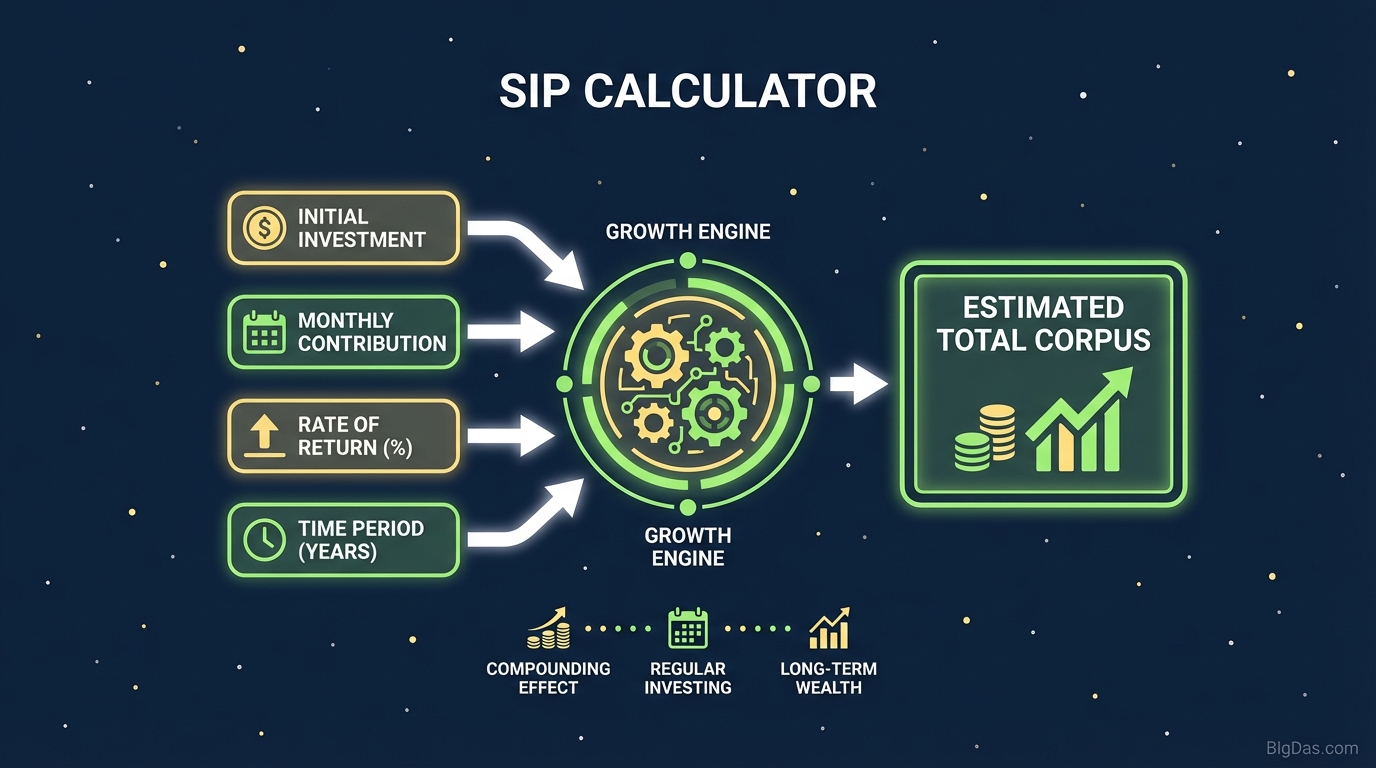
 Modern scientific illustration of SIP Calculator
SIP Calculator: Project the Future Value of Your Systematic Investment Plan
A Systematic Investment Plan (SIP) is a method of investing a fixed amount at regular intervals in a mutual fund. It builds wealth through rupee cost averaging and compounding, but without a projection tool, it is difficult to know whether your current monthly contribution will actually meet a long-term goal like a home purchase, education fund, or retirement corpus.
This page covers what a SIP calculator does, the formula it uses, how to read its output, and how to apply it to goal-based planning.
What is a SIP Calculator?
A SIP Calculator is a simulation tool that estimates the future value of monthly mutual fund contributions. You enter three inputs, monthly investment amount, expected annual return rate, and tenure, and the calculator returns the projected corpus, split between principal invested and returns earned.
The underlying concept is the SIP itself: a fixed rupee amount invested every month, regardless of market price. Over time, this averages out your purchase cost and exposes your capital to compounding.
Formula
Future Value of a SIP is calculated as:
$$FV = P \times \frac{(1+i)^n - 1}{i} \times (1+i)$$
Where:
- FV = Future Value of the investment
- P = SIP amount per period
- i = Periodic interest rate (annual rate divided by 12)
- n = Total number of payments (months)
The calculator applies this formula directly, so you do not have to compute it by hand.
Key Features
1. Visual Output
A side-by-side chart of "Invested Amount" vs. "Wealth Gained" makes the compounding effect visible at a glance. The gap between the two bars widens non-linearly as tenure increases.
2. Cost of Delay Comparison
Sliding the tenure back by even a few years shows how much final corpus you give up by starting late. This is often the most useful result for someone deciding whether to start now or "wait a bit."
3. Precise Calculations
The tool applies the formula to the exact number of months entered, avoiding the rounding errors common in spreadsheet models.
4. Reverse Calculation
If you enter a target corpus instead of a monthly amount, the calculator returns the monthly contribution required to reach that target. This is useful for goal-based planning.
How to Use the SIP Calculator
Step 1: Enter the Monthly Investment Amount
Enter the amount you can set aside each month. Even small amounts work, the formula scales linearly, and the compounding effect grows with tenure rather than starting capital.
Step 2: Select the Tenure
Common tenure ranges by goal:
- Short term (3 to 5 years): Vehicle, vacation
- Medium term (5 to 10 years): Home down payment
- Long term (15 to 30 years): Retirement, generational wealth
Step 3: Enter the Expected Annual Return Rate
Use realistic ranges based on the asset class:
- Debt funds: 6%, 8%
- Hybrid funds: 9%, 11%
- Equity funds: 12%, 15%
A 12% rate is the standard benchmark for long-term equity planning. Avoid using inflated figures like 25%, as they produce misleading projections.
Step 4: Read the Output
The calculator returns:
- Total Invested Amount: sum of all monthly contributions
- Estimated Returns: wealth gained from compounding
- Total Value: final projected corpus
Using the Tool for Planning
Apply a Step-Up (Top-Up) SIP
Income usually rises each year. Instead of running the calculation with a flat monthly amount, model a 10% annual step-up. A 10% yearly increase in contribution typically produces a final corpus roughly 1.5x to 2x larger than a static SIP over a 20-year horizon.
Adjust for Inflation
A target that looks sufficient today will be worth less in 20 years. When planning for retirement, add 20 to 30% to your calculated corpus requirement to preserve purchasing power.
Run Multiple Scenarios
Run the calculation three times to test the range of outcomes:
- Worst case: 8 to 10% return
- Base case: 12% return
- Best case: 15% return
If the worst-case outcome still meets your goal, the plan is robust.
Common Use Cases
Retirement Planning
With a 25 to 30 year horizon, the calculator shows how a modest monthly contribution can accumulate into a corpus large enough to fund retirement.
Short-Term Goal Savings
For a specific down payment or purchase target, use the reverse-calculation mode to find the required monthly SIP.
Education Funding
Estimate the future cost of higher education, then calculate the SIP required to cover it without taking on debt.
Frequently Asked Questions (FAQ)
1. Can the SIP Calculator predict exact returns?
No. Market returns vary year to year. The calculator produces a projection based on a fixed assumed rate of return, not a guarantee.
2. Does the calculator account for taxes and exit loads?
No. Standard SIP calculators return the gross value. Net returns will be lower once capital gains tax and any applicable exit loads are deducted.
3. How much should I increase my SIP each year?
A common guideline is to increase the SIP by 10% annually, in line with typical salary growth. This accelerates corpus growth without reducing monthly cash flow.
4. What return rate should I use?
For long-term equity mutual funds (7+ years), 12% is a standard benchmark. For debt funds, 7 to 8% is appropriate.
Summary
The SIP calculator applies a standard future-value formula to your monthly contribution, expected return, and tenure. It returns a projected corpus and a visual breakdown of principal versus returns. Use it to compare tenures, test step-up scenarios, and reverse-calculate the SIP required for a specific goal.
[> Try the Free SIP Calculator <]
Disclaimer: This tool provides estimates for educational purposes only. Mutual fund investments are subject to market risk. Read all scheme-related documents before investing.