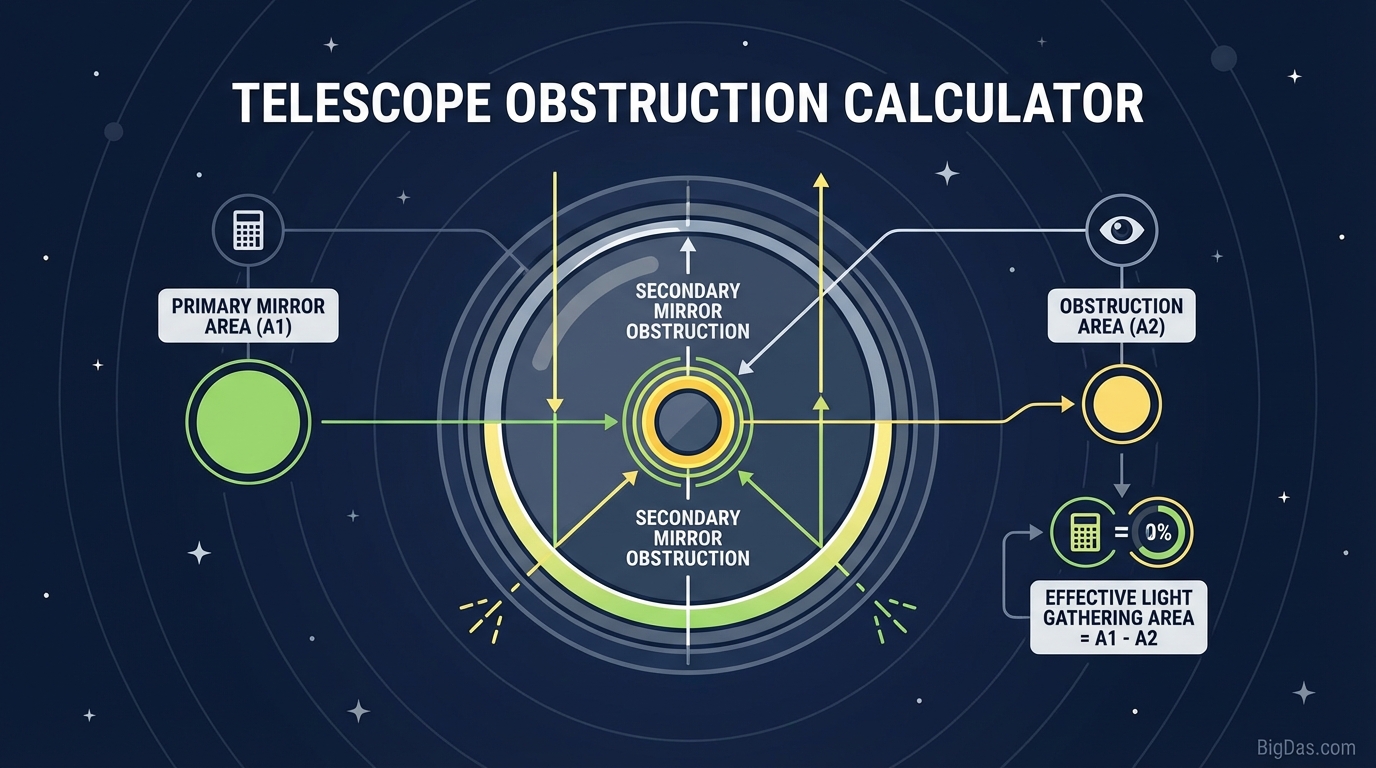
Telescope Obstruction Calculator
 Modern scientific illustration of Telescope Obstruction Calculator
Telescope Obstruction Calculator: Contrast and Clarity
You set up your scope, collimate the optics, and wait for steady seeing. You point at Jupiter and the image looks soft. The cloud bands are gray instead of sharp black and white. What is going on?
The culprit is usually the central obstruction in your optical tube assembly (OTA).
Newtonian reflectors, Schmidt-Cassegrains (SCTs), and Maksutov-Cassegrains all use a secondary mirror in the light path. That mirror blocks some incoming light and, more importantly, causes diffraction that reduces image contrast. The Telescope Obstruction Calculator quantifies exactly how much performance you are giving up to that secondary.
What the Calculator Does
The calculator computes the obstruction percentage caused by the secondary mirror and its holder relative to the primary mirror.
Telescope manufacturers list aperture (primary mirror diameter) prominently. They often hide or downplay the secondary obstruction. When they do publish the number, they sometimes quote the areal percentage, which is lower than the linear percentage and obscures the real impact on contrast.
The Physics Involved
Two effects matter when you add a central obstruction to a telescope:
- Light transmission. The secondary blocks some area. Even a large secondary only blocks a small fraction of total light, so brightness loss is usually minor.
- Diffraction. Light is a wave. When waves pass the edge of the obstruction, they diffract and redistribute energy from the central Airy disk into the surrounding rings. This lowers the Modular Transfer Function (MTF) at mid and high spatial frequencies. Fine planetary detail looks gray and washed out.
The calculator returns two separate values:
- Linear obstruction (by diameter): The number that matters for contrast.
- Areal obstruction (by area): The number that matters for brightness.
Features
1. Dual-metric output
The tool prints both linear and areal percentages side by side. You can spot the marketing trick where a manufacturer quotes areal percentage to hide a worse linear value.
2. Effective aperture
The calculator computes the effective light-gathering aperture so you can compare a reflector fairly against an unobstructed refractor of the same advertised size.
3. Obstruction category
Based on the standard rule of thumb in optics, the tool labels your scope as Low, Moderate, or High obstruction and predicts the visual impact for planetary work.
4. Unit-agnostic input
Enter measurements in millimeters or inches. The tool handles the conversion.
How to Use It
Step 1: Enter the primary aperture
Type the diameter of your primary mirror.
- Tip: This is the main spec listed for the telescope (203 mm for an 8-inch SCT, for example).
Step 2: Enter the secondary obstruction
Type the diameter of the secondary assembly.
- Critical: Measure the widest part of the holder (the central hub), not just the glass. The light is blocked by the housing as well as the mirror.
Step 3: Pick your units
Toggle between millimeters and inches.
Step 4: Read the results
Click Calculate. The output includes:
- Percentage by diameter: your contrast score.
- Percentage by area: your brightness score.
- Performance verdict: expected impact on planetary versus deep-sky viewing.
Reading the Results
Below 15%, "Refractor-like"
Linear obstruction under 15% has a negligible effect on contrast. Visually, the image is indistinguishable from a high-quality unobstructed apochromatic refractor. Long-focal-length Newtonians designed for planetary work can hit this range.
15% to 25%. General-purpose sweet spot
Typical for Newtonian Dobsonians. Contrast loss is slight. Jupiter and Mars show good detail. Diffraction is present but not distracting.
30% to 35%. SCT standard
Most Schmidt-Cassegrains fall here. They work well for deep-sky targets where aperture matters more than contrast. For planetary viewing, fine details look softer than they would through a reflector with a smaller secondary.
Above 40%. Fast astrographs
Astrograph designs need large secondaries to fully illuminate wide camera sensors. For visual use, this level of obstruction costs significant contrast. These scopes are not ideal for planetary observation.
Common Use Cases
Comparing a Maksutov to a Newtonian
You are choosing between a 5-inch Maksutov-Cassegrain and a 6-inch Newtonian. The Newtonian is bigger, but you want the sharpest view of Saturn. Run both numbers. The Newtonian might show 22% linear obstruction and the Mak might show 32%. On planets, the Newtonian often wins despite the smaller aperture.
Sizing a secondary for a custom Dob
You are building a truss-tube Dobsonian. Too small a secondary causes vignetting at the edge of the field. Too large a secondary kills contrast. The calculator helps you find the right size for your focal ratio.
Diagnosing bloated stars in astrophotos
If your stars look fat, the cause might be a large central obstruction rather than tracking error. A 45% obstruction makes bloated stars a physical certainty. Confirm with the calculator before chasing other fixes.
Practical Tips
Do not obsess over the area percentage. A 30% linear obstruction only blocks about 9% of the incoming light. The eye barely notices 9% brightness loss. Watch the diameter number instead.
Watch the spider vanes. Thick spider vanes add diffraction spikes and reduce contrast. Thin vanes perform better.
Compare in context. A 5% difference in linear obstruction rarely produces a visible improvement. Run your current scope and the scope you want to buy through the calculator before deciding if an upgrade is worth it.
Frequently Asked Questions
Does a central obstruction reduce resolution?
No. Resolution (the ability to split close double stars) is set by the full diameter of the primary. Obstruction reduces contrast, which makes low-contrast features harder to see even when the theoretical resolution is high.
Why are secondary mirrors so large?
Manufacturers enlarge the secondary to keep the field fully illuminated. A small secondary causes vignetting, and astrophotography setups need large secondaries to cover wide camera sensors.
Can I reduce my central obstruction?
Not on a commercial SCT. On a Newtonian, you can sometimes swap in a smaller high-quality secondary and a lower-profile focuser. Run the numbers first to make sure the new size does not cut off the light cone from the primary.
Is 20% better than 30%?
For planetary and lunar viewing, yes, 20% gives noticeably better contrast. For deep-sky viewing (nebulae and galaxies), the difference is small because your eye reads faint extended objects with the rods, which are insensitive to contrast loss at that level.
Summary
Central obstruction is a fact of life for any reflecting telescope, but its impact is measurable. The Telescope Obstruction Calculator gives you the numbers to compare scopes honestly, plan a custom build, or set realistic expectations for an existing setup.
Disclaimer: These calculations are based on optical physics. Real-world views also depend on atmospheric seeing, mirror cooling, and collimation accuracy.