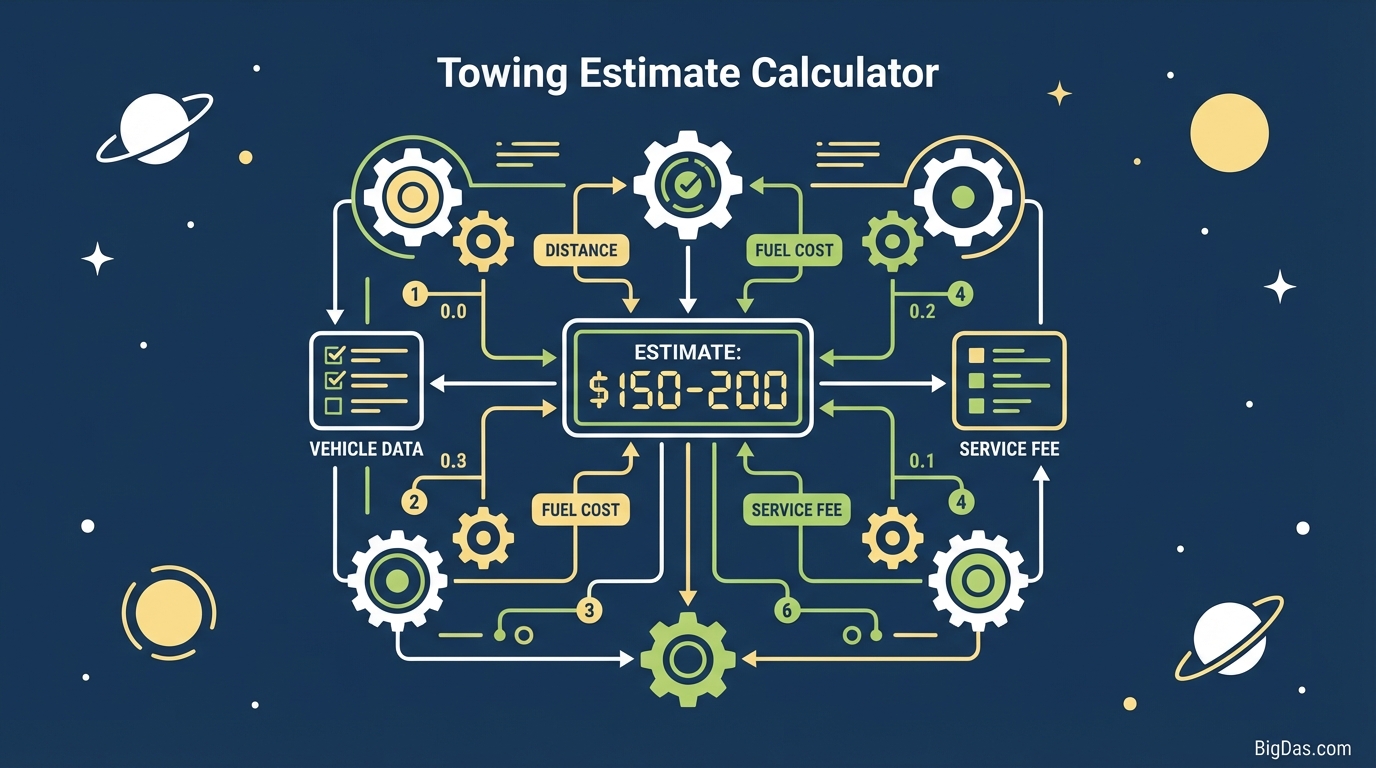
Towing Estimate Calculator
 Towing Estimate Calculator
Towing Estimate Calculator: Know Your Costs Before the Bill Arrives
A dead engine on the highway or a fender bender is stressful. Once safety and insurance are handled, the next question is cost.
Towing pricing is often unclear. Hook-up fees, per-mile charges, and surcharges stack up, and the final bill is rarely predictable. You shouldn't have to wait for the receipt to find out if you were charged fairly.
This guide explains the Towing Estimate Calculator, a tool that produces an instant estimate using distance, base fee, and per-mile rate.
What Is the Towing Estimate Calculator?
The calculator applies the standard industry formula for towing costs:
$$\text{Total Cost} = \text{Base Fee} + (\text{Distance} \times \text{Per-Mile Rate})$$
Instead of returning a vague range, it takes your specific numbers and returns a specific total.
Why Mental Math Fails Under Stress
Most people mix up the hook-up fee (the cost to get the truck to you) with the loaded-mile charge (the cost to tow you to the shop). The calculator separates these and returns the sum in one step.
The Three Variables
The calculator takes three inputs. These match how legitimate towing companies build their quotes.
1. Base Fee (Hook-Up Fee)
The flat rate for the truck to reach you and secure the vehicle. Covers the driver's time, fuel to your location, and equipment use.
- Typical range: $35 to $100. Heavy-duty trucks and flatbeds cost more.
2. Per-Mile Rate
Charged for each mile the loaded tow truck travels to the drop-off point.
- Typical range: $2.50 to $5.00 per mile. Varies with fuel costs and truck type.
3. Distance
The mileage from the breakdown location to the drop-off point (the shop or your home). It does not include the distance the truck drives to reach you.
Features
- Instant calculation: No sign-up, no email, no loading screen.
- Mobile-optimized: Loads fast on a phone, even with weak signal.
- Transparent math: Separating base fee from mileage helps you read and verify a towing invoice.
- Location-independent: Works the same in any state once you know the local rates.
How to Use the Calculator
Step 1: Find the Distance
Open Google Maps, Waze, or Apple Maps. Enter your current location and the destination (mechanic or home). Note the total miles.
- Tip: Round up to the nearest whole mile.
Step 2: Enter the Distance
Type the mileage into the Distance field.
Step 3: Enter the Base Fee
Call a towing company and ask, "What is your hook-up fee?" Enter that number.
- No quote yet? Use $75 as a conservative estimate for a standard sedan.
Step 4: Enter the Per-Mile Rate
Ask the dispatcher, "What is your rate per loaded mile?" Enter that number.
- No quote yet? Use $4.00 for urban areas or $3.00 for rural areas.
Step 5: Calculate
Hit the button. The result is your negotiation anchor. The final bill should be close to this figure.
Real-World Use Cases
1. Emergency Breakdown
You are stuck on the highway. The towing company is vague about pricing. Use the calculator to establish the fair price for your distance. A quote that is double the estimate is a signal to call someone else.
2. Buying a Non-Running Project Car
A $500 car 50 miles away is really an $800 car once you add towing. Calculate the tow cost before you make an offer.
3. Comparing Quotes
You call three companies to move a car. Company A has a low base fee and high per-mile rate; Company B is the opposite. The calculator shows you which is cheaper for your specific distance.
How to Get a Better Towing Price
Check Your Insurance and Card Benefits First
Many auto policies and credit cards include roadside assistance that covers the first 15 to 20 miles. Use the calculator to find the cost of any remaining miles you'll pay out of pocket.
Watch for "En Route" Mileage Charges
Some companies charge for the miles they drive to reach you. This is not standard; the base fee should cover arrival. If their quote is far above your estimate, ask if they're charging en-route mileage. If yes, hang up and call another company.
Match the Truck to the Vehicle
- Wheel lift: Cheaper, standard for most cars.
- Flatbed: More expensive, required for AWD vehicles or cars with low ground clearance.
- Tip: If you drive a standard 2WD sedan, a flatbed is an unnecessary cost.
Frequently Asked Questions
1. Does this calculator include taxes?
No. Add your local sales tax to the result. Tolls during the trip are also usually added to the final bill.
2. Why is the actual quote higher than the estimate?
Common reasons:
- After-hours surcharge: Towing at 2:00 AM often costs more.
- Winching or recovery fee: If the car is in a ditch or stuck, the driver charges for labor before the tow begins.
- Storage fees: If the car goes to an impound lot instead of a shop, daily storage fees apply.
3. Can I negotiate with the tow driver?
Drivers usually don't set rates; the dispatch office does. Having an estimate gives you leverage with the dispatcher. If your calculation says the trip should be $150 and they quoted $250, they may drop certain surcharges to keep your business.
Final Notes
Car trouble is stressful enough without worrying about being overcharged. Accurate numbers are the best defense against hidden fees.
The Towing Estimate Calculator gives you a quick, transparent estimate using the base fee, mileage rate, and distance. With those three numbers, you go into the call as an informed customer rather than a stranded driver.
Don't let a breakdown drain your wallet.