Unit Converter
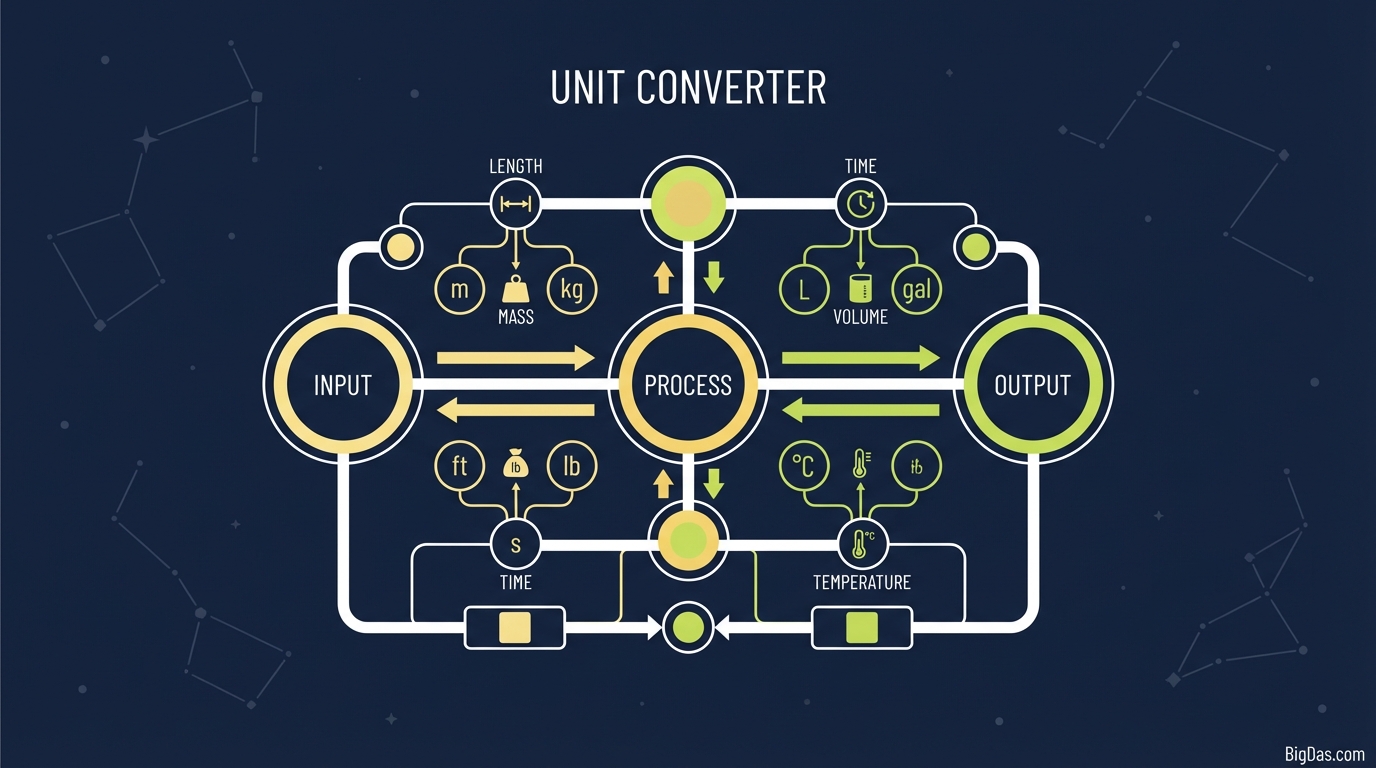
 Modern scientific illustration of Unit Converter
Master Measurements: A Practical Guide to Length & Weight Conversion
Measurement is a common source of error in daily tasks. A baking recipe from a European chef lists ingredients in grams, but your kitchen scale reads in ounces. A road trip abroad posts speed limits in kilometers per hour, but you think in miles. From DIY renovations and fitness tracking to academic research and international shipping, the gap between the Metric System and the Imperial System causes frequent mistakes.
This guide explains why accurate conversion matters, how a dedicated tool helps, and how to use it for precise results in any project, recipe, or calculation.
What Is a Unit Converter and Why Does It Matter?
A Unit Converter is a software utility that translates a quantity from one unit of measurement into an equivalent quantity in another unit. The concept is simple, but the underlying math determines whether your result is reliable.
Metric vs. Imperial
Two measurement systems dominate global use:
The Metric System (SI):
- Used by approximately 95% of the world. Built on units of ten, it includes meters (length) and kilograms (mass). It is the standard for science, medicine, and international trade.
The Imperial & US Customary Systems:
- Primarily used in the United States, Liberia, and Myanmar. This system relies on feet, miles, pounds, and ounces.
The Cost of Conversion Errors
Mental math and rough estimates fail often. The most documented example is the 1999 Mars Climate Orbiter: a $125 million NASA spacecraft lost in space because one engineering team used metric units while another used imperial units.
A construction error from confusing meters and feet can waste thousands of dollars in materials. A dosage error from miscalculating body weight between pounds and kilograms can have health consequences.
A dedicated Unit Converter removes this risk by providing a single interface for the most common conversions: Length and Weight.
Features of the Unit Converter
Many online converters are cluttered with ads, slow to load, or limited in scope. This tool focuses on speed, accuracy, and a clean interface.
1. High-Precision Calculations
Rounding errors compound and produce inaccurate results. The tool uses high-precision floating-point arithmetic so that converting 1 mile or 0.0004 grams returns the correct scientific equivalent.
2. Two Categories in One Place
Most converters split measurements across multiple pages. This tool consolidates the two most common categories:
- Length: Meters, Kilometers (km), Feet (ft), Miles (mi).
- Weight: Grams (g), Kilograms (kg), Pounds (lbs), Ounces (oz).
3. Real-Time Results
There is no "submit" button or page reload. As you type a number, the conversion updates instantly.
4. Clean Interface
The interface contains no pop-ups, no nested drop-downs, and no clutter. It is built to deliver the correct number as quickly as possible.
5. Mobile Responsive
Conversions often happen away from a desk. The tool is optimized for smartphones and tablets, so it works at the gym, on a construction site, or in the kitchen.
Step-by-Step Guide: How to Use the Unit Converter
Step 1: Identify Your Category
Determine what you are measuring.
- Distance, height, or width? Choose Length.
- Mass or grocery items? Choose Weight.
Step 2: Input Your Value
Type the number you currently have into the input field.
- Tip: Decimals (e.g., 5.5) are supported for precise calculations.
Step 3: Select Your "From" Unit
Choose the unit that matches your current number.
- Example: If your value is "10" representing 10 kilometers, select Kilometers (km).
Step 4: Select Your "To" Unit
Choose the unit you want to convert into.
- Example: To see the distance in miles, select Miles.
Step 5: Read and Copy
The result appears immediately. You can copy it directly to your clipboard for use in documents, spreadsheets, or messages.
Real-World Use Cases
1. Fitness (Kg vs. Lbs)
Powerlifters typically use kilograms, while commercial gyms in the US use pounds.
- Scenario: You want to compare your bench press PR (Personal Record) against international standards.
- Solution: Convert a 225 lb lift to 102 kg to see where you rank globally.
2. International Travel (Km vs. Miles)
Driving abroad is easier when you understand local road signs.
- Scenario: A sign indicates your exit is in 2 kilometers.
- Solution: Convert 2 km to roughly 1.2 miles to time your lane change accurately.
3. Cooking and Baking (Grams vs. Oz)
Baking requires exact measurements. Many professional recipes use metric weight (grams) because it is more consistent than volume (cups).
- Scenario: A recipe calls for 12 ounces of chocolate, but chocolate is sold in 100g bars.
- Solution: Convert 12 oz to roughly 340 grams to know how many bars to buy.
4. Construction and DIY (Meters vs. Feet)
Home renovation projects often mix standards, especially when assembling European furniture in an American home.
- Scenario: Your wall is 12 feet wide, but the cabinet specifications are in meters.
- Solution: Convert 12 feet to 3.65 meters to verify the fit before purchasing.
5. Academic and Student Work
Physics and chemistry students frequently convert between SI and imperial units. The tool serves as a reliable check for homework and lab reports, confirming methodology when mental math is uncertain.
Tips for Accurate Conversions
- Know Your Required Precision: Converting 1 mile to kilometers yields 1.60934. For general travel, 1.6 is sufficient. For engineering, keep the full decimal. Match the precision to your project's needs.
- Distinguish Mass and Weight in Physics: Mass (kg) is constant; weight (lbs) depends on gravity. For Earth-based daily applications (groceries, body weight, shipping), the tool treats them as interchangeable.
- Bookmark for Mobile Use: Keep the tool open in your phone browser at the gym, grocery store, or job site for instant access.
Frequently Asked Questions (FAQ)
1. Is the conversion between Kilograms and Pounds exact?
One kilogram is defined as approximately 2.20462 pounds. The tool uses this precise factor rather than the rough mental estimate of 2.2, preserving accuracy over large numbers.
2. Can I use this tool for commercial shipping calculations?
Yes. Shipping costs are often calculated by weight. If a carrier charges by the kilogram but your package is weighed in pounds, the tool provides accurate cost estimates and prevents overpayment.
3. Why doesn't the tool include volume (cups/liters)?
The tool currently focuses on Length and Weight to provide the fastest, most accurate experience for the two most common physical measurement needs. Specialization allows for higher accuracy and speed in these categories.
4. Is this tool free to use?
Yes, the Unit Converter is completely free. Accurate measurement is a fundamental utility and should be accessible to students, hobbyists, and professionals alike.
5. How many feet are in a mile?
There are 5,280 feet in one mile. While this is a standard fact, it is difficult to remember and multiply mentally, which is where the tool becomes useful.
Conclusion
Accuracy is a requirement in any data-driven task. Whether you are tracking weight loss, building a deck, or interpreting a European speed limit, the ability to convert units reliably prevents costly errors.
Avoid mental math that introduces mistakes. Use a tool designed for speed, precision, and clarity.
- Scroll up and start using the Unit Converter to bridge the gap between Metric and Imperial instantly.
Disclaimer: While this calculator provides highly accurate conversions for general, educational, and professional use, always consult specialized engineering standards for mission-critical safety calculations.