Tower of Hanoi
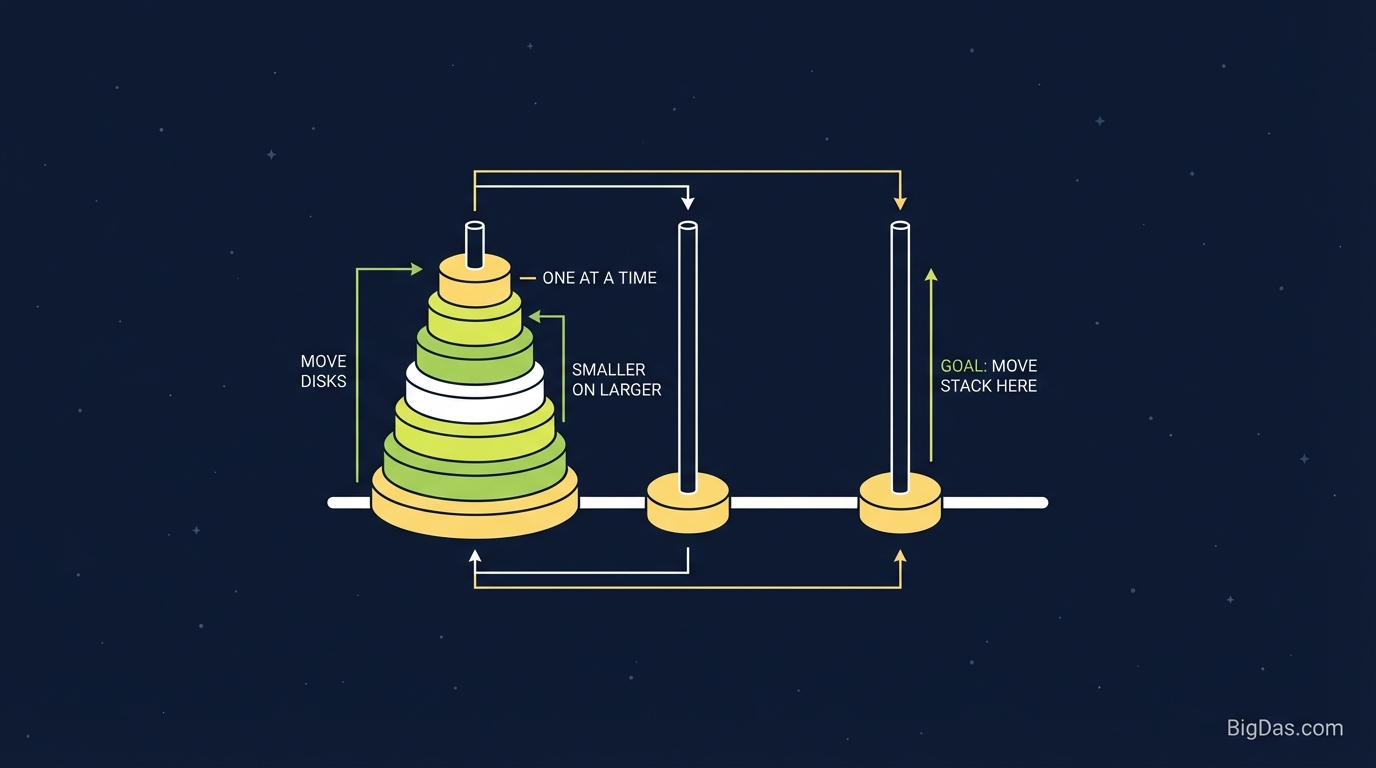
 Modern scientific illustration of Tower of Hanoi
Master the Tower of Hanoi: Logic, Recursion, and Brain Training
The Tower of Hanoi is a mathematical puzzle with simple rules and significant complexity. It has been used in mathematics, computer science, and cognitive research since 1883. The puzzle is also a common teaching tool for recursive algorithms and a popular test of planning ability.
This guide covers the history of the puzzle, the mathematics behind the optimal solution, and how to use a digital tool to practice it.
What is the Tower of Hanoi?
The Tower of Hanoi (also known as the Tower of Brahma or Lucas' Tower) is a mathematical puzzle and logic game. It looks simple but serves as a standard example in algorithmic theory.
Origin and the Myth
The puzzle was invented by the French mathematician Édouard Lucas in 1883. To market the game, a legend was attached: in a temple in Kashi Vishwanath, three diamond needles hold 64 golden disks. Priests move the disks according to fixed rules. The legend states that when all 64 disks are moved to the final needle, the temple will crumble and the world will end.
Moving one disk per second, 64 disks would take roughly 585 billion years.
Setup
The puzzle consists of:
- Three Rods: Usually labeled Source, Auxiliary, and Destination.
- A Stack of Disks: A number of disks (n) of different sizes that can slide onto any rod.
- The Initial State: The disks start in ascending order of size on one rod, smallest at the top.
Objective
Move the entire stack to another rod, following the movement rules. The number of moves required doubles with each additional disk.
Features of the Tower of Hanoi Tool
A digital tool provides speed, accuracy, and tracking that a physical set cannot.
1. Drag-and-Drop Interface
Physical sets can be clumsy. Disks get lost, and resets take time. The tool uses drag-and-drop precision so the focus stays on the logic.
2. Move Counter and Optimal Path Tracking
The tool tracks moves in real time and compares them against the mathematical minimum, giving immediate feedback on efficiency.
3. Adjustable Difficulty
Select any number of disks. Beginners can start with 3, advanced users can try 10 or more. Difficulty changes instantly.
4. Cognitive Benefits
- Executive Function: Planning ahead uses working memory and cognitive flexibility.
- Pattern Recognition: Recursive patterns become visible, a skill that transfers to programming and mathematics.
- Stress Relief: The logical structure of the puzzle supports concentration and a "flow state."
Step-by-Step Guide: How to Play and Win
Random moves lead to loops and deadlocks. To solve the Tower of Hanoi, follow the rules and apply the recursive strategy.
The Three Rules
- One Disk at a Time: Only one disk can be moved per turn.
- Top Disk Only: Only the top disk from any stack can be moved.
- Size Constraint: A larger disk cannot be placed on top of a smaller one.
The Winning Strategy (Recursion)
The Tower of Hanoi is solved using Recursion, where a problem is reduced to smaller instances of itself.
To move n disks from Rod A to Rod C using Rod B as a helper:
- Move the top n−1 disks from Source (A) to Auxiliary (B).
- Move the largest disk (disk n) from Source (A) to Destination (C).
- Move the n−1 disks from Auxiliary (B) to Destination (C).
Example: Solving 3 Disks
To move 3 disks from Rod 1 to Rod 3:
- Move Disk 1 to Rod 3.
- Move Disk 2 to Rod 2.
- Move Disk 1 to Rod 2.
- Move Disk 3 to Rod 3.
- Move Disk 1 to Rod 1.
- Move Disk 2 to Rod 3.
- Move Disk 1 to Rod 3.
Result: 7 moves ($2^3 - 1$).
Use Cases
For Computer Science Students and Developers
The Tower of Hanoi is a standard example for teaching Recursive Algorithms in Python, Java, and C++. The tool can visually verify move sequences generated by code.
For Job Interview Preparation
Technical interviews often include logic puzzles. Interviewers look for the ability to break complex problems into smaller steps. Practicing the puzzle exercises the same planning skills used in system design.
For Educators and Parents
The Tower of Hanoi gamifies critical thinking. It teaches perseverance (trial and error) and forward-thinking, and fits into STEM curricula and home-school programs.
For Neuro-Rehabilitation
Therapists use the Tower of Hanoi to assess planning and working memory in patients recovering from brain injuries. A high-contrast digital version makes it accessible on standard devices.
Pro-Tips
- Don't rush: The goal is minimum moves, not speed. Pause before the first move and visualize the final position of the largest disk.
- Identify the "Sub-Stack": Treat the top n−1 disks as a single unit. Move that unit out of the way so the bottom disk can be placed.
- The Odd/Even Rule:
- If n is Even, the first move of the smallest disk goes to the Auxiliary rod.
- If n is Odd, the first move of the smallest disk goes to the Destination rod.
- This rule speeds up manual solving.
- Use Reset: If stuck, reset and run the correct opening sequence again. Undoing random moves is slower than restarting.
Frequently Asked Questions (FAQ)
What is the minimum number of moves required to solve the puzzle?
The minimum number of moves is calculated with the formula $2^n - 1$, where $n$ is the number of disks.
- 3 Disks: $2^3 - 1 = 7$ moves
- 4 Disks: $2^4 - 1 = 15$ moves
- 5 Disks: $2^5 - 1 = 31$ moves
Can the Tower of Hanoi be solved with any number of disks?
Yes, in theory. The number of moves grows exponentially. A 10-disk tower requires 1,023 moves; the 64-disk legend requires $1.84 \times 10^{19}$ moves.
Is this game good for kids?
Yes. It is recommended for children aged 8 and up. It develops spatial awareness, logical sequencing, and patience.
Why is this puzzle so famous in coding?
It is a clear visual example of recursion. It demonstrates how a large problem can be solved by applying the same function to a smaller version until a base case is reached.
Conclusion
The Tower of Hanoi is a logic puzzle, a math problem, and a planning exercise. It is used in computer science education, cognitive research, and casual play. The optimal-solution formula is $2^n - 1$, and the recursive strategy scales to any number of disks.
Start with 3 disks, learn the pattern, and work up to larger towers.