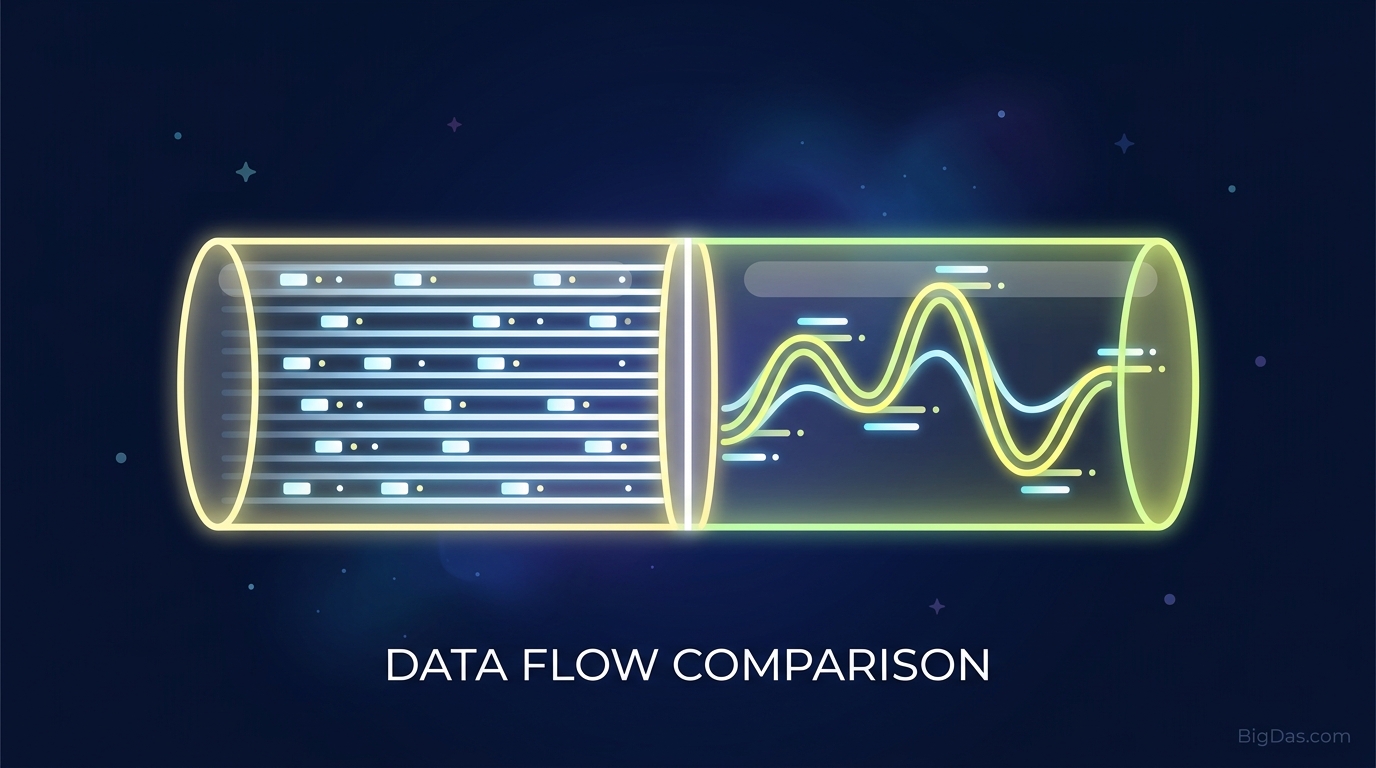
Bandwidth Sharing (FDM vs FHSS)

Bandwidth Sharing: A Guide to FDM vs FHSS
The electromagnetic spectrum is a finite resource in telecommunications. Every wireless device relies on it to transmit data, and with billions of devices competing for limited bandwidth, engineers must share this spectrum efficiently and without interference.
Two foundational techniques for managing network traffic are Frequency Division Multiplexing (FDM) and Frequency Hopping Spread Spectrum (FHSS). Understanding how these technologies work is essential for anyone studying network engineering, RF systems, or wireless protocols like Bluetooth.
This guide covers the theory, mathematics, and practical applications of both techniques, and introduces the Bandwidth Sharing (FDM vs FHSS) interactive visualization tool for exploring these RF concepts through real-time animation.
The Theory: How It Works
The capacity of any communication channel is governed by the Shannon-Hartley Theorem:
$$C = B \cdot \log_2(1 + S/N)$$
Where:
- C is the channel capacity (bits per second).
- B is the bandwidth of the channel (Hertz).
- S/N is the Signal-to-Noise Ratio.
Because bandwidth (B) is fixed by regulatory bodies (like the FCC in the United States), engineers must find ways to slice, share, and manipulate the available frequency to accommodate multiple users simultaneously. FDM and FHSS take two different approaches to this problem.
Frequency Division Multiplexing (FDM): The Highway Lanes
Frequency Division Multiplexing (FDM) divides the total available bandwidth into a series of non-overlapping frequency sub-bands.
Think of FDM as a multi-lane highway. The total width of the highway represents the total bandwidth. To prevent cars (data) from colliding, the highway is divided into strict lanes (frequency channels). Each user is assigned a specific, dedicated lane for the duration of their communication.
The Mechanics of FDM
In an FDM system, multiple baseband signals are modulated onto different carrier frequencies. Let's assume we have three users transmitting voice signals, each requiring 4 kHz of bandwidth.
- Modulation: User 1's signal is modulated onto a 100 kHz carrier, User 2 onto a 104 kHz carrier, and User 3 onto a 108 kHz carrier.
- Multiplexing: These distinct signals are added together by a multiplexer (MUX) into a single composite signal transmitted over the shared medium.
- Demultiplexing: At the receiving end, a demultiplexer (DEMUX) uses band-pass filters to separate the composite signal back into its individual frequency components.
The Role of Guard Bands
In practice, band-pass filters are not perfect brick walls; they have a "rolloff" or sloping edge. If channels are placed too closely together, the tail end of one signal's frequency bleeds into the adjacent channel, causing Adjacent Channel Interference (ACI) or cross-talk.
To prevent ACI, engineers insert Guard Bands, narrow, unused strips of frequency placed between active channels. While guard bands maintain signal integrity, they represent wasted bandwidth. The efficiency of an FDM system depends heavily on the sharpness of its filters and the required width of its guard bands.
Frequency Hopping Spread Spectrum (FHSS): The Agile Jumper
While FDM relies on static, dedicated lanes, Frequency Hopping Spread Spectrum (FHSS) takes a dynamic approach. Invented in the 1940s by actress Hedy Lamarr and composer George Antheil as a method to prevent radio-controlled torpedoes from being jammed, FHSS is a spread-spectrum technique.
Instead of transmitting data continuously on a single, narrow frequency channel, an FHSS system rapidly "hops" the carrier frequency across a wide band of channels in a pseudorandom pattern.
The Mechanics of FHSS
In an FHSS system, both the transmitter and the receiver are equipped with synchronized clocks and an identical Pseudorandom Noise (PN) generator.
- The PN Sequence: The PN generator uses an algorithm to output a sequence of numbers that appears random to an outside observer but is deterministic if you possess the starting "seed" or key.
- Frequency Synthesis: This PN sequence dictates the specific frequency channel the system uses at any given millisecond.
- Dwell Time: The signal transmits on a specific frequency for a tiny fraction of a second, known as the dwell time (denoted as $T_d$), before hopping to the next frequency in the sequence.
- Synchronization: Because the receiver shares the exact same PN sequence and clock timing, its internal synthesizer hops in unison with the transmitter, catching the fragmented data packets and reconstructing them into a seamless data stream.
The Advantages of the Hop
FHSS provides three key advantages over FDM:
- Interference Resilience: If an interfering signal exists on a specific frequency, an FDM user on that channel is completely blocked. An FHSS system encounters the interference for only a microsecond before hopping away, resulting in minor, easily correctable data loss.
- Anti-Jamming: To jam an FHSS signal, a malicious actor would need to jam the entire wideband spectrum simultaneously (which requires immense power) or guess the PN sequence (which is cryptographically secure).
- Security: To an unauthorized receiver lacking the PN sequence, an FHSS transmission sounds like background white noise.
What is the Bandwidth Sharing (FDM vs FHSS) Tool?
Telecommunications involves invisible waves, and grasping how these waves behave, overlap, and transition in real-time can be difficult for students and professionals alike.
The Bandwidth Sharing (FDM vs FHSS) Tool is an interactive, web-based animated visualization that bridges the gap between abstract theory and observable behavior. By simulating a shared radio frequency spectrum, this tool lets users visually compare how FDM divides static bandwidth versus how FHSS dynamically hops across it.
Through side-by-side animated graphs, users can watch "packets" of data being transmitted over time and frequency domains. The tool visually represents concepts like guard bands, dwell times, and spectrum allocation, translating mathematical algorithms into intuitive, color-coded animations.
Key Features & Benefits
- Side-by-Side Visual Comparison: The tool splits the screen, showing the static, horizontal frequency allocation of FDM alongside the scattered, time-variant hopping of FHSS.
- Real-Time Animation: Watch data packets move through the spectrum in real-time. This clarifies the concept of "dwell time" in FHSS and continuous transmission in FDM.
- Interactive Variable Sliders: Users can adjust the number of users/channels, the bandwidth of each user, and the hopping rate of the FHSS system to see how the algorithms respond instantly.
- Interference Simulation: A feature that allows users to introduce a "jamming" signal or narrow-band interference into the spectrum to visually demonstrate how FDM fails on a blocked channel while FHSS bypasses it.
- Educational Overlay: Hover-over tooltips and real-time metrics display the current frequency, bandwidth utilization percentages, and simulated signal-to-noise ratios.
Step-by-Step Guide on How to Use It
Using the visualization tool is straightforward, making it useful for classroom demonstrations, corporate training, or self-study.
Step 1: Select Your Baseline Parameters Upon launching the tool, start by using the slider to select the total available spectrum (e.g. 100 MHz) and the number of active users you wish to simulate.
Step 2: Observe the FDM Spectrum Focus on the FDM graph. Notice how the total bandwidth is sliced into distinct, color-coded horizontal bars. Toggle the "Show Guard Bands" option to see how the tool dynamically shrinks the usable channel width to accommodate the empty safety buffer between channels.
Step 3: Analyze the FHSS Animation Shift your attention to the FHSS graph. Press the "Play" button to initiate the time-domain animation. You will see colored blocks (representing different users) appearing and disappearing across the vertical frequency axis. Adjust the "Hopping Rate" slider to see the difference between slow-hopping and fast-hopping systems.
Step 4: Introduce Interference Click the "Inject Interference" button. A dark band representing RF noise will appear across a specific frequency range. Observe how the FDM user assigned to that frequency stops transmitting data successfully, whereas the FHSS users continue to transmit with only fractional packet loss as they momentarily hop through the interference zone.
Practical Applications & Real-World Use Cases
Both FDM and FHSS are deeply embedded in the infrastructure of modern telecommunications. They are not competing to replace one another; rather, they are used in different contexts based on their strengths.
Where FDM is King
FDM (and its digital cousin, OFDM. Orthogonal Frequency Division Multiplexing) is favored in environments where high-throughput, continuous data streams are required, and the transmission medium is relatively controlled or licensed.
- Broadcast Radio and Television: When you tune your car radio to 97.1 FM, you are selecting a specific FDM channel. The station owns that "lane," and continuous audio data streams without interruption.
- Cable Television: Coaxial cables carry dozens of high-definition TV channels simultaneously using FDM.
- Optical Fiber Networks: In fiber optics, FDM is referred to as Wavelength Division Multiplexing (WDM), where different colors of laser light represent different frequency channels, allowing terabits of data to flow through a single strand of glass.
Where FHSS Shines
FHSS is used in congested, unlicensed environments where security, mobility, and resilience against interference are prioritized over maximum data throughput.
- Bluetooth Technology: The most ubiquitous use of FHSS today is Bluetooth. Operating in the heavily congested 2.4 GHz ISM band (competing with Wi-Fi, microwaves, and baby monitors), Bluetooth devices hop across 79 designated channels at a rate of 1,600 times per second to maintain a stable connection.
- Military Communications: Because FHSS signals look like background noise without the correct PN sequence, military tactical radios use advanced FHSS to prevent enemy eavesdropping and localized jamming efforts.
- UAV and Drone Telemetry: Commercial and military drones use FHSS to ensure the control link between the pilot and the aircraft remains unbroken, even when flying through areas with heavy RF pollution.
FAQ Section
1. What is the main difference between FDM and FHSS? The primary difference lies in how they allocate frequency over time. FDM divides the available bandwidth into static, dedicated channels where users transmit continuously on a single frequency. FHSS allows users to transmit over the entire available bandwidth by rapidly switching (hopping) their transmission frequency over time in a pseudorandom sequence.
2. Why does Bluetooth use FHSS instead of FDM? Bluetooth operates in the 2.4 GHz Industrial, Scientific, and Medical (ISM) band. This band is congested with interference from Wi-Fi routers, cordless phones, and microwaves. If Bluetooth used FDM, it would frequently get blocked by static interference. By using FHSS (hopping 1600 times a second), Bluetooth steps around the interference, dropping only a microsecond of data that is easily retransmitted, ensuring a stable connection.
3. What is a guard band in FDM? A guard band is a narrow, unused portion of the frequency spectrum placed between adjacent active channels in an FDM system. Because electronic filters are not perfectly precise, signals can "bleed" at their edges. Guard bands prevent this bleeding from causing adjacent channel interference (cross-talk).
4. How does FHSS prevent signal jamming? To jam a signal, a jammer must broadcast high-power noise on the exact frequency the signal is using. Because an FHSS signal constantly changes frequencies based on a secret cryptographic sequence, a jammer cannot predict where the signal will be next. The only way to jam it is to blast the entire wideband spectrum simultaneously, which requires prohibitively massive amounts of energy.
5. Is OFDM the same as FDM? No, but they are related. Orthogonal Frequency Division Multiplexing (OFDM) is a digital evolution of FDM. While FDM requires guard bands to prevent interference, OFDM uses complex mathematics to space the sub-carrier frequencies "orthogonally" (at exact right angles mathematically) so they overlap without interfering. This eliminates the need for guard bands, making OFDM more efficient. OFDM is the backbone of modern 4G/5G and Wi-Fi networks.
Conclusion
Modern wireless communication relies on our ability to share the electromagnetic spectrum efficiently. Frequency Division Multiplexing (FDM) provides the stability and high-capacity required for continuous, dedicated broadcasts, acting as the multi-lane highways of the airwaves. Frequency Hopping Spread Spectrum (FHSS) provides the agility, security, and resilience needed to navigate the noisy environments of modern unlicensed spectrums.
Interactive tools like the Bandwidth Sharing (FDM vs FHSS) visualization help engineers and students bridge the gap between mathematical algorithms and real-world RF behavior. Understanding the differences between these two multiplexing strategies is fundamental to designing the reliable, secure networks that drive modern telecommunications.