Firefly Algorithm (FA)
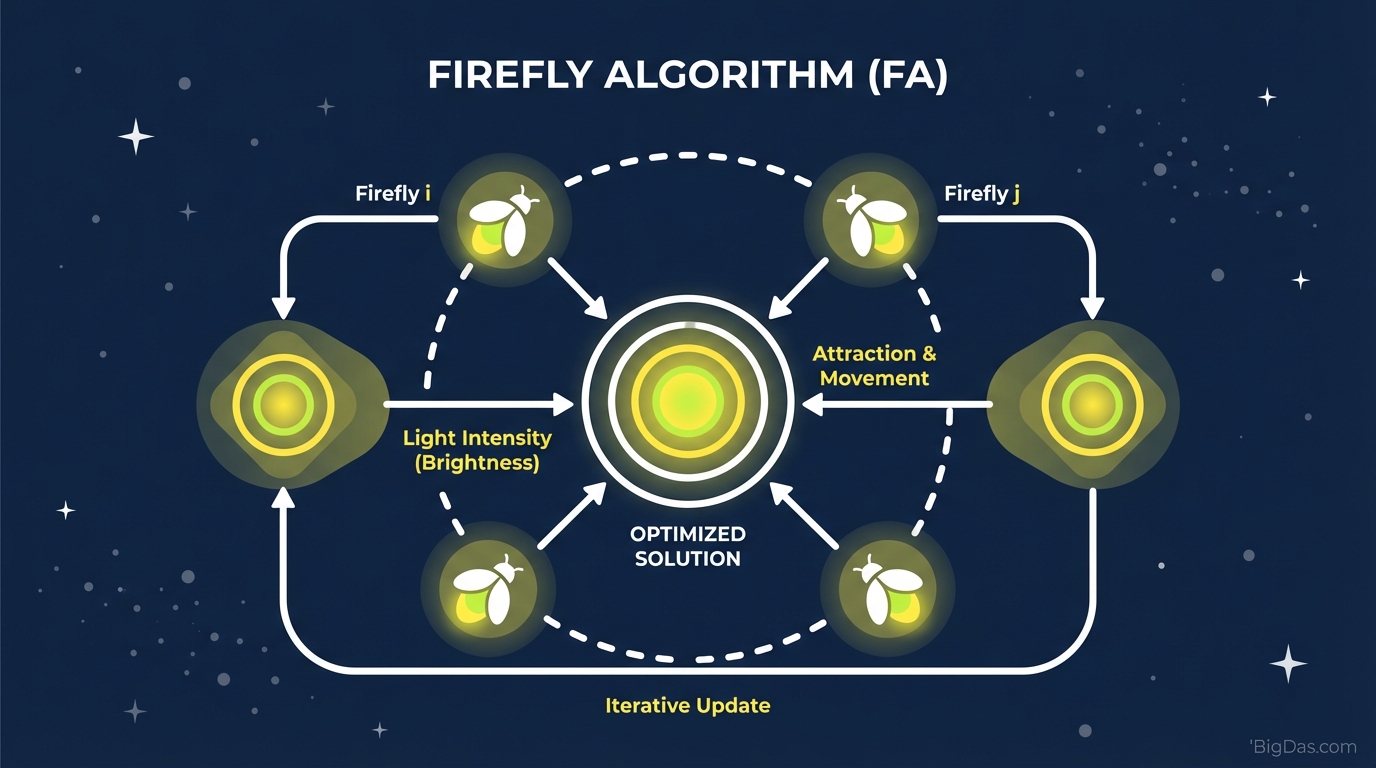
 Modern scientific illustration of Firefly Algorithm (FA)
What is the Firefly Algorithm (FA)?
The Firefly Algorithm is a metaheuristic optimization method introduced by Xin-She Yang in 2008. It is based on the flashing behavior of tropical fireflies, which use bioluminescence to attract mates and lure prey. The algorithm translates this behavior into a set of rules for searching a problem space.
The Core Logic
The algorithm operates on three idealized rules:
- Unisex attraction: All fireflies are unisex, so any firefly is attracted to any other regardless of sex.
- Brightness equals attractiveness: A less bright firefly moves toward a brighter one. As distance increases, apparent brightness decreases due to the inverse square law of light. If no brighter firefly exists nearby, the firefly moves randomly.
- Objective function determines brightness: Brightness is defined by the objective function. In a maximization problem, brightness is proportional to the function value at the firefly's position.
How the Tool Helps
The Firefly Algorithm Tool renders the algorithm in real time. It plots the swarm as it moves through the search space, making it easy to see whether agents cluster around the global optimum or get stuck in local traps. Watching the swarm converge is often more informative than reading numerical logs.
Key Features and Benefits
1. Dynamic Visualization of Convergence
Most optimization software returns a final value without showing the search process. This tool plots each iteration, so you can see whether the swarm is exploring broadly or collapsing into a local peak. Visual feedback makes parameter tuning faster.
2. Multi-Modal Problem Solving
Functions with multiple peaks are difficult for gradient-based methods. The Firefly Algorithm maintains a balance between exploration (random walks) and exploitation (moving toward bright fireflies), which helps it find the global optimum in multi-modal landscapes.
3. Advanced Parameter Control
Three parameters drive the algorithm:
- Alpha ($\alpha$): The randomization parameter.
- Beta ($\beta$): The attractiveness coefficient.
- Gamma ($\gamma$): The light absorption coefficient.
Each parameter can be adjusted with a slider. For example, increasing $\gamma$ makes attraction short-ranged, which forces fireflies to search randomly. Decreasing $\gamma$ makes attraction global, which produces behavior similar to Particle Swarm Optimization (PSO).
4. High-Performance Computation
The simulation runs on an optimized backend that handles thousands of agents per iteration without slowdown.
Step-by-Step Guide
Step 1: Define the Problem Space
Enter your objective function or select one of the built-in test functions (Rosenbrock, Rastrigin, Sphere). The function defines the landscape that the fireflies search.
Step 2: Initialize the Swarm
Choose a population size:
- 10 to 25 fireflies: Fast, but limited coverage of the search space.
- 50 to 100 fireflies: Slower per iteration, but better coverage of complex landscapes.
- 40 fireflies is a reasonable starting point.
Step 3: Configure Light Intensity and Absorption
- Set $\gamma$ (Gamma): Controls how quickly light diminishes with distance. Large $\gamma$ restricts attraction to nearby fireflies. Small $\gamma$ makes attraction global.
- Set $\alpha$ (Alpha): Adds randomness to movement. Increase $\alpha$ if the swarm converges too early.
Step 4: Run the Simulation
Press Start. The swarm is initialized randomly, then evolves over iterations. Typical behavior:
- Phase 1: Fireflies move erratically.
- Phase 2: Small clusters form around local peaks.
- Phase 3: Clusters merge or migrate toward the global maximum.
Step 5: Extract the Solution
When movement stabilizes, pause the simulation. The position of the brightest firefly is the optimal solution.
Expert Advice: Exploration vs. Exploitation
A common mistake is setting $\beta$ too high early in the run. The swarm then collapses onto a single point before the search space is adequately explored (premature convergence).
A more reliable strategy: Start with a higher $\alpha$ and a moderate $\gamma$ so fireflies explore the space broadly. As iterations progress, reduce $\alpha$ and increase attraction. This cooling schedule resembles Simulated Annealing and produces tighter convergence in the final phase.
Real-World Use Cases
1. Structural Engineering Design
FA minimizes the weight of trusses and beams under stress and deflection constraints. The tool plots the feasible region and the convergence path.
2. Machine Learning: Feature Selection
In datasets with many features, FA identifies the subset that maximizes model accuracy while minimizing computation.
3. Image Processing
FA performs multi-level image thresholding and segmentation. The tool shows how pixels are grouped by intensity.
4. Telecommunications
FA optimizes antenna array configurations and routing paths in sensor networks, balancing coverage against interference.
Frequently Asked Questions (FAQ)
1. How is FA different from Particle Swarm Optimization (PSO)?
PSO updates each particle using its personal best and the global best. FA uses brightness and distance-based attraction, with explicit parameters for randomness ($\alpha$) and light absorption ($\gamma$). This often gives FA a stronger balance between local and global search on multi-modal problems.
2. What happens if the objective function is flat?
If all fireflies have equal brightness, they perform a random walk. The algorithm does not stall on flat regions.
3. Can the tool handle discrete optimization problems?
Yes. A discretization module maps continuous movements to discrete steps, which is useful for scheduling, routing (including TSP), and combinatorial problems.
4. Is the Firefly Algorithm deterministic?
No. The algorithm is stochastic, using random numbers in the movement step. Two runs may take different paths but should converge to the same optimum with a properly tuned parameter set.
Summary
The Firefly Algorithm is a stochastic, population-based method for global optimization. It is effective on non-linear, multi-modal problems where gradient information is unavailable or unreliable. The tool visualizes the swarm in real time, exposes the three core parameters ($\alpha$, $\beta$, $\gamma$) for direct control, and supports continuous and discrete problem formulations.