Particle Swarm Optimization
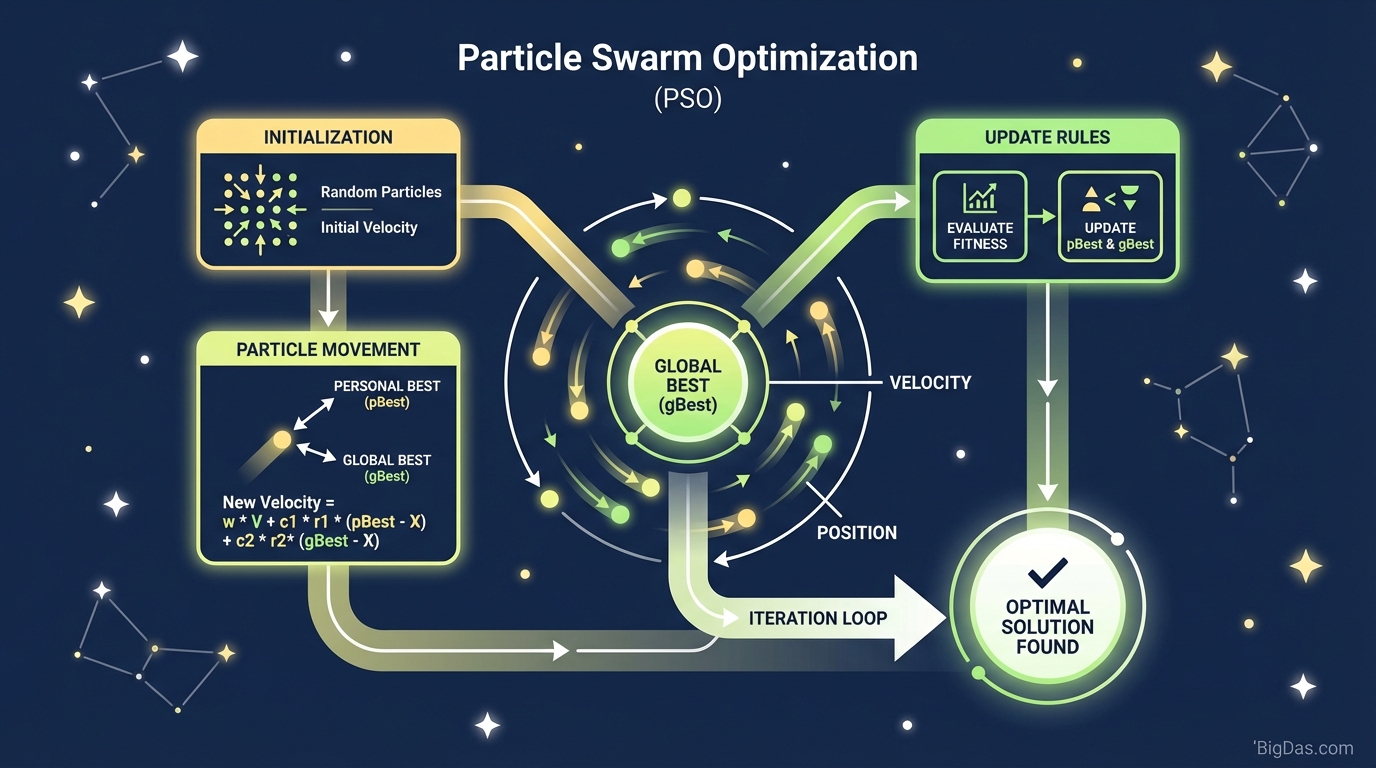
 Modern scientific illustration of Particle Swarm Optimization
Particle Swarm Optimization (PSO) Guide
Linear optimization methods often fail on non-linear, high-dimensional, or noisy data because they get stuck in local optima. Particle Swarm Optimization (PSO) handles these cases by using collective intelligence to navigate complex search spaces.
PSO is a population-based stochastic optimization technique developed by Dr. Eberhart and Dr. Kennedy in 1995. Unlike gradient descent, it requires no gradient information, which makes it useful for black-box optimization problems.
What is Particle Swarm Optimization?
The Concept: Swarm Intelligence
Imagine a group of birds searching for food in a large area. None of the birds know exactly where the food is, but each one knows how far it is from the food at any given moment.
- The Particle: Each candidate solution in the search space is treated as a "bird," or particle.
- The Swarm: The collection of all particles is the swarm.
- The Movement: Every particle has a fitness value (from the objective function) and a velocity.
The Mechanics
In the simulation, every particle flies through the problem space by following the current best particles. The movement of each particle is driven by three components:
- Inertia: The tendency of the particle to continue in its current direction.
- Cognitive Component (Personal Experience): The particle remembers the best position it has found so far (pBest) and feels a pull back toward it.
- Social Component (Collective Wisdom): The particle knows the best position found by the entire swarm (gBest) and feels a pull toward it.
The algorithm updates the velocity and position of each particle iteratively until the swarm converges. Balancing exploration (searching new areas) and exploitation (refining known good areas) is what makes PSO work.
Key Features
1. Real-Time Visualization
The tool plots the swarm in real time on 2D and 3D contour surfaces. Watching the particles spread out or collapse inward helps you diagnose whether the parameters are too aggressive or too passive.
2. Parameter Tuning
The tool exposes the main coefficients directly:
- Inertia Weight (w): Controls momentum.
- Acceleration Coefficients (c_1, c_2): Balance the cognitive vs. social pull.
- Velocity Clamping: Prevents particles from leaving the search space.
3. Benchmark Function Library
The tool comes pre-loaded with Rastrigin, Rosenbrock, and Sphere functions, which are standard tests for optimization algorithms.
4. Parallel Processing
The backend runs particle evaluations in parallel. This keeps the simulation responsive even with large population sizes or high-dimensional problems.
5. Convergence History
A line graph of Global Best Fitness vs. iteration shows the convergence rate and the stability of the final solution.
Step-by-Step Guide
Step 1: Define the Objective Function
Select a benchmark function (such as Ackley or Griewank) from the dropdown, or input a custom cost function.
Step 2: Set the Search Space
- Lower Bound / Upper Bound: The range of each variable (e.g. -50 to 150).
- Dimension: The number of variables (e.g. x, y, z).
Step 3: Initialize the Swarm
- Population Size: 30 to 50 particles is a standard starting point.
- Max Iterations: Set a stopping criterion (e.g. 1000 iterations or error < 0.001).
Step 4: Tune the Coefficients
- Set Inertia (w) to about 0.9 initially, decreasing to 0.4 if dynamic weights are enabled. This encourages early exploration and late convergence.
- Set Cognitive (c_1) and Social (c_2) to 2.0 as a baseline.
Step 5: Run and Analyze
Click Simulate and watch the particles traverse the graph.
- If they converge too fast, you may be in a local optimum. Increase the inertia.
- If they fly around chaotically, reduce the velocity limits.
Real-World Use Cases
1. Machine Learning
PSO is used for Hyperparameter Optimization and for training the weights of neural networks when gradient descent is too slow or gets stuck.
2. Engineering Design
Structural, aerodynamic, and thermal design problems are usually non-linear. PSO is used to find designs that meet strength, weight, and cost constraints.
3. Robotics and Path Planning
PSO generates collision-free paths by treating path coordinates as variables in the optimization problem.
4. Telecommunications
PSO is used to optimize antenna radiation patterns and bandwidth allocation in multi-objective problems.
Expert Tips
- Balance Exploration vs. Exploitation: If the swarm converges instantly, it has not explored enough. If it never converges, it is exploring too much. Use Inertia Weight as the throttle: high for exploration, low for exploitation.
- Topology Matters: A "Global" topology connects every particle to every other (fast convergence, higher risk of local optima). A "Local" or "Ring" topology connects particles only to their neighbors (slower, but less likely to get stuck).
- Noisy Objective Functions: PSO is robust against noisy fitness evaluations. When the objective function returns slightly different values for the same input (common in sensor data), PSO averages them out better than gradient-based methods.
Frequently Asked Questions (FAQ)
1. How is PSO different from Genetic Algorithms (GA)?
Both are population-based metaheuristics. PSO does not use selection, crossover, or mutation. It uses internal velocity and memory instead. PSO is typically easier to implement and converges faster on continuous problems. GA is usually preferred for discrete, combinatorial problems.
2. What happens if a particle flies outside the search space?
The tool uses a Reflect or Clamp boundary condition. A reflection bounces the particle back into the valid space; a clamp stops it at the boundary.
3. Can PSO guarantee the global optimum?
No. Like all stochastic algorithms, PSO cannot mathematically guarantee the global optimum. With proper tuning and enough iterations, it finds the global optimum or a near-optimal solution with high probability, far faster than exhaustive search.
4. Is a larger population always better?
No. A larger population increases the chance of finding the global optimum but raises the cost per iteration. A swarm size of 30 to 50 is sufficient for most standard problems.
Conclusion
PSO offers a simple, fast way to find good solutions to non-linear, high-dimensional problems where gradient-based methods fail. It is widely used in machine learning, engineering design, robotics, and telecommunications.
Use the tool to visualize convergence, tune parameters, and benchmark performance on standard test functions before applying the algorithm to your own data.