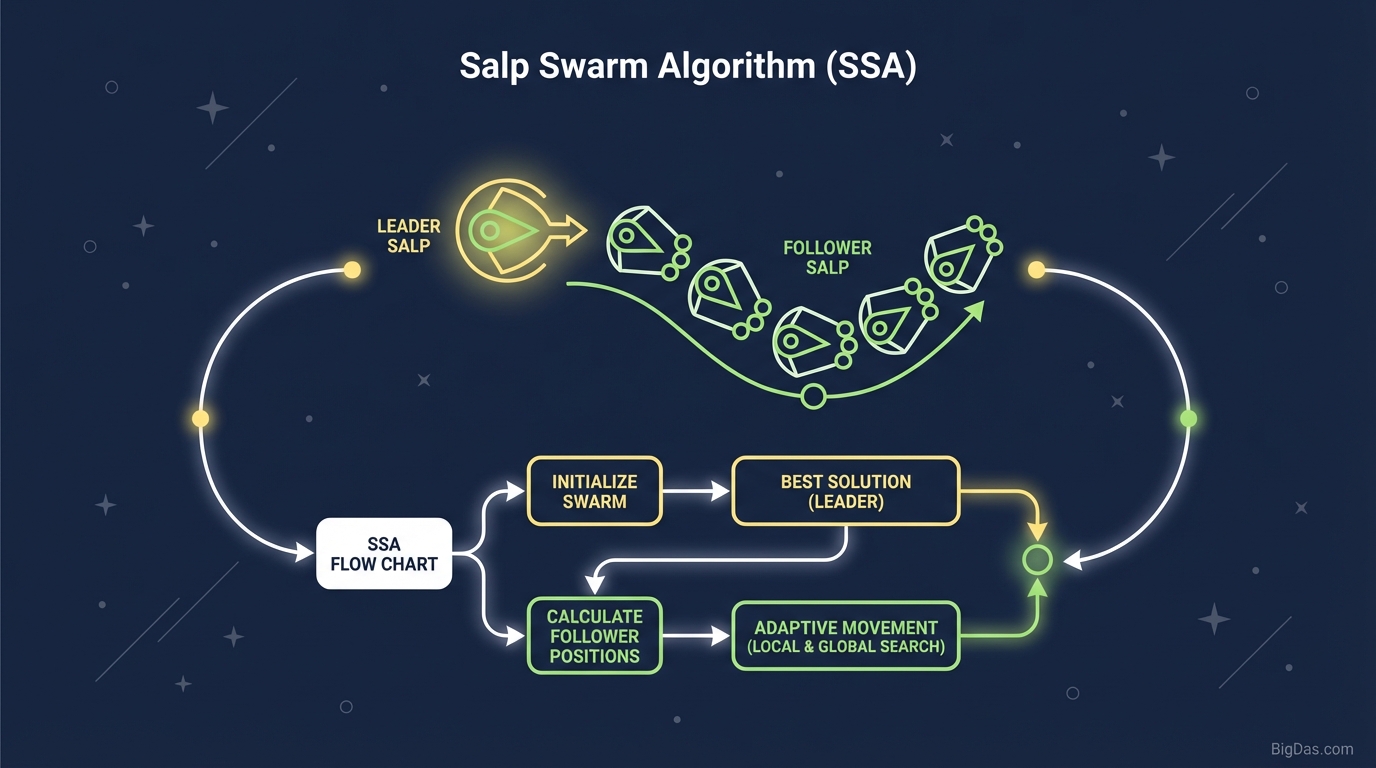
Salp Swarm Algorithm (SSA)
 Modern scientific illustration of Salp Swarm Algorithm (SSA)
The Salp Swarm Algorithm (SSA)
Optimization problems appear in aircraft wing design, neural network hyperparameter tuning, and power grid management. In each case, the task is to find the best solution from a large set of possibilities.
Gradient-based methods work well for simple problems but fail on non-linear, multi-dimensional ones. Swarm Intelligence addresses this by modeling the collective behavior of social animals.
Ant Colony Optimization and Particle Swarm Optimization are common examples. Another effective option is the Salp Swarm Algorithm (SSA), proposed in 2017.
This guide covers how SSA models deep-sea salp behavior to search complex spaces, avoid local optima, and converge on global solutions.
What is the Salp Swarm Algorithm (SSA)?
SSA is a bio-inspired metaheuristic that simulates the swarming behavior of salps: barrel-shaped, gelatinous marine animals that move by pumping water through their bodies.
Salps often form a Salp Chain, linking together to swim in coordination while foraging for phytoplankton.
The Metaphor
In SSA, the search space is the "ocean" and the optimal solution is the "food source."
The population splits into two groups:
The Leader: The first salp in the chain. It moves directly toward the food source.
The Followers: The remaining salps. Each follower tracks the salp immediately ahead, creating a chain of movement.
This structure balances two optimization phases:
- Exploration: Scanning the full search space.
- Exploitation: Refining solutions in promising regions.
The follower chain lets SSA escape local optima, which trap many other metaheuristics.
Key Features of SSA
SSA competes with Genetic Algorithms (GA) and Particle Swarm Optimization (PSO) on several points:
1. Gradient-Free
SSA does not require a derivative of the objective function. This makes it suitable for black-box problems where the math is unknown, noisy, or discontinuous.
2. Fast Convergence
Once the leader locates a promising region, the chain converges quickly, reducing compute time.
3. Adaptive Exploration/Exploitation
A parameter $c_1$ decreases over iterations:
- Early iterations: High exploration.
- Late iterations: High exploitation.
The algorithm tunes this balance internally, so manual parameter adjustment is minimal.
4. Few Parameters
SSA has a small number of control parameters. Implementation is straightforward, and the algorithm handles high-dimensional, multi-modal landscapes.
How SSA Works: Step-by-Step
Phase 1: Initialization
- Define the search space using lower bounds $lb_j$ and upper bounds $ub_j$ for each variable $j$.
- Generate a random population of $N$ salps within those bounds.
- Set the maximum number of iterations $T$.
Phase 2: Fitness Evaluation
- Evaluate each salp against the objective function $F$.
- Assign the best-performing salp as the current Food Source (target).
Phase 3: The Optimization Loop
For each iteration $t$:
Update $c_1$: $$c_1 = 2 e^{-\left(\frac{4t}{T}\right)^2}$$
Update the Leader: For each dimension $j$: $$x_j^1 = \begin{cases} F_j + c_1 \left((ub_j - lb_j) c_2 + lb_j\right) & c_3 \geq 0 \ F_j - c_1 \left((ub_j - lb_j) c_2 + lb_j\right) & c_3 < 0 \end{cases}$$ where $c_2$ and $c_3$ are random numbers in $[0, 1]$.
Update the Followers: $$x_j^i = \frac{1}{2}\left(x_j^i + x_j^{i-1}\right)$$ for $i \geq 2$.
Boundary Check: If any $x_j^i < lb_j$ or $x_j^i > ub_j$, clamp it to the boundary.
Phase 4: Termination
- If $t < T$, return to Phase 2 (update the Food Source if a better solution was found).
- Otherwise, return the Food Source position as the global optimum.
Real-World Applications
1. Engineering Design
SSA minimizes weight and cost while meeting structural constraints.
- Welded beam design: Finding optimal weld thickness, length, and beam height.
- Tension/compression spring design: Tuning wire diameter and coil count.
2. Solar PV Parameter Estimation
PV cells have non-linear current-voltage characteristics. SSA estimates cell parameters (e.g., in the single-diode and double-diode models) more accurately than Newton-Raphson in many cases.
3. Machine Learning Feature Selection
SSA acts as a wrapper method for feature selection, treating each feature as a binary variable (1 = include, 0 = exclude). This reduces dimensionality and improves model accuracy.
4. Neural Network Training
SSA optimizes the weights and biases of Feed-Forward Neural Networks (FNNs). Replacing standard backpropagation with SSA reduces the risk of getting stuck in local minima.
Practical Tips
Population Size
- <30 salps: Fast but risks missing the global optimum.
- >100 salps: Higher accuracy at higher compute cost.
- Baseline: Start with 50 salps and 1000 iterations.
Hybridization
For complex problems, combine SSA with a local search method (e.g., Simulated Annealing) or Chaos Theory to escape stagnation when the leader converges too early.
Constraints
SSA does not handle constraints natively. Use a penalty function: add a large penalty term to the fitness of any salp that violates a constraint, so the swarm ignores infeasible regions.
FAQ
1. How does SSA compare to PSO?
PSO often converges prematurely because particles rush toward the best-known position. SSA's chain structure moves more gradually, allowing broader inspection of the search space before committing.
2. Can SSA handle multi-objective problems?
Yes. The Multi-Objective Salp Swarm Algorithm (MSSA) stores non-dominated solutions in an external archive to approximate the Pareto front.
3. Which programming languages support SSA?
Python (NumPy), MATLAB, C++, and Java. The math is basic matrix operations plus random number generation, so libraries handle most of the work.
4. Does SSA guarantee the global optimum?
No. All metaheuristics rely on stochastic components, so none can guarantee the global optimum on every run. SSA's exploration-exploitation balance gives it a higher statistical chance of finding it compared to many alternatives.
Summary
The Salp Swarm Algorithm models the foraging behavior of salp chains. Its leader-follower structure, gradient-free evaluation, and adaptive $c_1$ parameter make it a practical tool for engineering design, PV modeling, feature selection, and neural network training.
Implement SSA, test it on your objective function, and benchmark it against GA or PSO to see how it performs on your specific problem.