Breakout
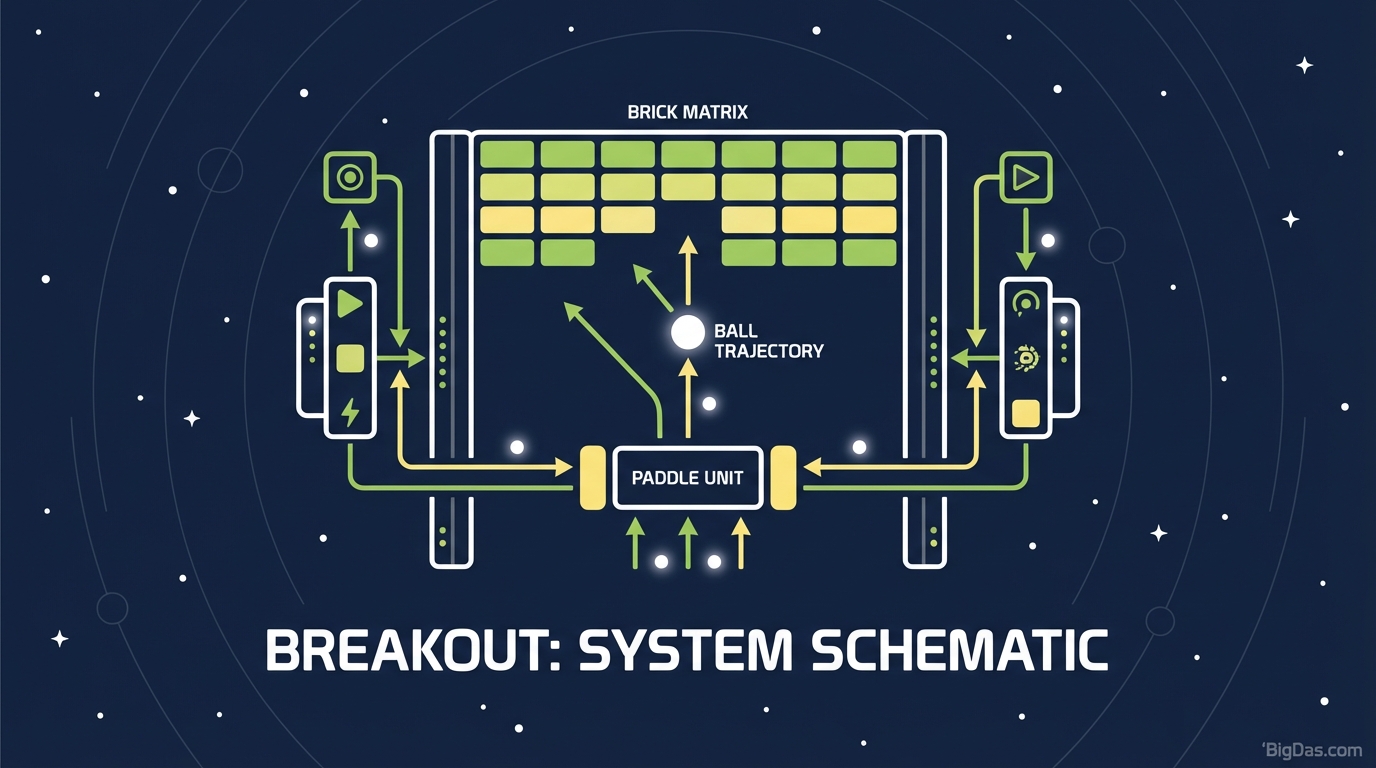
 Modern scientific illustration of Breakout
Play Breakout Online: A Practical Guide to the Classic Arcade Game
Breakout is one of the simplest games ever made, and that is exactly why it still works. You move a paddle, bounce a ball, and clear a wall of bricks. No tutorials, no cutscenes, no menus. Just the game.
This guide covers the history, the mechanics, and the strategies that separate casual players from high scorers.
What is Breakout?
Breakout was designed in the 1970s, with hardware built by Steve Wozniak. It took the two-player formula of Pong and turned it into a single-player challenge.
The rules: you control a horizontal paddle at the bottom of the screen. A ball bounces around the play area, and you hit it back up to break a wall of bricks. Clear the bricks to win. Lose the ball, and you lose a life.
The HTML5 Version
Most browser ports of Breakout run on Flash emulators or poorly maintained Java applets. They stutter, lag, and rarely match the feel of the original.
This Breakout tool runs on HTML5 with a lightweight physics engine. It loads instantly, runs at a consistent frame rate, and works on any device with a modern browser.
Key Features
1. Pixel-Precise Physics
The angle of the ball's reflection depends on where it hits the paddle. Hit the center for a straight return. Hit the edge for a sharp angle. The collision detection matches the visuals, so you always get the result you expect.
2. Low-Latency Controls
The paddle responds immediately to mouse, keyboard, or touch input. There is no perceptible delay between your movement and the paddle's movement on screen.
3. Progressive Difficulty
The game starts slow enough for beginners to learn the basics. As you clear bricks, the ball speeds up and the paddle may shrink. The difficulty curve is steep but fair.
4. Cross-Platform Support
The interface scales to fit any screen. On desktop, use the mouse or arrow keys. On mobile, drag your finger below the brick line to move the paddle.
5. Cognitive Benefits
- Hand-eye coordination: Tracking the ball trains reflex pathways.
- Trajectory prediction: You learn to calculate angles and bounces in real time.
- Stress relief: Short sessions provide a focused break from work or study.
How to Use Breakout
Step 1: Launch the Tool
Open the Breakout page. The game loads in your browser. No accounts, no downloads, no installation.
Step 2: Choose Your Controls
- Mouse/Touchpad (Recommended): Move your cursor left and right to slide the paddle. This gives you the smoothest analog control.
- Keyboard: Use the Left and Right Arrow keys. Better for small, precise adjustments but slower for full-width moves.
- Touch (Mobile): Drag your finger anywhere below the brick line to position the paddle.
Step 3: Serve the Ball
Click the mouse or press Spacebar to launch the ball. Be ready: it starts moving immediately.
Step 4: Play the Game
Your only job is to keep the ball in play.
- Center hits send the ball straight up at a predictable angle.
- Edge hits create sharp angles. Use these to reach bricks in the corners.
Step 5: Clear the Screen
When all bricks are destroyed, a new level loads. The ball moves faster, and the brick pattern changes. Your score carries over.
Advanced Strategies
Tunneling
Tunneling is the fastest way to clear a level. Pick one side of the brick wall (far left or far right) and focus all your hits there. Drill a vertical gap straight up to the ceiling.
Once the ball passes the top row, it bounces between the ceiling and the top of the brick stack. It will tear through the level on its own while you focus on catching it.
Speed Management
The ball accelerates at set intervals: after 4 hits, after 12 hits, and after breaking certain colored bricks. When the speed jumps, stop aiming for corners. Switch to a defensive stance and return the ball with the center of the paddle. Survive the speed bump, then resume attacking.
Paddle Positioning
Avoid parking the paddle against the wall. If it is stuck at the edge when the ball returns at a sharp angle, you have no room to react. Keep the paddle near the center of the screen whenever the ball is moving upward.
Practical Use Cases
1. The Pomodoro Break
The Pomodoro Technique recommends a 5-minute break after 25 minutes of focused work. Scrolling social media often leaves you more distracted than before. One round of Breakout engages visuospatial processing instead of linguistic processing, giving your brain a genuine reset.
2. Focus Training
When your thoughts are scattered, Breakout forces you to track a single moving object. That kind of directed attention works as a grounding exercise. Five minutes of play is often enough to clear your head.
3. Reflex Drills
Daily play keeps your reaction time sharp. This matters for competitive gaming, sports, or any task that requires fast visual decisions.
4. UI/UX Reference
For designers, Breakout is a useful case study. Three elements (a ball, a paddle, and bricks) create an engaging loop through interaction alone. No graphics, no sound design, no narrative required.
Frequently Asked Questions (FAQ)
1. Is this Breakout tool free to use?
Yes. There are no paywalls, microtransactions, or play-time limits.
2. Does the game save my high score?
Yes. The tool uses your browser's local storage to remember your best score. Clearing your browser cache will reset it.
3. Can I play this on my smartphone?
Yes. The game is fully responsive and works in Chrome, Safari, and Firefox on mobile devices.
4. Is there a way to slow down the ball?
No. Ball speed is part of the difficulty curve. Hitting the ball with the center of the paddle keeps the trajectory more predictable, which offsets the speed.
5. Why does the ball angle change unpredictably?
Because of the physics engine. When the ball hits a brick corner or the edge of your paddle, it reflects at a calculated angle. This rewards positioning and makes the game more skill-based.
Conclusion
Breakout is a 50-year-old design that still works because it does one thing well. You move a paddle. You bounce a ball. You break bricks. That is the whole game.
Load the page, grab the paddle, and see how long you can keep the ball alive.