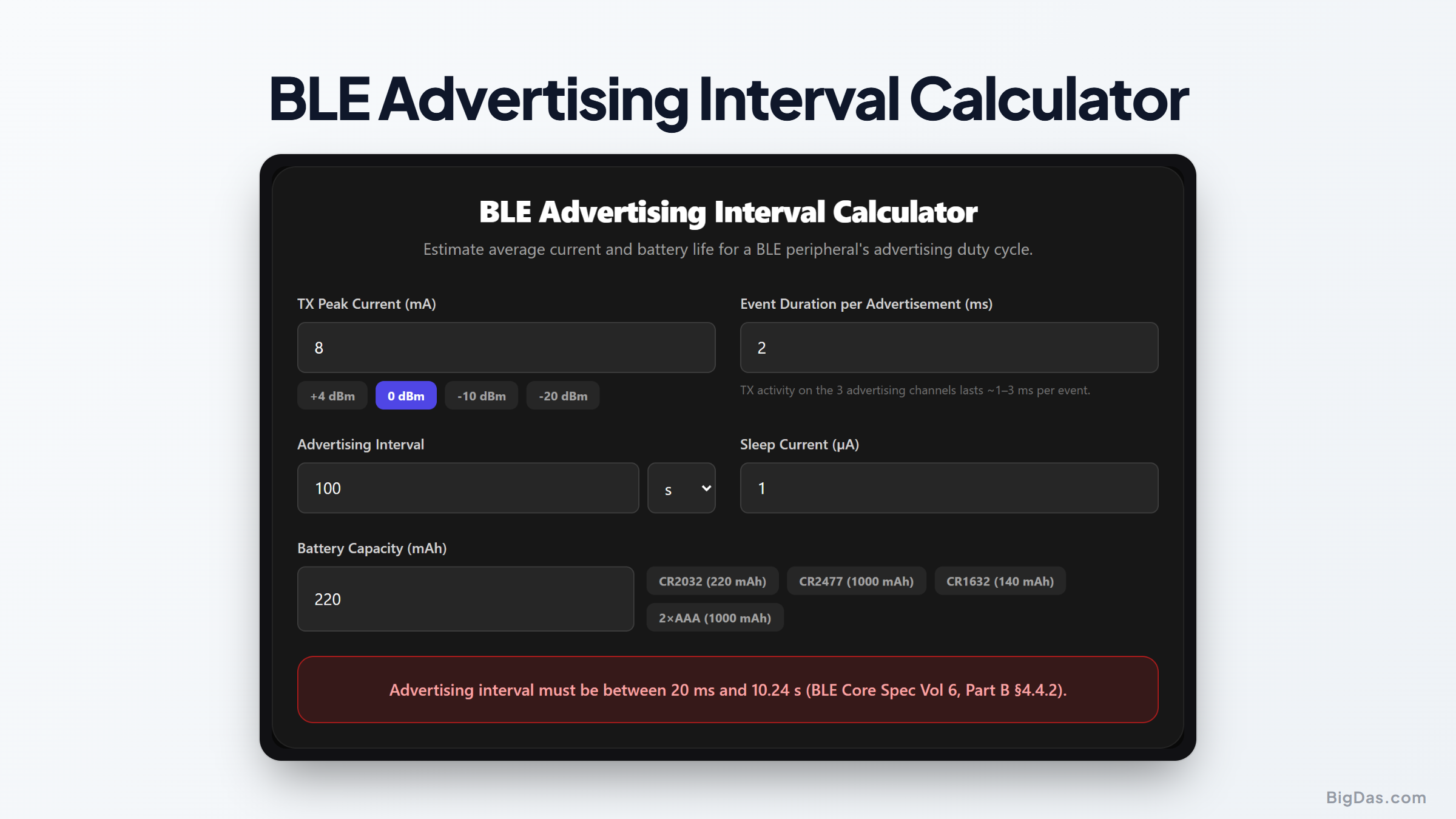
BLE Advertising Interval Calculator
 Generated infographic and interface snapshot for BLE Advertising Interval Calculator
Balance discoverability against battery life for a BLE beacon or sensor.
Free BLE Advertising Interval Calculator Online — Big Das
Bluetooth Low Energy devices spend most of their life asleep, waking briefly to shout their presence on three advertising channels. The Big Das BLE Advertising Interval Calculator models that wake-sleep pattern to give you the average current draw, projected battery life, duty cycle, and a plain-language discoverability rating for any advertising interval from 20 ms to 10.24 s.
How BLE Advertising Affects Battery Life
A BLE peripheral advertising once per interval T draws a short burst of peak current I_TX for the event duration t_event, then returns to a very low sleep current I_sleep. The average current is the energy-per-event spread over the interval, plus the sleep floor:
I_avg = (I_TX × t_event) / T + I_sleep × (1 − t_event/T)
Because an event lasts only 1–3 ms, the dominant term for fast advertising (short T) is the burst energy; for slow advertising, the sleep current dominates. Doubling the interval roughly halves the burst contribution — but also halves how often a phone sees the device, so discoverability suffers.
Battery life follows directly:
Life (h) = Capacity (mAh) / I_avg (mA)
Duty cycle = t_event / T
The BLE Core Specification (Vol 6, Part B, §4.4.2) limits the advertising interval parameter to the range 20 ms – 10.24 s, which the calculator enforces.
How to Use the BLE Advertising Interval Calculator
- TX peak current — enter your radio's datasheet value (mA) or tap a transmit-power preset. Higher TX power costs more current per event.
- Event duration — the total radio-on time per advertising event, typically 1–3 ms (TX on channels 37/38/39 plus turnaround).
- Advertising interval — any value from 20 ms to 10.24 s. Toggle between ms and s.
- Sleep current — the deep-sleep quiescent draw between events, in µA.
- Battery capacity — enter mAh, or tap a preset such as CR2032 (220 mAh).
- Read the results — live average current, battery life, duty cycle, and a discoverability rating based on the chosen interval.
Worked Example
A temperature beacon advertises every 100 ms from a CR2032 cell (220 mAh). At 0 dBm the radio peaks at 8 mA, each event lasts 2 ms, and it sleeps at 1 µA.
Burst term: (8 mA × 2 ms) / 100 ms = 160 µA
Sleep term: 1 µA × (98 / 100) = 0.98 µA
I_avg ≈ 161 µA
Battery life = 220 / 0.161 ≈ 1 366 h ≈ 57 days
Duty cycle = 2/100 = 2 % → short intervals, high duty, rapid discovery but clear battery cost.
Stretch the interval to 1 s and the average drops to ≈ 17 µA — over a year of life — at the price of a one-second worst-case discovery delay.
Common Use Cases
- Battery life estimation for BLE beacons, trackers, and sensors.
- TX power trade-offs — see how dBm settings map to longevity.
- Interval selection when balancing discovery latency against run time.
- Firmware power audits — sanity-check a measured average current.
- Coin-cell product design — verify a CR2032 can meet a target lifespan.
Frequently Asked Questions
Why is my measured current higher than the calculator predicts?
Real devices also draw current for the stack's pre-event wake-up, RC oscillator startup, and post-event processing — often 1–5 ms extra per event and 10–50 µA of additional average current. Measure once and adjust the event-duration input upward to match.
Is the 20 ms minimum a hardware limit?
No — it is the BLE Core Specification's minimum for the advertising-interval parameter (Vol 6, Part B, §4.4.2). Some silicon supports an additional random 0–10 ms delay to reduce collisions with other advertisers.
Why 1–3 ms for the event duration?
A connectable undirected advertising event transmits one PDU on each of channels 37, 38, and 39, with an RX listening window after each. At 1 Msym/s and typical 31-byte payloads, the whole sequence completes in about 1–3 ms.
Does number of advertising channels matter?
Yes. This model assumes the typical 3-channel case. Advertising on a single channel shortens the event; 37 channels is not allowed — the spec defines exactly channels 37, 38, and 39 for primary advertising.
My battery is rechargeable (Li-ion).
Do the numbers still apply?
The math is the same; just enter your Li-ion cell's capacity in mAh. Remember that Li-ion self-discharge and voltage-regulator quiescent current add a few µA that the model does not include.
What duty cycle should I target for a good user experience?
For interactive pairing or ranging apps, intervals below ~100 ms (duty ≥2 %) respond quickly. For telemetry-only beacons, 1–10 s intervals are acceptable where discovery latency is not critical.