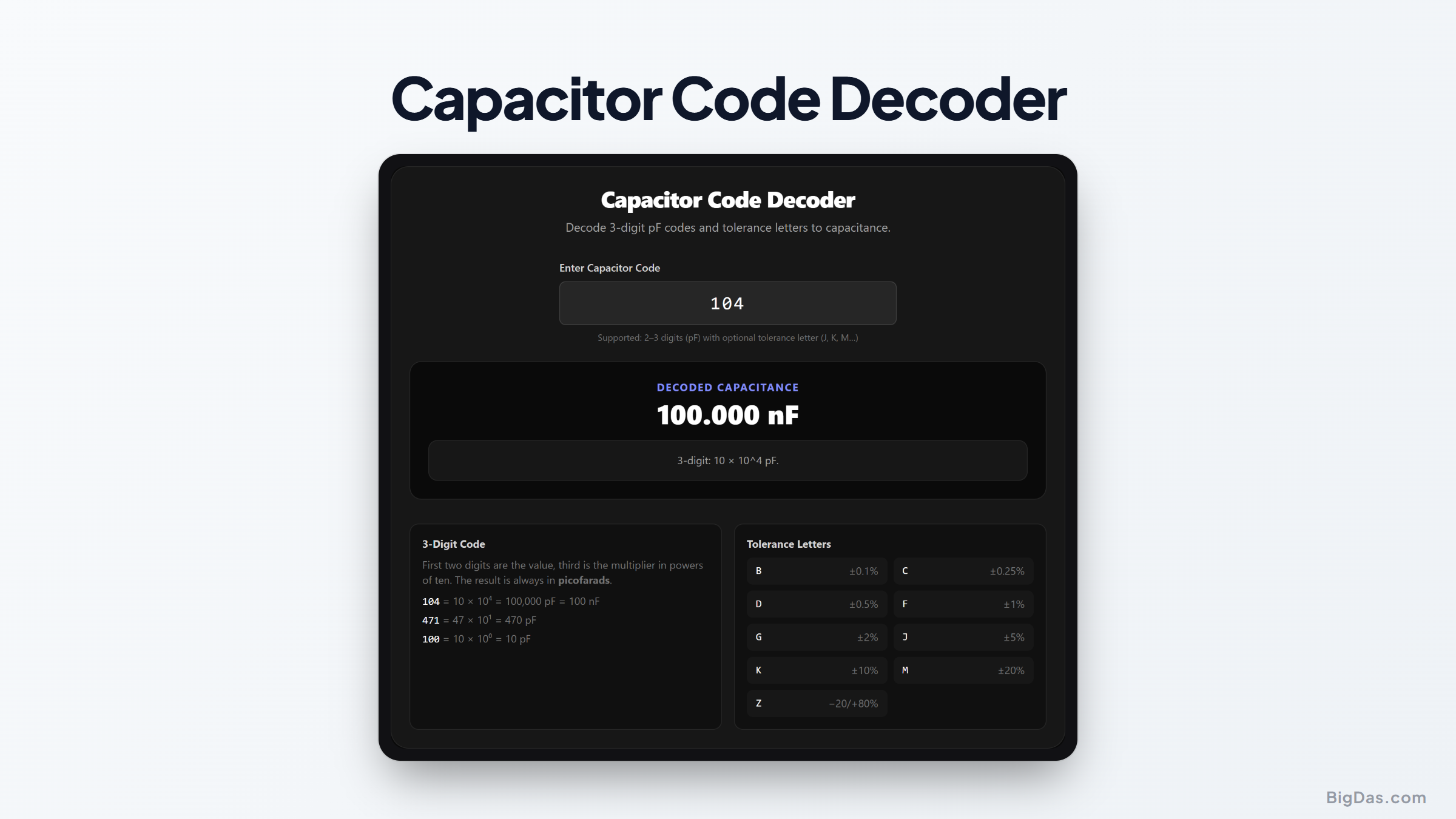
Capacitor Code Decoder
 Generated infographic and interface snapshot for Capacitor Code Decoder
Decode 3-digit ceramic and film capacitor markings instantly.
Free Capacitor Code Decoder Online — Big Das
Ceramic and film capacitors are too small for printed values like "100 nF," so manufacturers stamp them with compact numeric codes. The Big Das Capacitor Code Decoder translates those markings into picofarads, nanofarads, or microfarads, and interprets tolerance letters like J, K, and M.
Enter a code such as 104 or 471K and the answer appears immediately — fully client-side, no signup, no ads.
What Is a Capacitor Code?
A capacitor code is a short marking that encodes capacitance in picofarads (pF). Because many capacitors measure only a few millimeters across, there isn't room to print "0.1 µF" or "100 nF." Instead, manufacturers use a 3-digit system borrowed from resistor marking.
The code consists of:
- Two significant digits
- One multiplier digit (the number of zeros to append)
- An optional tolerance letter
Where You'll Find These Codes
These markings appear on ceramic disc capacitors, multilayer ceramic capacitors (MLCCs), film capacitors, and some tantalum parts. Aluminum electrolytics usually print the full value instead, so they're exempt from the code system.
How to Use the Capacitor Code Decoder
- Locate the code on the capacitor body. It's usually three digits, sometimes followed by a letter.
- Enter the code into the input field. The tool accepts 2–3 digits with an optional tolerance letter.
- Read the result — capacitance displays in pF, nF, or µF, along with tolerance if a letter was provided.
- Check the reference tables — below the result, the tool reminds you how the 3-digit rule and tolerance letters work.
Decoding Rules
3-Digit Code
The first two digits are significant; the third is the power-of-ten multiplier. The result is always in picofarads.
- 104 = 10 × 10⁴ pF = 100,000 pF = 100 nF
- 471 = 47 × 10¹ pF = 470 pF
- 100 = 10 × 10⁰ pF = 10 pF
2-Digit Code
For small values below 100 pF, the marking may be just two digits, read directly in picofarads.
- 22 = 22 pF
- 47 = 47 pF
Tolerance Letters
A trailing letter indicates the tolerance class:
- B = ±0.1%
- C = ±0.25%
- D = ±0.5%
- F = ±1%
- G = ±2%
- J = ±5%
- K = ±10%
- M = ±20%
- Z = −20% / +80% (common on ceramics)
Worked Example
You pull a capacitor from an old radio marked 152J:
First two digits: 15
Multiplier: 10² = 100
Capacitance: 15 × 100 = 1500 pF = 1.5 nF
Tolerance: J = **±5%*
Another part reads 104K:
10 × 10⁴ = 100,000 pF = 100 nF
K = **±10%*
A tiny disc capacitor marked 47:
Direct reading: 47 pF
No tolerance letter, so tolerance is unspecified by the code.
Common Use Cases
- PCB repair: Identify a failed ceramic capacitor before ordering a replacement.
- Component salvage: Sort loose capacitors from a junk box into labeled bins.
- Kit building: Verify that the part in your hand matches the bill of materials.
- Education: Learn standard component marking without memorizing every combination.
- Reverse engineering: Document capacitor values on a board you don't have schematics for.
Frequently Asked Questions
Why are capacitor codes always in picofarads?
Picofarads provide a convenient integer-friendly unit for the small values typical of ceramic and film capacitors. The convention dates back decades and persists because it avoids decimal points in tiny print.
What does the letter after the digits mean?
That's the tolerance code. A "J" means the actual value is guaranteed within ±5% of the marked value, "K" means ±10%, and "M" means ±20%. Precision capacitors use tighter letters like F or D.
How do I convert pF to nF or µF?
Divide by 1,000 to go from pF to nF, and by 1,000,000 to go from pF to µF. The tool does this automatically and displays the most readable unit.
My capacitor has a letter like "2A" under the digits — what is that?
That's often a voltage rating or date code, not part of the capacitance marking. This tool decodes the capacitance digits and tolerance letter; consult the manufacturer's datasheet for voltage codes.
Are all 3-digit capacitor codes read the same way?
Almost. The 3-digit system with a power-of-ten multiplier is standard for ceramic and film capacitors. Tantalum capacitors sometimes use a similar scheme, but always check the package style and datasheet if in doubt.
What does "Z" tolerance mean?
Z is an asymmetric tolerance common on older ceramic capacitors. It means the value can be 20% below or up to 80% above the marked value — effectively a very loose specification. The tool notes this special case when you enter a Z suffix.