Futures Trading Fee Calculator
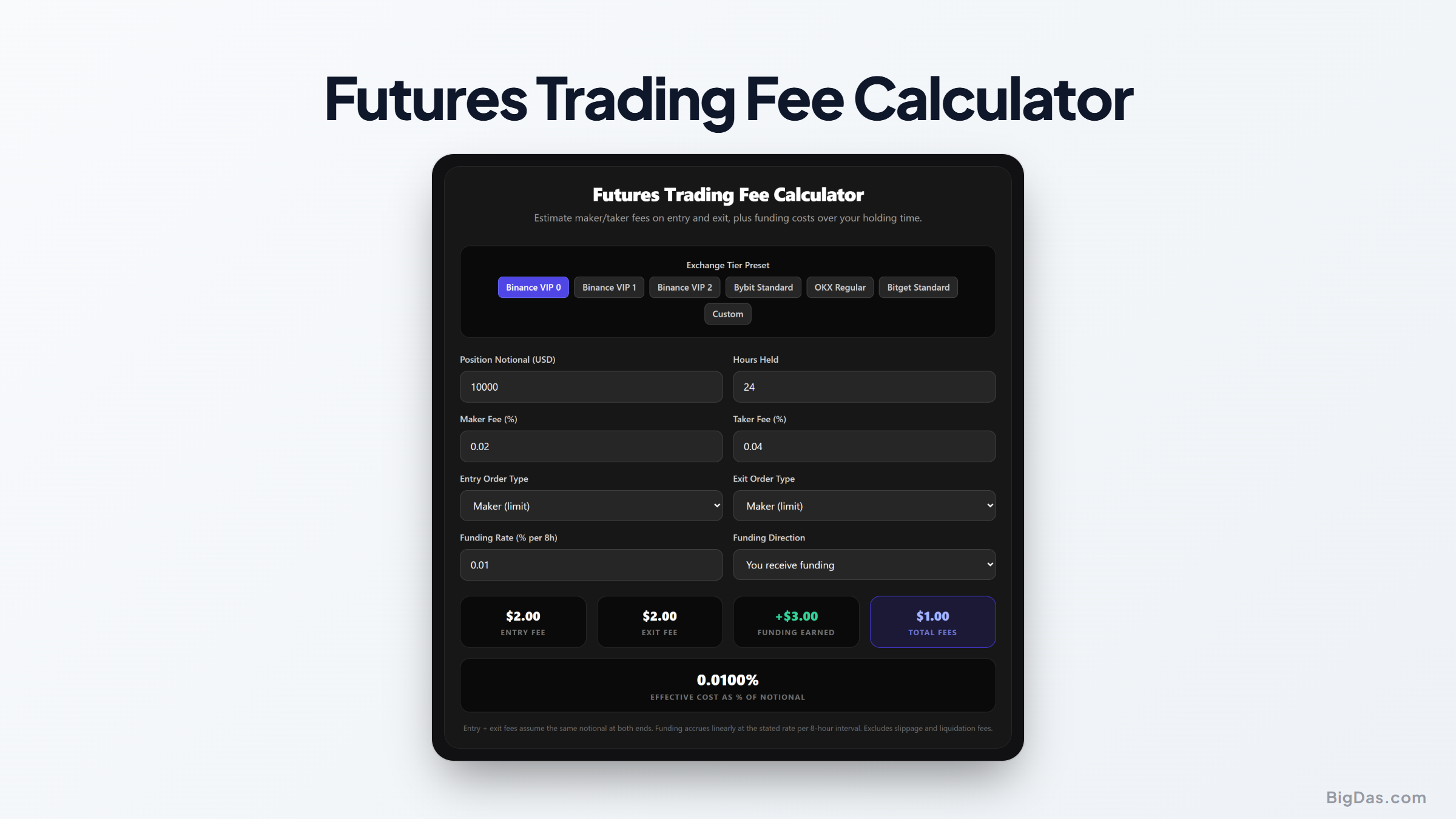
 Generated infographic and interface snapshot for Futures Trading Fee Calculator
Crypto Futures Fee Calculator: Understanding Entry, Exit, and Perpetual Swap Funding Costs
Trading cryptocurrency futures offers massive market opportunities, allowing traders to utilize leverage, manage risk, and speculate on both rising and falling prices. However, behind every successful position lies an often overlooked reality: trading costs. While spot market fees are straightforward, crypto futures fees involve multiple dynamic components that can quietly drain your margin if you do not account for them properly. When you open a perpetual futures contract, you are not just paying a single transaction fee. You encounter distinct entry and exit order charges, usually categorized as maker taker fees. On top of that, holding a position over several hours or days introduces perpetual swap funding rates, which fluctuate periodically depending on market sentiment. Without a clear picture of these cumulative expenses, even a profitable setup on paper can turn into a losing trade in practice. This article breaks down how trading fees work in derivative markets and explains how using a dedicated exchange fee calculator helps you maintain tight control over your capital.
What is Futures Trading Fee Calculator?
A Futures Trading Fee Calculator is a specialized tool designed to compute the complete financial friction associated with derivative trades. Rather than relying on simplified estimates or rough mental math, this calculator isolates every fee layer involved in opening, maintaining, and closing a leveraged position. The primary purpose of the calculator is to aggregate entry fees, exit fees, and funding rate accruals over a specific duration into two actionable numbers: total trading cost in fiat or stablecoin value, and fee cost expressed as a percentage of total position notional. To calculate these costs accurately, the tool factors in four core variables:
- Position size and leverage, which define the overall notional value of the contract.
- Maker taker status on entry, determining whether your initial order added liquidity or removed it from the order book.
- Maker taker status on exit, applying the corresponding fee rate when closing the trade.
- Duration held in hours alongside the projected average funding rate, which calculates the interest payments transferred between long and short traders over time. By combining these variables into a unified calculation, the tool provides immediate clarity on your true break even price before you place an order.
Key Features & Benefits
Accurate cost projection is essential for sustainable risk management. Here are the core features and practical benefits that make this calculator an essential component of a trader toolkit.
Dual Order Type Processing
Exchanges apply different fee schedules depending on whether an order acts as a maker or a taker. A maker order sits on the order book as a limit order, providing liquidity, while a taker order executes instantly against existing orders, consuming liquidity. This tool allows you to specify separate order types for entry and exit, ensuring your calculations reflect realistic execution conditions such as entering with a limit order and exiting with a market stop loss.
Time Adjusted Funding Rate Calculation
Perpetual contracts do not have an expiration date. To keep contract prices aligned with the spot market, exchanges utilize a funding rate mechanism, typically settled every eight hours or every hour depending on the platform. The calculator projects cumulative funding payments based on the exact number of hours you plan to hold the position, accounting for both positive and negative funding environments.
Notional Value Relative Impact Analysis
A common trap for high leverage traders is underestimating how small percentage fees compound against initial margin. A 0.05 percent fee on a 100,000 dollar position equals 50 dollars. If your initial margin was only 1,000 dollars at 100x leverage, that single fee consumes 5 percent of your account balance. The calculator displays fee costs both in absolute values and as a percentage of total position notional, making margin drag immediately visible.
Multi Exchange Fee Flexibility
Different trading venues maintain distinct fee tier structures based on monthly trading volume or native exchange token holdings. The calculator lets you manually input custom percentage rates for maker fees, taker fees, and funding rates, making it compatible with any major crypto derivative platform.
Step by Step Guide on How to Use It Using the Futures Trading Fee
Calculator requires just a few simple inputs to generate a full breakdown of expected costs. Follow these steps to evaluate your next trade setup.
Step 1: Enter Your Position Details
Start by entering your proposed trade size and leverage level. Alternatively, you can directly input the total position notional value. For example, if you plan to trade 1 BTC at a price of 60,000 dollars, your position notional value is 60,000 dollars.
Step 2: Select Entry Order Type and Fee Rate
Determine whether your entry will be a maker or taker order. Input the specific fee percentage charged by your exchange for that order type. Typical maker fees range from 0.01 percent to 0.02 percent, while taker fees generally range from 0.04 percent to 0.07 percent.
Step 3: Select Exit Order Type and Fee Rate
Specify your planned exit order type and fee percentage. If you intend to take profit using a limit order, use your exchange maker rate. If you plan to close using a market order or stop loss, use the taker rate.
Step 4: Define Holding Time and Funding Rate
Input the estimated number of hours you intend to keep the position open. Next, enter the current or predicted funding rate for the eight hour funding period. If long traders are paying short traders, enter a positive percentage; if short traders are paying long traders, input the appropriate value.
Step 5: Analyze Total Trading Cost
Review the final results generated by the tool. The calculator provides the total dollar cost across entry, exit, and funding, as well as the total fee percentage relative to your position notional value. Use this data to adjust your target profit price so your trade remains net profitable.
Why You Need This Tool (Use Cases)
Understanding cost structure is relevant for every trading style. Here is how different market participants utilize this tool to improve execution and profitability.
Scalpers and Day Traders
Scalpers execute multiple fast trades throughout a single session, seeking tiny price moves. Because profit targets are small, order execution costs can easily outweigh gross gains. By running scenarios through a maker taker fee calculator, scalpers can evaluate whether using limit orders instead of market orders preserves enough margin to make their strategy viable.
Swing
Traders and Position Holders Traders who keep positions open for days or weeks face significant exposure to funding rates. A position held for two weeks undergoes 42 funding settlements on standard eight hour cycles. If the funding rate averages 0.03 percent per period, the cumulative holding cost reaches over 1.25 percent of the total position notional. Using a funding rate calculator prevents unexpected erosion of position equity over long time frames.
High Leverage Speculators
When trading with high leverage, initial margin is a small fraction of total exposure. Fees are always charged against total contract notional, not initial margin. High leverage traders use this calculator to realize how quickly entry and exit fees deplete their liquidation buffer.
Arbitrage and Delta Neutral Traders
Arbitrage strategies, such as cash and carry trades or funding rate farming, rely on narrow yield differentials between spot and futures markets. These strategies require precision down to the fraction of a percent. Calculating exact maker taker fees alongside funding payments ensures that systemic exchange friction does not turn a theoretically neutral profit into a net loss.
FAQ Section
What is the difference between a maker fee and a taker fee in crypto futures?
A maker fee applies when you place an order that goes into the order book and waits to be matched, such as a post only limit order. This adds liquidity to the exchange. A taker fee applies when your order matches immediately against an existing limit order on the book, such as a market order, which removes liquidity. Exchanges reward makers with lower fee rates to encourage liquid order books.
How does perpetual swap funding work?
Perpetual swap contracts do not have a fixed settlement or expiry date like traditional futures. To keep the perpetual contract price close to the underlying spot asset price, exchanges use funding rates. When the contract trades at a premium to spot, long position holders pay short position holders. When the contract trades at a discount to spot, short position holders pay long position holders. These payments occur periodically, usually every eight hours.
Why are fees so much higher when using leverage?
Exchange fees are calculated as a percentage of total position notional value, not your initial margin balance. If you deposit 1,000 dollars and use 10x leverage to open a 10,000 dollar position, a 0.05 percent fee is calculated against 10,000 dollars, resulting in a 5 dollar fee. Relative to your 1,000 dollar margin, that fee represents 0.5 percent of your capital, effectively magnifying the cost relative to your collateral.
Can funding rates be negative and how does that affect overall cost?
Yes, funding rates can be negative when market sentiment is heavily bearish and contract prices trade below spot prices. In a negative funding rate environment, traders holding short positions pay funding fees to traders holding long positions. If you hold a long position while the funding rate is negative, you receive funding payments, which offsets your entry and exit trading costs.
Conclusion
To wrap up, understanding your true trading expenses is just as critical as predicting market direction. Crypto derivative markets carry hidden costs that extend far beyond initial transaction fees, particularly when holding perpetual contracts across multiple funding intervals. Using a Futures Trading Fee Calculator brings complete clarity to your order planning, helping you evaluate maker taker costs, project duration based funding payments, and set accurate break even targets. By factoring all friction costs into your risk management framework before opening a trade, you protect your margin and build a more disciplined trading strategy over time.