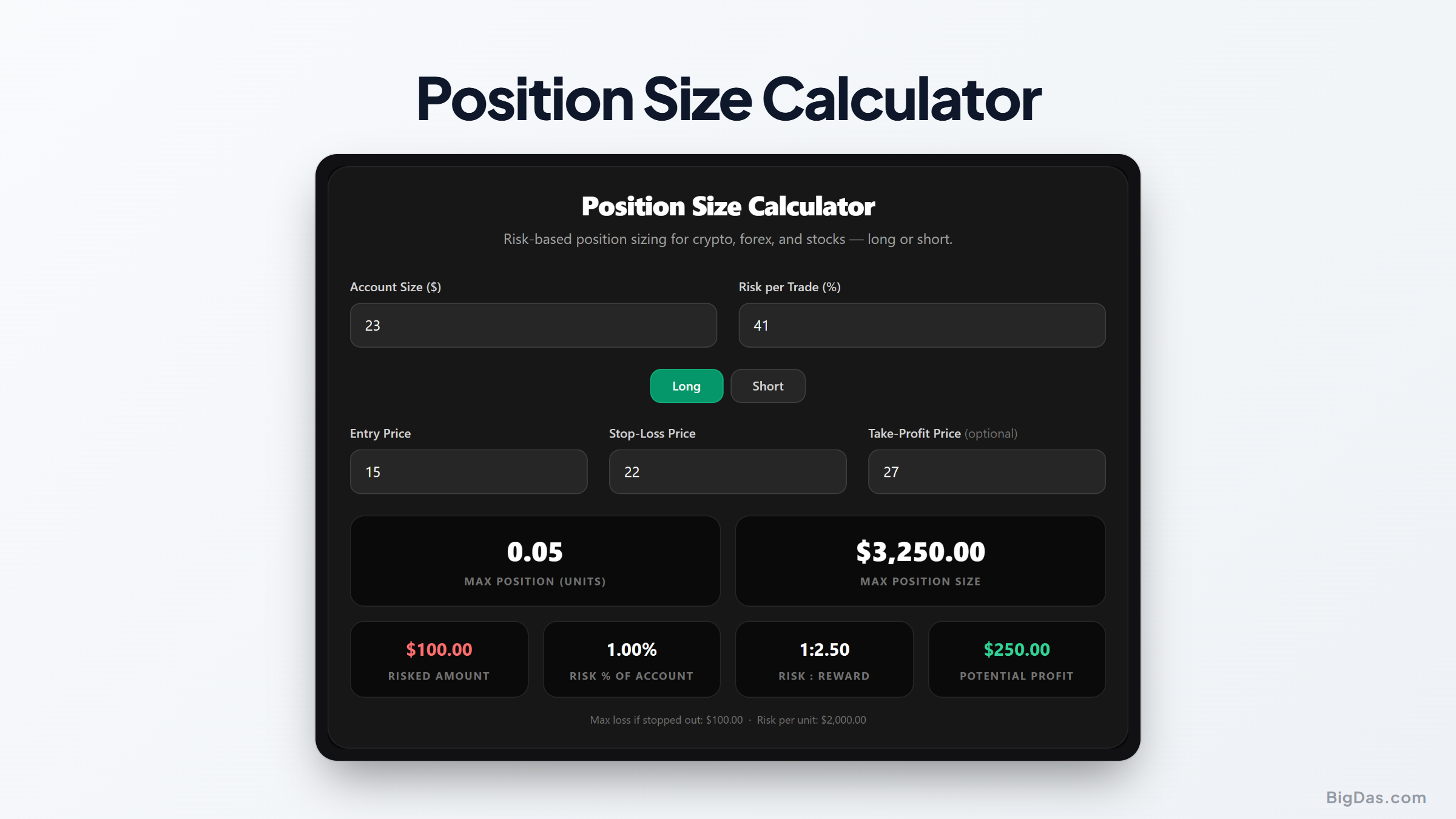
Position Size Calculator
 Generated infographic and interface snapshot for Position Size Calculator
Master Trading Risk: How to Use a Position Size Calculator for Crypto, Forex, and Stocks
In financial trading, capital preservation is the single most critical factor for long term survival. Most beginner traders fail not because their chart analysis is flawed, but because they lack proper account discipline. Entering a order without calculating the correct trade size transforms trading from a strategic probability game into unmanaged gambling.
Every market trade involves risk, but managing that risk determines whether a trading account grows or vanishes. The most effective way to maintain control over your portfolio is by utilizing a risk based approach to sizing. A position size calculator gives you exact figures on how many stock shares, forex lots, or cryptocurrency units you should trade based on your individual risk tolerance and current account balance.
By automating complex financial calculations, this tool eliminates emotional bias, prevents massive account drawdowns, and ensures that no single market movement can destroy your trading capital.
What is a Position Size Calculator?
A position size calculator is a quantitative financial tool that determines the total monetary volume or unit quantity a trader should commit to a trade. Instead of arbitrarily picking a random dollar amount or share count, the calculator works backward from your maximum allowable account risk to find your ideal exposure.
The core mechanics of the calculation rely on four primary variables: your total liquid account balance, your chosen risk per trade percentage, your intended entry price, and your predetermined stop loss level.
Risk Capital = Account Balance × (Risk Percentage / 100)

Stop Loss Distance = Absolute Value (Entry Price - Stop Loss Price)

Position Size Units = Risk Capital / Stop Loss Distance
By running these calculations before execution, the calculator guarantees that if the market hits your price stop loss, your financial loss will equal exactly the percentage of capital you agreed to risk beforehand. This systematic approach applies equally across long position strategies where you profit from rising prices, and short position setups where you profit from falling markets.
Key Features and Benefits
Using an automated calculator introduces consistent discipline into your daily trading workflow. Below are the primary benefits and operational features offered by a modern risk management calculator.
Precise Risk Per Trade Control
The foundation of professional portfolio management is strict control over risk per trade. Most professional traders advocate risking between 1% and 2% of total account capital on any single setup. The calculator converts this simple percentage into an exact cash amount, making sure you never accidentally overexpose your account balance.
Universal Multi Market Support
Financial markets measure trade size differently. Stock markets use share counts, forex markets use standard, mini, or micro lots, and cryptocurrency markets rely on fractional coin units. A high quality calculator standardizes these metrics, offering accurate output values regardless of which asset class you trade.
Dual Long and Short Position Support
Market opportunities occur in both directions. Whether you buy an asset expecting a rally or sell short expecting a price drop, the calculator adjusts the price distance formula accordingly. This ensures your maximum dollar loss remains identical regardless of market direction.
Integrated Risk to Reward Ratio Analysis
Alongside trade sizing, calculating your target exit price alongside your stop loss allows the tool to display your total risk to reward ratio. Knowing your prospective ratio helps you immediately reject setups where the potential profit does not justify the capital at risk.
Elimination of Emotional Sizing
Fear and greed often drive traders to size up after a winning streak or double down after a loss. A position size calculator removes emotion from decision making, grounding your order execution in cold, objective mathematics.
Step by Step Guide on How to Use the Calculator
Calculating your position size takes only a few seconds before placing an order with your broker or exchange. Follow these simple steps to ensure optimal trade execution.
Step 1: Input Your Total Account Capital
Enter the exact current cash value of your trading portfolio balance. This represents the master balance that your risk allocation percentage will reference.
Step 2: Define Your Risk Percentage
Select the percentage of your total account you are willing to lose if the trade fails. For conservative capital management, select 1% or lower. Aggressive strategies typically do not exceed 2% to 3%.
Step 3: Set Your Entry Price
Enter the exact price at which you plan to enter the market. If you are placing a market order, use the current ask price for long positions or bid price for short positions. For pending limit orders, use your planned execution price.
Step 4: Establish Your Stop Loss Price
Specify the price point where your trade setup becomes invalid. This level should be based on technical analysis, such as below recent price support for long positions or above key resistance for short positions. Never place your stop loss arbitrarily just to make the position size larger.
Step 5: Select Trade Direction and Target (Optional)
Indicate whether you are taking a long or short position. If you have a specific profit target price in mind, enter it into the target field to automatically view your total calculated risk to reward ratio.
Step 6: Review Calculated Results
The calculator instantly generates several critical data points:
- Total cash risk in your base currency.
- Exact unit quantity (shares, coins, or forex lots) to purchase.
- Total position cash value and leverage requirements.
- Potential monetary gain and corresponding risk to reward ratio.
Primary Use Cases Across Different Markets
Different financial asset classes present unique structural conditions. Here is how position sizing directly impacts various trading environments.
Stock Market Trading
Stock prices range from fractional penny stocks to high priced shares worth thousands of dollars. Buying an equal dollar amount across different stocks creates wildly inconsistent risk profiles because individual stock volatility varies. A stop loss calculator ensures that high volatility equities receive smaller position sizes while stable blue chip stocks receive appropriately adjusted share counts.
Forex Trading
Forex trading involves base currencies, quote currencies, pip values, and variable lot sizes. Calculating manual risk across non dollar currency pairs can lead to execution errors. The position size calculator translates standard lots (100,000 units), mini lots (10,000 units), and micro lots (1,000 units) into precise figures, ensuring your pip distance matches your risk capital.
Cryptocurrency Trading
Cryptocurrency markets operate around the clock and exhibit extreme price volatility. A single news event can move prices by double digit percentages quickly. By placing wider technical stop loss levels and calculating smaller total unit sizes, crypto traders protect their portfolios against severe market swings and sudden liquidations.
Managing Account Drawdowns
Preventing deep drawdowns is mathematically essential for long term profitability. If a trading account suffers a 50% loss, the remaining capital must generate a 100% gain just to break even. Strict risk per trade sizing keeps drawdowns shallow, making account recovery manageable after an inevitable series of losing trades.
Frequently Asked Questions
What is the recommended risk per trade percentage for beginners?
Most experienced traders recommend risking no more than 1% of total account capital per trade. For beginners, risking 0.5% to 1% is ideal. This conservative approach allows you to make mistakes and gain experience without risking significant portfolio damage.
What is the difference between position size and leverage?
Position size refers to the total nominal value or unit quantity of an open market position. Leverage is borrowed capital provided by a broker that allows you to open larger position sizes with less margin. Increasing leverage does not alter your ideal position size, it simply reduces the amount of personal margin collateral required to open that specific trade.
Can a stop loss calculator protect against market slippage?
A calculator provides mathematically exact numbers based on your input parameters under normal market liquidity. However, during major news releases or sudden flash crashes, market slippage can cause orders to fill past your defined stop loss level. To minimize this risk, avoid trading directly during high impact economic announcements.
Should I change my risk percentage after winning or losing trades?
Your absolute dollar risk will naturally scale as your total account balance changes. As your account grows, a static 1% risk allocation converts into a larger dollar amount. Conversely, if your account balance shrinks during a losing period, that same 1% risk allocation decreases your absolute dollar losses, preserving capital during difficult market cycles.
Core Value Summary
Mastering market execution requires far more than finding good chart patterns. Long term trading performance relies entirely on systematic risk management and capital preservation. A position size calculator strips away market confusion and emotional guesswork, replacing them with consistent financial logic.
By determining exact position sizing across crypto, forex, and stock markets before entering any trade, you guarantee that your capital remains safe, your losses stay controlled, and your portfolio stays positioned for sustained long term growth.