Crypto Tax Estimator
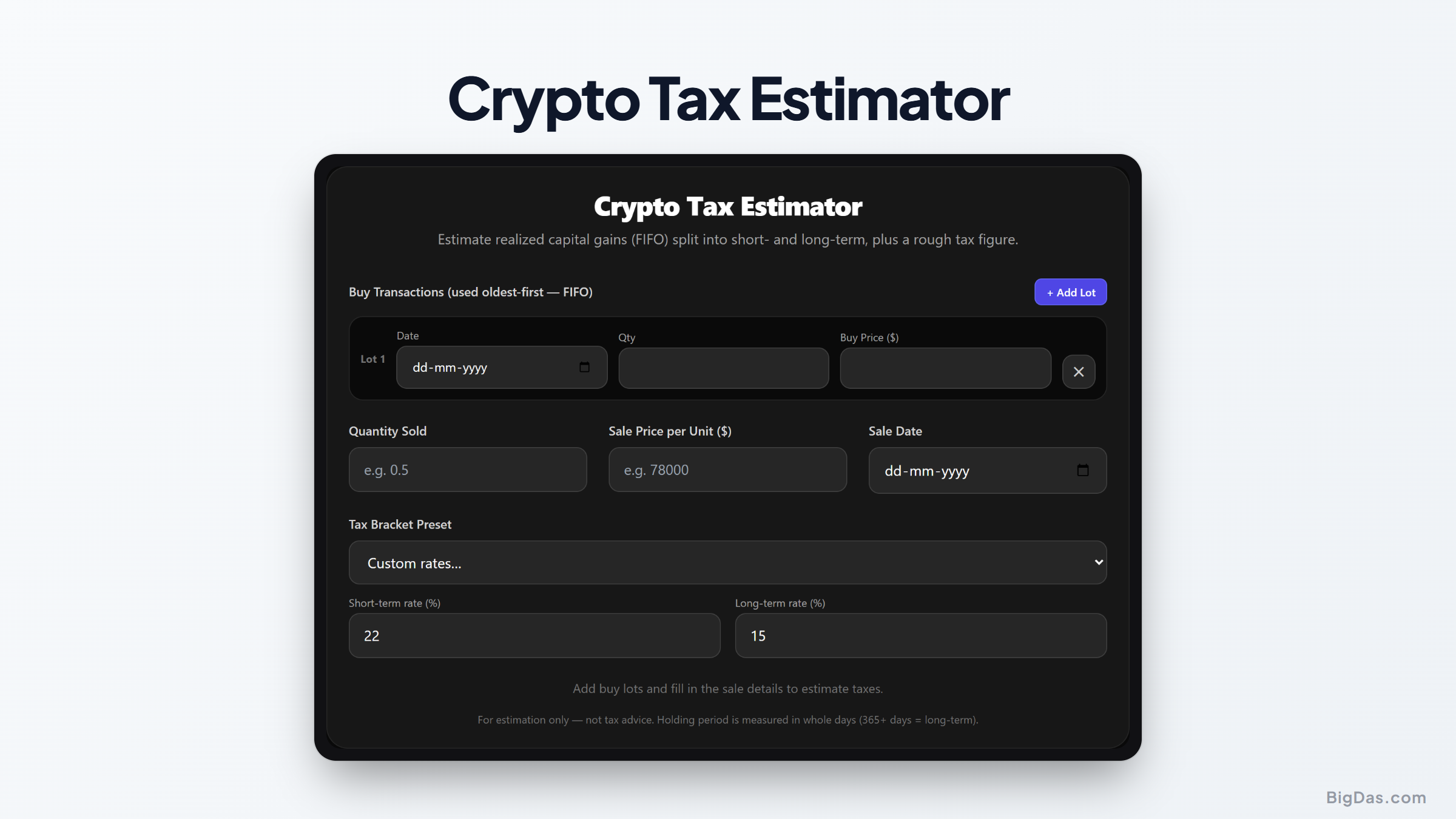
 Generated infographic and interface snapshot for Crypto Tax Estimator
Crypto Tax Estimator: How to Calculate Capital Gains and FIFO Cost Basis
Navigating tax obligations for cryptocurrency transactions can quickly become complicated. Unlike traditional fiat currency, tax authorities such as the Internal Revenue Service treat digital assets as property. Every time you sell Bitcoin, trade one token for another, or convert cryptocurrency back into cash, you trigger a taxable event. Determining exactly how much tax you owe requires tracking your acquisition costs, holding periods, and local tax brackets. Calculating realized gains manually across multiple transactions often leads to confusion. A single error in calculating your cost basis can mean overpaying on your return or underreporting profits and facing penalties. The Crypto Tax Estimator provides a clear, accurate, and simple way to model your taxable events. By using the First In First Out inventory method alongside current United States tax bracket standards, this capital gains estimator takes the friction out of tax planning.
What is the Crypto Tax Estimator?
The Crypto Tax Estimator is an interactive web tool built to help investors calculate profit and tax liabilities resulting from digital asset transactions. Operating as a streamlined crypto tax calculator, it evaluates your transaction history to determine realized capital gains or losses. When you purchase cryptocurrency at varying prices over time, calculating the precise profit on a later sale requires a specific accounting rule. This tool applies the First In First Out approach, commonly referred to as the FIFO cost basis method. Under FIFO accounting, the assets you bought first are considered the assets you sell first. Beyond calculating total net profit, the tool breaks down your earnings into two distinct categories: short term capital gains and long term capital gains. It then cross references these figures against United States federal income tax bracket presets. This provides an instant, realistic view of potential tax liabilities without requiring you to share sensitive personal details or connect private exchange accounts. Note: This tool is designed strictly for estimation and educational purposes. It does not constitute formal financial, accounting, or legal advice.
Key Features and Benefits
To manage cryptocurrency taxes effectively, you need accurate calculations paired with practical context. The Crypto Tax Estimator combines essential accounting mechanics into a straightforward dashboard.
1. Accurate FIFO Cost Basis Calculation
The IRS default accounting method for cryptocurrency transactions is First In First Out. The tool applies strict FIFO logic to align your buy orders with your sell orders. This guarantees that your calculated cost basis reflects standard regulatory expectations, giving you a accurate baseline for tax season.
2. Automatic Short Term vs Long Term Split
Holding duration directly dictates your tax rate in the United States. * Short Term Capital Gains: Assets held for 365 days or fewer are taxed at standard individual income tax rates.
- Long Term Capital Gains: Assets held for 366 days or longer qualify for reduced capital gains tax rates. The tool analyzes acquisition dates alongside sale dates, automatically categorizing gains into their proper tax buckets so you do not have to split them manually.
3. Integrated US Federal Tax Bracket Presets
Calculating net profit is only half the battle. You also need to know how much cash to reserve for tax day. The tool incorporates United States tax bracket presets, allowing you to select your single, joint, or head of household filing status along with your estimated income range. It then applies the matching federal tax rates directly to your realized gain.
4. Direct Realized Gain Calculator Mechanics
By subtracting your purchase fees and baseline cost basis from gross sale proceeds, the tool works as a robust realized gain calculator. It isolates true profit from original capital invested, ensuring that you only estimate taxes on net gains.
5. Privacy First Architecture
Security is paramount in the crypto ecosystem. This estimator operates entirely inside your web browser. You do not need to connect web3 wallets, upload API keys, or input private financial credentials. You maintain full control over your data at all times.
Step by Step Guide on How to Use the Estimator
Using this crypto tax calculator requires only a few basic details from your trade records. Follow this simple process to estimate your capital gains.
Step 1: Gather Transaction Records
Collect your buy and sell transaction history for the specific asset you want to calculate. Note down:
The date you purchased the asset
The original purchase price per unit, including exchange fees
The date you sold or traded the asset
The final sale price per unit, minus selling fees
Step 2: Enter Purchase Details
Input your initial buy orders into the calculator field. If you purchased Bitcoin at multiple prices over time, enter each lot sequentially. The tool uses these entries to build your baseline FIFO cost basis profile.
Step 3: Enter Sale Information
Input the details of the asset sale. Specify the total units sold, the sale price, and the date the transaction was finalized.
Step 4: Select Your Filing Status and Income Bracket
Choose your filing status from the preset menu (Single, Married Filing Jointly, Married Filing Separately, or Head of Household). Select your estimated annual income bracket. This ensures the tool applies the correct tax percentage to short term income and long term investment returns.
Step 5: Review the Estimated Results
The tool will generate a comprehensive overview detailing:
Total gross proceeds
Total FIFO cost basis
Net realized capital gain or loss
Separation of short term gains versus long term gains
Estimated federal tax liability owed
Why You Need This Tool: Primary Use Cases
Whether you trade active altcoins daily or simply accumulate assets over time, tracking tax liabilities should happen throughout the year, not just in April.
Scenario A: Planning a Sale Before Executing
Imagine you bought Bitcoin in early 2021 and accumulated more in mid 2023. You want to sell one full coin today to cover a real estate down payment. Using this tool as a dedicated Bitcoin tax calculator lets you run scenario analyses. You can test how selling a specific amount affects your long term tax liabilities versus short term rates before committing to the transaction on an exchange.
Scenario B: Avoiding Tax Season Surprises
Many investors trade heavily during market rallies without setting funds aside for taxes. By using the tool after major profit taking events, you can calculate your approximate tax burden immediately. This allows you to hold back the necessary cash in a yield savings account, avoiding a sudden liquidity shortage when tax returns are due.
Scenario C: Tax Loss Harvesting Analysis
If the market undergoes a correction, you may want to realize losses deliberately to offset capital gains realized earlier in the year. Inputting depreciated assets into the tool helps you see how much total realized gain you can eliminate by closing out underperforming positions.
Frequently Asked Questions
What is FIFO cost basis and why does it matter?
FIFO stands for First In First Out. It is an accounting methodology that assumes the first assets you bought are the first ones you sell. For crypto tax reporting, establishing an established cost basis strategy is required by regulatory bodies. FIFO is the standard baseline method required by the IRS unless specific lot identification criteria are satisfied.
How are short term capital gains taxed compared to long term gains?
Short term capital gains apply to assets held for one year or less. These gains are treated as ordinary personal income and taxed at standard rates ranging from 10 percent to 37 percent based on your income bracket. Long term capital gains apply to assets held for longer than one year and benefit from reduced preferential tax rates of 0 percent, 15 percent, or 20 percent.
Does this tool account for state income taxes?
This tool calculates tax estimations based on United States federal tax brackets and general capital gains rules. State income tax rates vary significantly, ranging from 0 percent in states like Texas and Florida to over 10 percent in states like California. You should account for state tax requirements separately based on where you reside.
Can I use this calculator for crypto to crypto trades?
Yes. Exchanging one cryptocurrency directly for another (for instance, trading Bitcoin for Ethereum) is a taxable event under United States tax rules. You must treat the exchange as a sale of the original asset at its fair market value at the time of the swap, followed by an immediate purchase of the new asset.
Does using this tool replace the need for a CPA?
No. This Crypto Tax Estimator is a helpful strategic tool for modeling liabilities, tracking cost basis logic, and planning trades. However, tax laws constantly change, and individual financial situations differ. Always review your final tax filings with a licensed CPA or qualified tax professional.
Practical Takeaways for Managing Crypto Taxes
To wrap up, maintaining control over your crypto tax obligations requires proactive calculation rather than last minute guessing. Using a structured capital gains estimator allows you to calculate your FIFO cost basis, categorize profits into short term and long term buckets, and project estimated federal liabilities in real time. Incorporating these estimates into your ongoing financial strategy ensures you keep accurate records, preserve capital, and enter tax season with absolute clarity.