Crypto Unit Converter
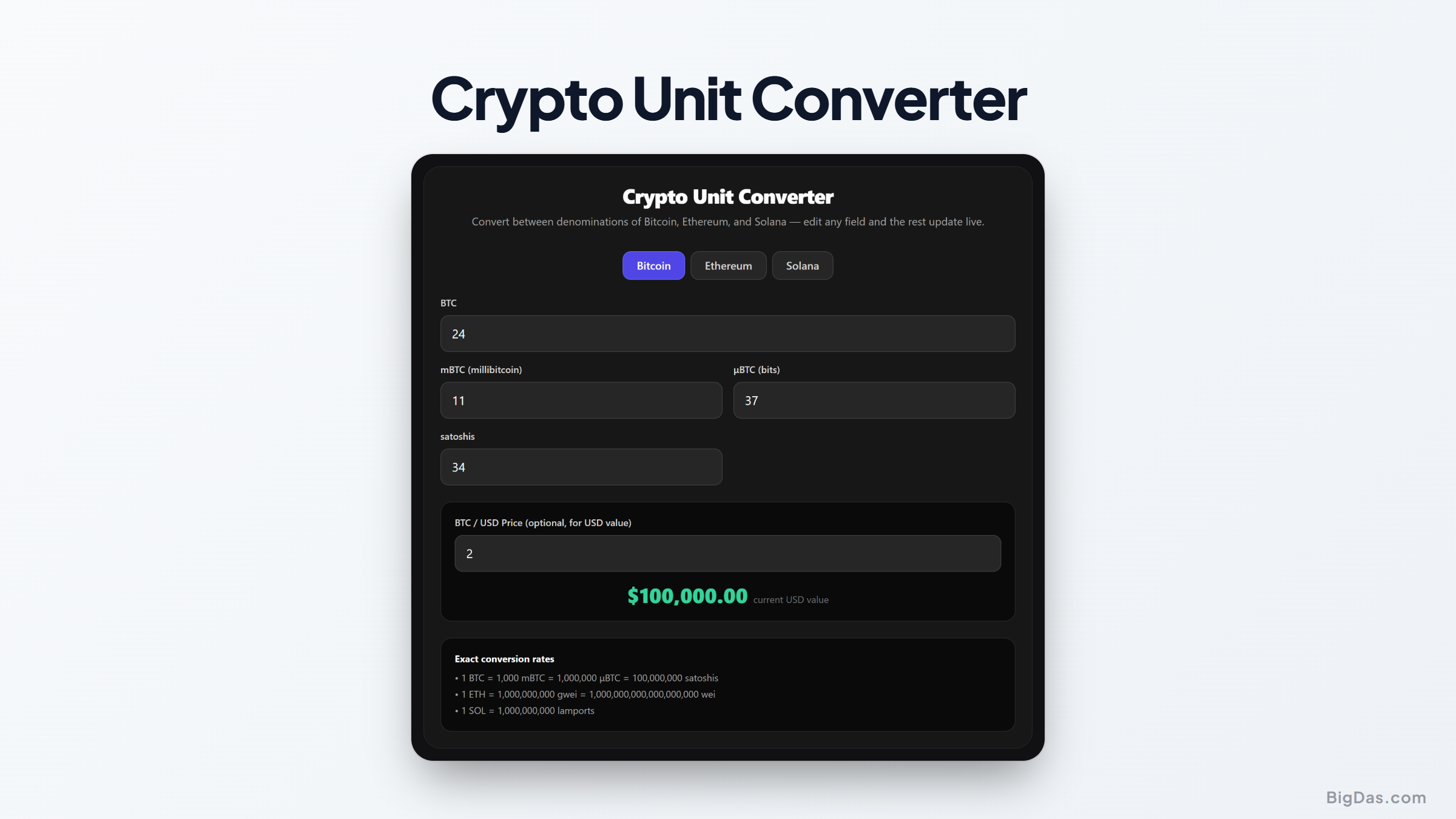
 Generated infographic and interface snapshot for Crypto Unit Converter
Crypto Unit Converter: Calculate BTC to Satoshi, Wei to ETH, and Lamports Instantly
Navigating cryptocurrency transactions often requires handling numbers across vastly different orders of magnitude. Standard accounting software uses two decimal places, but public decentralized ledgers require far higher mathematical precision. Bitcoin divides into tens of millions of smaller fractions. Ethereum measures gas fees in sub units that reach up to eighteen decimal places. Solana uses granular base amounts to process micro fractions of a cent in network fees. When preparing a smart contract interaction, configuring node parameters, or issuing micro payments on secondary networks, calculating conversions between native protocol units manually introduces significant risk. A misplaced zero in a gas calculation can cause transactions to fail or waste money on unnecessary fees. A dedicated crypto unit converter solves this operational hurdle by executing exact mathematical calculations across various units of protocol measurement. Whether you need to run a satoshi converter query to compute micro Bitcoin balances, calculate wei to eth values for EVM transactions, use a gwei calculator to estimate gas fees, or convert lamports to sol for Solana log analysis, exact tools keep your calculations fast and error free.
What is Crypto Unit Converter?
The Crypto Unit Converter is a precision utility engineered for crypto developers, traders, liquidity providers, and everyday blockchain users. Instead of requiring users to manually count long strings of zeros or rely on basic calculators that round off figures, this engine translates native protocol units using exact integer powers of ten. Blockchains do not natively process fractional numbers inside their core execution environments. Instead, underlying protocol code tracks whole integers using the smallest denomination of the native token. For instance, the Bitcoin ledger tracks satoshis, the Ethereum Virtual Machine records state changes in wei, and the Solana runtime operates strictly on lamports. This converter bridges the gap between low level protocol data and human readable balance displays. By selecting your network, entering an amount in any field, and providing a real time market price, you obtain instant conversions across all related protocol denominations along with estimated fiat values in United States Dollars.
Key Features and Benefits
Absolute Mathematical Precision
Standard web calculators often drop trailing decimal points or round off large figures due to standard computing floating point limitations. JavaScript numbers, for example, lose precision past fifteen decimal places, which creates inaccuracies when handling Ethereum values that extend to eighteen decimal places. This tool calculates exact conversion steps across all magnitudes without precision loss.
Multi Protocol Support
Switch seamlessly between Bitcoin, Ethereum, and Solana networks within a single unified interface. You do not need to keep multiple tabs open or memorize the decimal scales for different networks.
Integrated Gwei Calculator
Gas prices on the Ethereum network fluctuate constantly based on block space demand. Evaluating gas fees in Gwei allows users to configure transaction parameters accurately without overpaying network validators or setting fees too low.
Instant Fiat Value Estimation
Tracking raw protocol units makes it challenging to understand actual real world transaction costs. Entering a live price figure converts satoshis, gwei amounts, or lamports directly into equivalent USD values.
Bi Directional Calculations
The converter updates dynamically regardless of where you enter your numbers. Type a decimal fraction into the base token field, or enter billions of base units into the sub unit field, and every corresponding metric updates instantly.
Step by Step Guide on How to Use It
Step 1: Select Your Network
Choose the cryptocurrency network relevant to your current activity. Select Bitcoin for Bitcoin mainnet or secondary network payments, Ethereum for EVM smart contracts and gas fees, or Solana for high throughput program accounts.
Step 2: Enter Your Input Figure
Type your value into whichever unit field you currently possess. If you are reading gas costs from an EVM block explorer, enter the number into the Gwei or Wei field. If you are working with wallet balance statements, type directly into the primary token field.
Step 3: Review Converted Network Units
The calculation engine automatically computes and displays matching values across all network denominations. For Bitcoin, you will see BTC, mBTC, and Satoshis. For Ethereum, you will see ETH, Gwei, and Wei. For Solana, you will see SOL and Lamports.
Step 4: Include Market Price for USD Estimates
Enter the current token market price in the live price field. The tool instantly multiplies your converted protocol amounts by the fiat exchange rate to show exact monetary value across every unit level.
Why You Need This Tool: Primary Use Cases
Smart Contract
Development and Execution Developers writing Solidity code interact with smart contract interfaces that demand input values denominated in Wei. Passing a standard ETH decimal float to a smart contract method can break execution scripts or cause severe financial errors. Converting wei to eth through a dedicated conversion engine ensures that deployment scripts carry accurate funding parameters every time.
Micro
Transactions and Lightning Network Operations Bitcoin stackers and users of layer two payment rails like the Lightning Network frequently manage values measured in thousands or millions of satoshis. Running a quick btc to satoshi check eliminates confusion when generating invoices or auditing channel liquidity balances.
Solana CLI
Commands and Program Verification Building applications on Solana requires reading system program logs and terminal outputs that report rent balances and account transfers in lamports. Converting lamports to sol allows developers to audit account states, verify transaction fee allocations, and manage program storage fees efficiently.
Independent Gas Fee Analysis
Wallet software often hides underlying gas fee estimations behind simplistic presets like low, medium, or high. Utilizing an independent gwei calculator enables traders to verify raw gas rates against live network congestion before submitting high value swaps or non fungible token mints.
FAQ Section
How many satoshis are in one Bitcoin?
There are exactly 100,000,000 (one hundred million) satoshis in a single Bitcoin. Named after Bitcoin founder Satoshi Nakamoto, a satoshi is the smallest base unit recorded on the primary Bitcoin blockchain.
What is the mathematical relationship between Wei, Gwei, and ETH?
Wei represents the smallest base unit on Ethereum. One ETH contains 1,000,000,000,000,000,000 (10 to the 18th power) Wei. Gwei, short for Giga Wei, equals 1,000,000,000 (10 to the 9th power) Wei. Network gas costs are expressed in Gwei because it provides a clear whole number representation rather than requiring users to read billions of Wei or microscopic fractions of ETH.
What is a
Lamport on the Solana network?
A lamport is the smallest unit of value on the Solana protocol, named in honor of computer scientist Leslie Lamport. One SOL contains 1,000,000,000 (one billion) lamports.
Why do blockchains use small base units instead of standard decimals?
Computers handle integer math far more efficiently and securely than fractional floating point arithmetic. By storing all internal balances as whole integers of base units like satoshis, wei, or lamports, blockchain nodes prevent rounding errors that could disrupt balance consensus across thousands of independent nodes.
Can I convert fractional
Gwei or fractional Satoshis?
While protocol ledgers do not store fractional base units on layer one, off chain networks like the Lightning Network utilize milli satoshis for routing accounting. This converter allows inputs across standard integer power tiers to satisfy both layer one and layer two tracking requirements.
Summing Up
Working with digital assets across multiple blockchain networks requires absolute numerical accuracy. Attempting to convert deep sub units like wei, gwei, satoshis, or lamports manually creates unnecessary exposure to calculation mistakes. Utilizing a precise, real time crypto unit converter ensures that developers, traders, and everyday network participants can verify transaction inputs, evaluate network fees, and manage balance records with total peace of mind.