dBm to Watts & Volts Converter
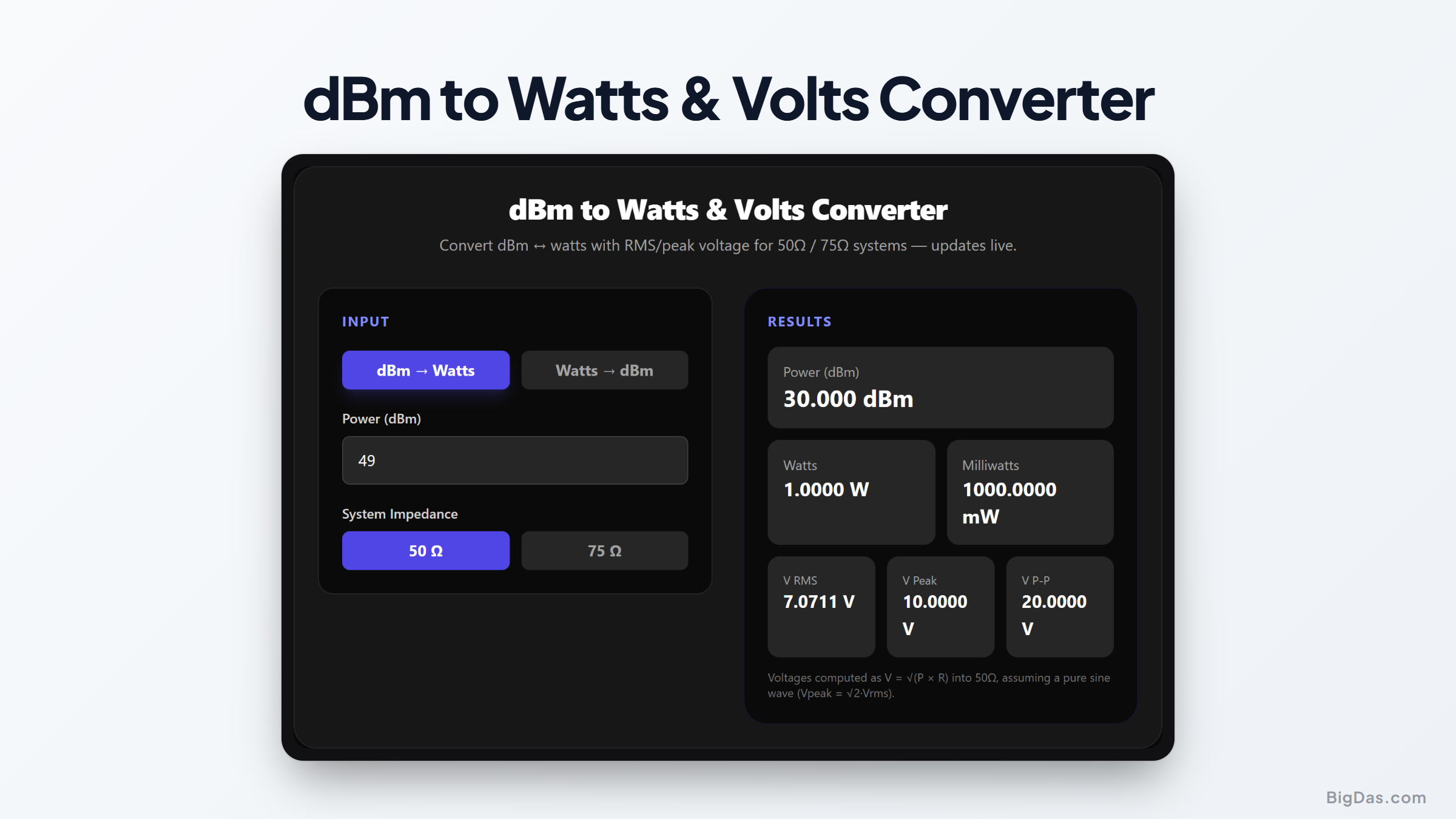
 Generated infographic and interface snapshot for dBm to Watts & Volts Converter
Instantly convert RF power levels between dBm, watts, and RMS/peak voltage.
Free dBm to Watts & Volts Converter Online — Big Das
Whether you are setting up a radio transmitter, troubleshooting a Wi-Fi amplifier, or reading a spectrum analyzer, you constantly bounce between three ways of describing signal power: dBm (logarithmic power referenced to 1 mW), watts (linear power), and volts (what your oscilloscope actually shows across a 50 Ω load). Our free dBm to Watts & Volts Converter does all three conversions at once, live as you type.
What Is dBm?
dBm is an absolute power unit on a logarithmic decibel scale, referenced to exactly 1 milliwatt. It exists because RF engineers deal with enormous dynamic ranges — a receiver can decode signals at −110 dBm while the transmitter outputs +50 dBm. On a linear scale that spans 16 orders of magnitude; in dBm it is simple mental arithmetic. Every +10 dB multiplies power by ten; every +3 dB roughly doubles it.
How to Use the Converter
- Pick a direction — choose "dBm → Watts" to find linear power and voltages from a dBm reading, or "Watts → dBm" to convert a wattage back to the log scale.
- Enter your value — type the dBm figure (negatives like −30 are fine) or a power in W, mW, or µW.
- Choose the system impedance — 50 Ω is the RF/laboratory standard; 75 Ω rules cable TV, broadcast, and video.
- Read the results panel — it shows the power in dBm, watts and milliwatts, plus the RMS, peak, and peak-to-peak voltages a sine wave of that power would develop across your chosen impedance.
The Formulas
The conversions the tool performs are:
P(mW) = 10^(P(dBm) / 10)— soP(W) = 10^((dBm − 30) / 10)P(dBm) = 10 × log10(P(mW))Vrms = √(P × R)Vpeak = Vrms × √2andVpp = 2 × Vpeak(pure sine wave)
Worked Examples
- +30 dBm into 50 Ω: P = 10^0 = 1 W. Vrms = √(1 × 50) ≈ 7.07 V; Vpeak ≈ 10 V; Vpp ≈ 20 V.
- 0 dBm into 50 Ω: exactly 1 mW, Vrms = √(0.001 × 50) ≈ 0.224 V — the level you see at a healthy receiver antenna input.
- *A 100 W FM rig in a 75 Ω feeder:
- 100 W = 50 dBm, Vrms = √(100 × 75) ≈ 86.6 V.
- **−90 dBm sensitivity limit:*
- 1 pW (10⁻⁹ W) — into 50 Ω that is just (0.001 · 10⁻⁹ · 50)½ ≈ 7.07 µV RMS.
Common Use Cases
Comparing transmitter power specs stated in dBm with regulatory limits stated in watts or ERP.
Setting oscilloscope expectations: converting a generator's dBm output to the volts your 50 Ω-terminated probe will actually show.
Link-budget verification for Wi-Fi, LoRa, and cellular equipment.
Checking safe voltage ratings on attenuators, couplers, and dummy loads during amplifier testing.
Frequently Asked Questions
Why is voltage different for 50 Ω and 75 Ω at the same power?
Because power and voltage are linked through impedance: V = √(P × R). The higher the impedance, the more voltage (and less current) the same power produces. A watt into 75 Ω develops √(75) ≈ 8.66 V RMS versus 7.07 V into 50 Ω.
Can dBm be negative?
Yes — negative dBm simply means the power is below 1 mW. −30 dBm is 1 µW; −90 dBm is 1 pW. Smaller signals just get more negative.
What is the difference between
Vpeak and Vpp?
Vpeak measures the maximum excursion from 0 V to the top of the sine wave. Vpp (peak-to-peak) measures the full swing from negative peak to positive peak, which is exactly twice Vpeak for a symmetric sine wave — it is what oscilloscopes usually display.
Does the voltage result account for VSWR or cable loss?
No. It assumes a perfectly matched load and a lossless path, plus zero cable resistance. Real systems with impedance mismatch create standing waves that produce local voltages higher than the computed value.
Is this calculator accurate for non-sine waveforms?
The power conversions (dBm ↔ watts) are waveform-independent. The Vpeak and Vpp outputs assume a pure sine wave; for square or modulated signals, use the RMS voltage figure and apply the waveform's crest factor separately.