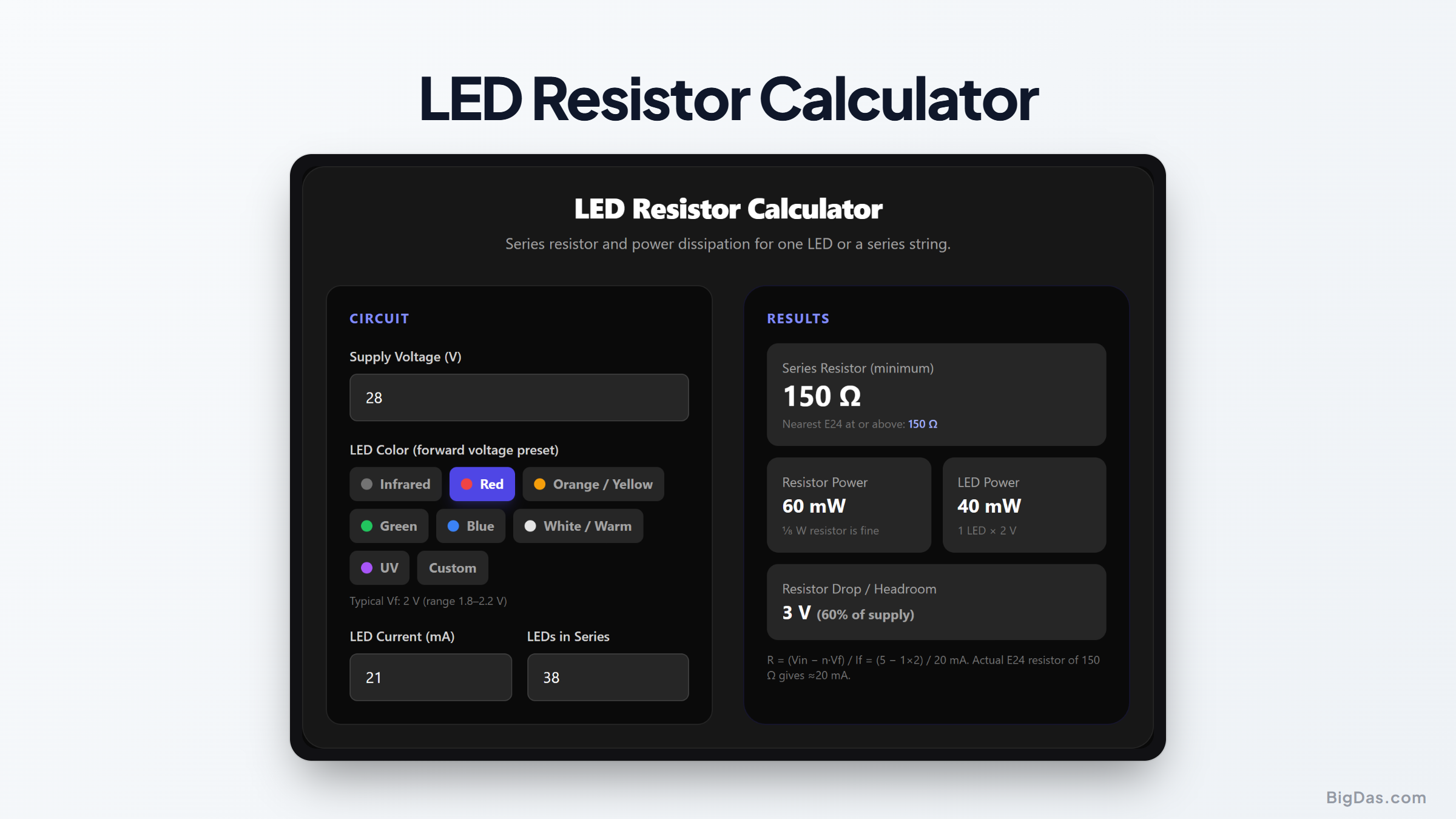
LED Resistor Calculator
 Generated infographic and interface snapshot for LED Resistor Calculator
The right series resistor for any LED, every time.
Free LED Resistor Calculator Online — Big Das
LEDs are unforgiving about current. Feed them straight from a battery or GPIO pin and they blow — or slowly cook — because an LED barely limits its own current. A single series resistor fixes that, as long as you know the supply voltage, the LED's forward voltage, and the current you want to run.
The Big Das LED Resistor Calculator computes the minimum series resistance, recommends the nearest standard E24 value, and shows the power dissipated in both the resistor and the LED — for a single LED or a whole series string.
What Is an LED Series Resistor?
An LED series resistor sits between the supply and the LED to set the operating current. An LED behaves roughly like a fixed voltage drop once conducting: everything the supply provides above that drop appears across the resistor, and Ohm's law turns that voltage into current.
Without the resistor, the LED current climbs exponentially with voltage and the junction overheats within seconds. With the right resistor, the same LED can run for a hundred thousand hours.
Forward
Voltage by Color
Forward voltage (Vf) mostly depends on the semiconductor, which is what sets the color:
- Infrared / red: ~1.2–2.2 V — the oldest and lowest-Vf chemistry.
- Yellow / green: ~2.0–3.2 V depending on modern vs. standard types.
- Blue / white / UV: ~3.0–4.0 V — white LEDs are blue dies with phosphor.
Pick a preset in the tool and the typical Vf is applied automatically; use Custom for a datasheet value.
How to Use the LED Resistor Calculator
- Enter your supply voltage — e.g. 5 V from USB or an Arduino pin, 9 V from a battery, 12 V from a supply rail.
- Pick the LED color preset or switch to Custom and type the forward voltage from your datasheet.
- Enter the desired current in mA — 20 mA is the classic indicator LED rating; high-brightness parts often take 10–30 mA.
- Enter the number of LEDs in series — leave at 1 for a single LED.
- Read the results — the minimum resistance, the nearest E24 value, resistor power with a wattage-rating recommendation, and the headroom check.
The Formulas Used
- Series resistor:
R = (Vin − n × Vf) / If - Resistor power:
P_R = (Vin − n × Vf) × If - LED power:
P_LED = n × Vf × If
For multiple LEDs, the drops add in series, so the resistor only has to absorb Vin − n·Vf.
Worked Example
Driving a red LED (Vf ≈ 2 V) from a 5 V USB supply at 20 mA:
R = (5 − 2) / 0.020 = 150 Ω
The nearest E24 value at or above is 150 Ω exactly — a perfect hit.
Resistor power = 3 V × 20 mA = 60 mW — a standard ⅛ W or ¼ W part is plenty.
A trickier case: three white LEDs (3.2 V each) from a 9 V battery. Total Vf = 9.6 V > 9 V, so the supply cannot drive the string — the tool flags this immediately. Run them in parallel pairs or switch to 12 V.
Common Use Cases
- Arduino / Raspberry Pi indicators: series resistor for GPIO-driven LEDs.
- Panel lights and status LEDs: sizing resistors for 12 V / 24 V panels.
- LED strips and arrays: checking that series groups actually fit the supply.
- Brightness control: raising or lowering the resistor value trades brightness for lifetime.
- Current limiting on batteries: LED flashlights and battery testers.
Frequently Asked Questions
What happens if my supply is lower than the forward voltage?
The LED simply will not light — there is no voltage left across the resistor. The tool shows an error when Vin ≤ n·Vf so you can adjust the supply or the number of LEDs.
Why does the tool recommend the nearest E24 value at-or-above?
Choosing a standard value slightly above the calculated minimum underruns the LED a touch, sacrificing almost no brightness while protecting the junction. Rounding down would push above your target current.
Can I run LEDs in parallel with one resistor?
You can, but it is poor practice: slight Vf differences between LEDs unbalance the current, and the brightest LED hogs the current and dies first. Give each parallel branch its own resistor.
How much power does the resistor waste?
Exactly (Vin − n·Vf) × If. For a 12 V supply and a single 2 V red LED at 20 mA, that's 200 mW — you need at least a ¼ W resistor. The tool computes this and suggests a wattage class.
Is 20 mA always the right current?
Not necessarily. Modern high-efficiency LEDs are bright at 2–5 mA, and battery projects benefit from running at 1–10 mA. Check the datasheet — and remember perceived brightness doesn't double with double current.
My LED flickers or is dim with the calculated resistor — why?
Check supply sag under load, a higher-than-typical Vf for your specific LED (datasheets give ranges), and cold solder joints. If headroom is under 10%, small variations have outsized effects — the tool warns when that's the case.