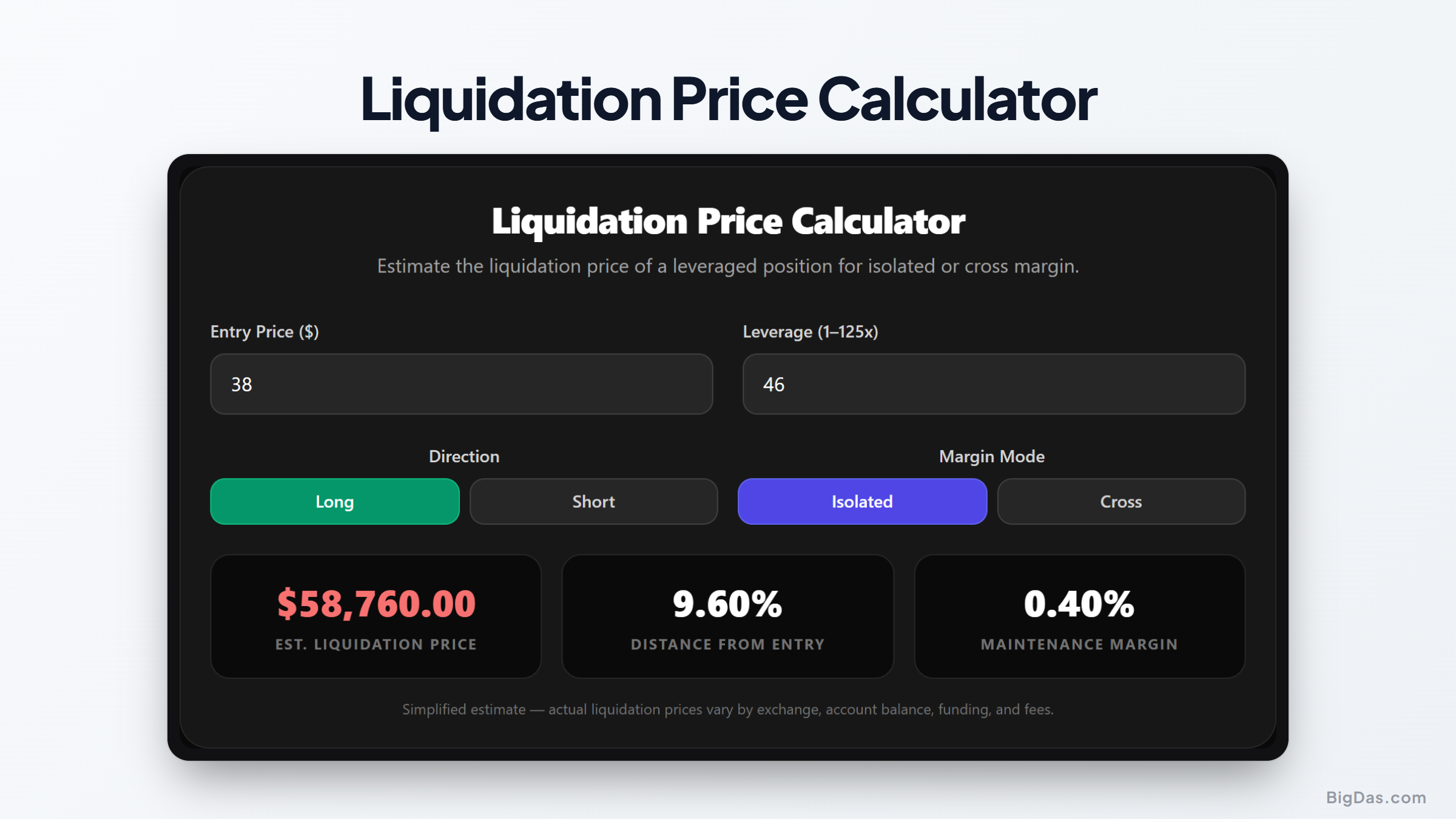
Liquidation Price Calculator
 Generated infographic and interface snapshot for Liquidation Price Calculator
Liquidation Price Calculator: Calculate Risk and Margin Levels in Perpetual Futures
Leveraged trading in crypto perpetual futures offers market participants the capability to open large trading positions with a fraction of total capital as collateral. While leverage increases buying power, it equally shrinks the margin for error. A minor market move against your position can wipe out your margin balance, triggering a forced liquidation. Understanding the precise threshold where an exchange will forcibly close your position is critical before submitting any order. A liquidation price calculator eliminates guesswork by computing the exact price level at which your open position will be liquidated, along with the percentage distance from your entry price. Whether you are opening a long position expecting prices to rise or a short position anticipating a decline, calculating your risk parameters ensures you protect your trading capital against sudden price moves.
What is a Liquidation Price Calculator?
A liquidation price calculator is an essential financial tool designed to determine the precise price point at which a leveraged derivatives trade gets closed by an exchange risk management system. In markets like perpetual futures, exchanges mandate that traders maintain a baseline level of capital relative to position size, known as the maintenance margin rate. When asset prices move in an adverse direction, your account equity drops. If equity drops to the maintenance margin level, the exchange automatically liquidates your contract to prevent your account balance from turning negative. The calculator operates across two distinct margin modes:
Isolated Margin Mode
In isolated margin mode, collateral is strictly allocated to an individual position. If market movements trigger a leveraged position liquidation, losses are contained strictly to the margin assigned to that specific trade. The rest of your account balance remains untouched. The calculator measures the assigned margin, entry price, contract size, and maintenance rate to establish the cutoff price.
Cross Margin Mode
In cross margin mode, your entire available account balance acts as collateral across all open trades. This setup can shift your liquidation price further away from your entry price because your total portfolio equity supports the trade. However, if market movements reach the calculated liquidation threshold, your entire account balance is at risk of being wiped out. By inputting your entry parameters into the calculator, you get an immediate calculation of your liquidation threshold alongside the exact percentage move required for the price to reach that critical zone.
Key Features and Benefits
Calculating forced exit points manually involves complex formulas, variable maintenance margin tiers, and exchange fee schedules. Using an automated calculator offers distinct technical advantages: * Precise Percentage Distance Calculation: Knowing the exact liquidation price is valuable, but knowing the distance from entry in percentage terms is far more actionable. For example, if your liquidation price sits just 3% away from your entry point in a high volatility asset, normal intraday price swings could force a liquidation before your trade thesis plays out.
- Support for Both Long and Short Positions: Long positions require price levels to stay above a lower liquidation floor, whereas short positions face liquidation when prices rise above an upper liquidation ceiling. The calculator handles both directions accurately, factoring in appropriate leverage multipliers.
- Dual Evaluation for Isolated and Cross Margin: Traders often struggle to visualize how shifting between isolated margin and cross margin alters their total risk profile. By calculating outcomes under both structures, you can select the margin style that aligns best with your overall portfolio management plan.
- Maintenance Margin Buffer Integration: Exchanges apply specific maintenance rates based on position size tiers. High leverage positions require higher relative maintenance buffers. The calculator builds these rules into its underlying math, delivering results that closely mirror real exchange engine behavior.
- Effective Position Sizing and Stress Testing: Before placing orders on an exchange order book, you can model different leverage levels, such as 5x, 10x, or 20x, to observe how increased leverage brings your liquidation price closer to your entry point.
Step by Step Guide on How to Use It
Using a liquidation price calculator requires just a few key parameters from your proposed or active trade setup. Here is how to complete the process:
1. Select Your Position Direction
Indicate whether you are taking a long position (buying with the expectation that the asset value will increase) or a short position (selling with the expectation that the asset value will decrease).
2. Choose Your Margin Mode
Select either isolated margin or cross margin. Choose isolated margin if you want to bound risk to a single dedicated collateral pool. Choose cross margin if you want your full wallet balance to back the position.
3. Enter Your Entry Price
Input the price at which you plan to enter the position or your filled average entry price in perpetual futures contracts.
4. Set Your Leverage Multiplier
Enter the leverage multiplier you plan to use, such as 2x, 5x, 10x, 25x, or 50x. Remember that higher leverage lowers the required initial margin but significantly moves the liquidation price closer to entry.
5. Enter Margin Balance and Position Size
Provide the exact collateral amount allocated to the position alongside total position size in contract terms or base currency. For cross margin mode, include your total available account balance.
6. Analyze the Generated Metrics
Review the output values provided by the tool:
Estimated Liquidation Price: The exact numerical asset price at which forced liquidation occurs.
Distance From Entry in Percent: The exact percentage drop or rise needed to reach liquidation.
Required Maintenance Margin: The minimal threshold equity required to keep the position open.
Why You Need This Tool: Practical Use Cases
Strategic Stop Loss Placement
A common mistake among crypto derivatives traders is placing stop loss orders at arbitrary levels without knowing where forced liquidation sits. If your stop loss order is set below your liquidation price on a long position, the exchange risk engine will liquidate your position before your stop order can execute, subjecting you to additional liquidation clearance fees. Using a calculator allows you to position your stop loss well ahead of the forced liquidation point.
Evaluating Volatility Buffers
Different assets move with varying levels of price volatility. A 10% price move in a major cryptocurrency might take several days, while in smaller altcoins it can occur within minutes. By checking the distance from entry in percentage terms, you can determine if your leverage multiplier gives the trade enough breathing room to absorb expected price fluctuations.
Understanding Cross Margin Liquidation Cascades
Cross margin can give a false impression of safety because the displayed liquidation price appears very distant. However, if you hold multiple cross margin positions simultaneously, adverse moves across several assets consume your shared account balance rapidly. Using the calculator for cross margin trades helps you assess how much of your total account value is exposed to a worst case scenario.
Avoiding Forced Liquidation Penalties
Exchanges charge higher fee rates on forced liquidations compared to standard market or limit orders because the system must pass your position to an insurance fund or auto deleveraging system. By identifying your liquidation price in advance, you can manually close positions or add margin before the exchange engine triggers an automated liquidation.
Frequently Asked Questions
What causes a leveraged position liquidation in perpetual futures?
A forced liquidation happens when asset prices move against a position to a degree where position margin equity falls below the exchange maintenance margin requirement. At that point, the trading system automatically liquidates the trade to cover theoretical losses and avoid account insolvency.
How does isolated margin differ from cross margin regarding forced exits?
In isolated margin mode, risk is confined to the specific capital assigned to that individual trade. If liquidation occurs, only that assigned collateral is lost. In cross margin mode, the system uses your entire account balance as collateral to maintain the trade. While this pushes the liquidation price further away, reaching that liquidation price can wipe out your entire account balance.
Why does the calculated liquidation price differ slightly from exchange displays?
Exchanges utilize a mark price system derived from index prices across multiple trading venues rather than relying solely on the last traded price. This prevents temporary order book manipulation from causing unwarranted liquidations. Small differences can also result from funding fee payments accrued over time or tiered maintenance margin schedules applied by specific exchanges.
Can liquidation occur before reaching the exact liquidation price?
Yes, liquidation can occur early if market conditions trigger high funding fee payments that deduct collateral directly from your position margin. Additionally, during extreme market volatility, rapid price gaps can cause mark prices to slip past theoretical thresholds faster than order books can adjust.
Protecting Your Capital with Precision
To trade perpetual futures successfully over the long term, protecting capital must take priority over chasing potential profits. Leverage is a powerful mechanism, but without clear visibility into your risk boundaries, it can destroy account equity rapidly. Using a reliable liquidation price calculator gives you the exact numerical data needed to manage leverage wisely, set effective stop loss levels, and determine whether isolated margin or cross margin fits your trade design. Integrating accurate risk calculations into your daily trading process provides the clarity required to trade with confidence and consistency.