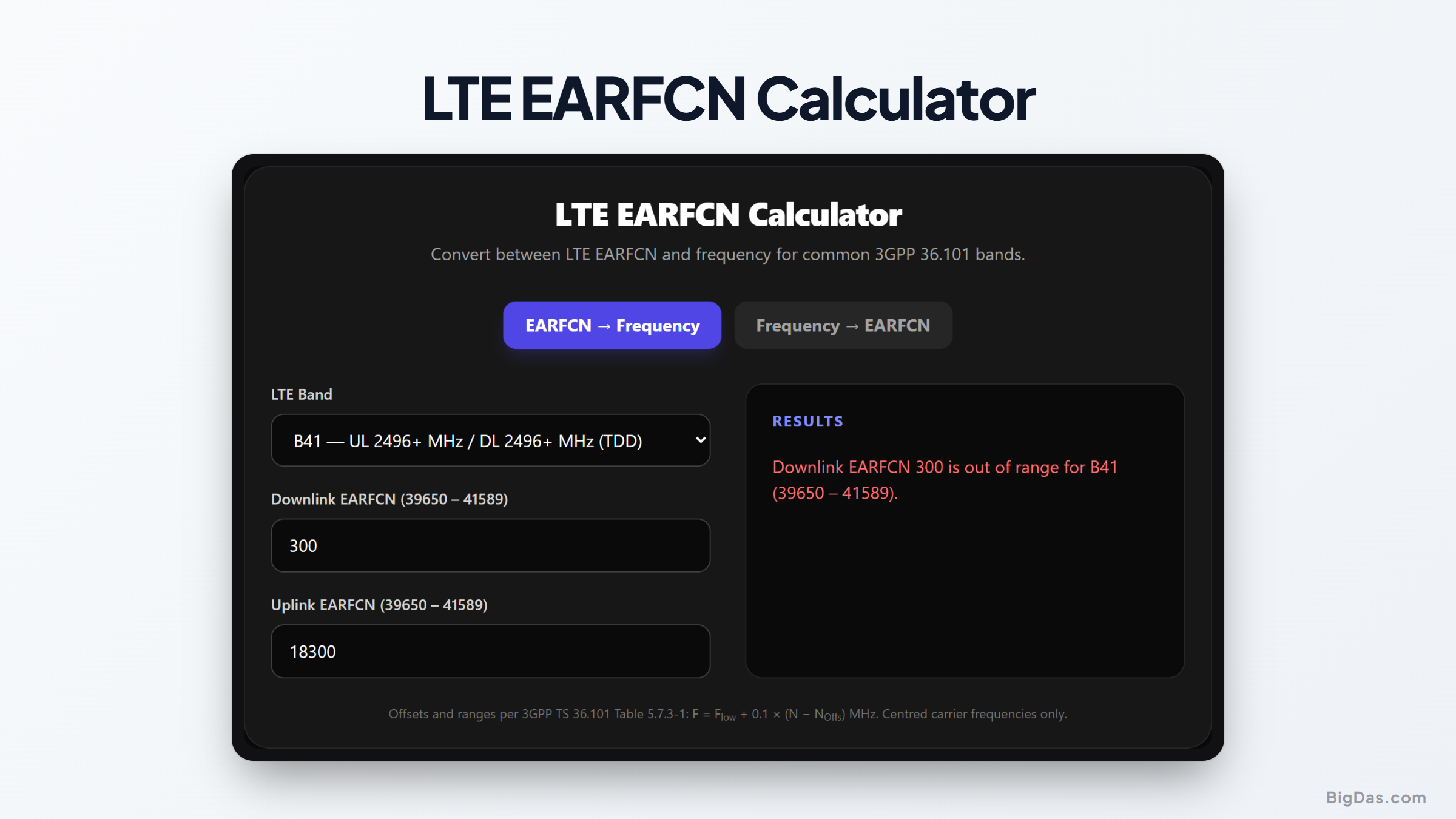
LTE EARFCN Calculator
 Generated infographic and interface snapshot for LTE EARFCN Calculator
Translate EARFCN channel numbers to real frequencies and back, per 3GPP.
Free LTE EARFCN Calculator Online — Big Das
LTE networks identify carriers with EARFCN numbers instead of raw frequencies. The Big Das LTE EARFCN Calculator converts EARFCN to uplink/downlink frequency — or detects the band from any frequency — for common bands like B1, B3, B7, B20, B28, and B41.
No spec-sheet diving: pick a band or type a frequency, and results update live.
What Is an EARFCN?
EARFCN (E-UTRA Absolute Radio Frequency Channel Number) is the integer LTE uses to label the centre frequency of a carrier. Because each band starts at a different frequency, the EARFCN space is partitioned into ranges — downlink channels live in one slice of the number space and uplink channels in another, with per-band offset values called N_Offs-DL and N_Offs-UL defined by 3GPP TS 36.101.
- *Downlink
- EARFCNs tell the phone where the base station transmits.
- *Uplink
- EARFCNs tell it where to transmit back.
- The carrier raster is 100 kHz, so every EARFCN step is 0.1 MHz.
This tool supports the most widely deployed bands: B1, B2, B3, B4, B5, B7, B8, B20, B28 (FDD) and B40, B41 (TDD).
How to Use the LTE EARFCN Calculator
- Choose a direction — «EARFCN → Frequency» or «Frequency → EARFCN».
- EARFCN → Frequency: select the LTE band, then enter the downlink and uplink EARFCN values.
- Frequency → EARFCN: type the frequency in MHz or GHz; every supported band is scanned automatically.
- Read the results — frequencies in MHz, or matching bands with their EARFCN values, appear instantly.
The Formulas Used
Downlink:  F_DL (MHz) = F_DL_low + 0.1 × (N_DL − N_Offs-DL)
Uplink:    F_UL (MHz) = F_UL_low + 0.1 × (N_UL − N_Offs-UL)

Inverse:   N = N_Offs + (F − F_low) / 0.1
where F_DL_low, F_UL_low, N_Offs-DL, and N_Offs-UL come from 3GPP TS 36.101 Tables 5.5-1 and 5.7.3-1 for each band.
Worked Example
You find EARFCN 6300 in a field-test log on Band 20 (800 MHz digital dividend):
F_DL = 791 + 0.1 × (6300 − 6150)
= 791 + 0.1 × 150
= 806 MHz
The matching uplink, EARFCN 24300:
F_UL = 832 + 0.1 × (24300 − 24150) = 847 MHz
So this is a Band 20 carrier centred at 806 MHz down / 847 MHz up — exactly what the calculator shows.
Common Use Cases
- Drive-test analysis: map logged EARFCNs to actual spectrum while investigating coverage or interference.
- Network planning: choose channel numbers when configuring eNodeBs, repeaters, or private LTE (CBRS-adjacent) systems.
- Spectrum clearing: detect which band an unknown measured carrier belongs to.
- SDR experiments: tune a software-defined radio to a carrier advertised by a cell mapper app.
Frequently Asked Questions
Why does the same EARFCN mean different frequencies on different bands?
Each band reserves its own slice of the EARFCN space with its own offset. EARFCN 300 on B1 is 2140 MHz, but B1's uplink at EARFCN 18300 is 1950 MHz. The numbers are only meaningful together with the band.
What happens if my EARFCN is out of range for the band?
Nothing is calculated — the tool flags the value against the band's official range from TS 36.101 (for example, 0–599 for B1 downlink) and shows the valid range so you can correct it.
Why is my frequency not found?
You either landed between two 100 kHz raster points (tolerance ±0.05 MHz) or on a band this calculator doesn't include. Try the nearest round value in MHz.
Are TDD bands handled differently?
Bands B40 and B41 share one range for uplink and downlink because TDD uses the same frequency in both directions; the tool lists them under both.
Does this give the channel bandwidth?
No — EARFCN encodes only the carrier centre frequency. Channel bandwidth (1.4–20 MHz) is signalled separately in SIB2.
How accurate is the conversion?
Exact. EARFCN math is integer arithmetic on the 100 kHz raster defined by 3GPP, with no approximation.