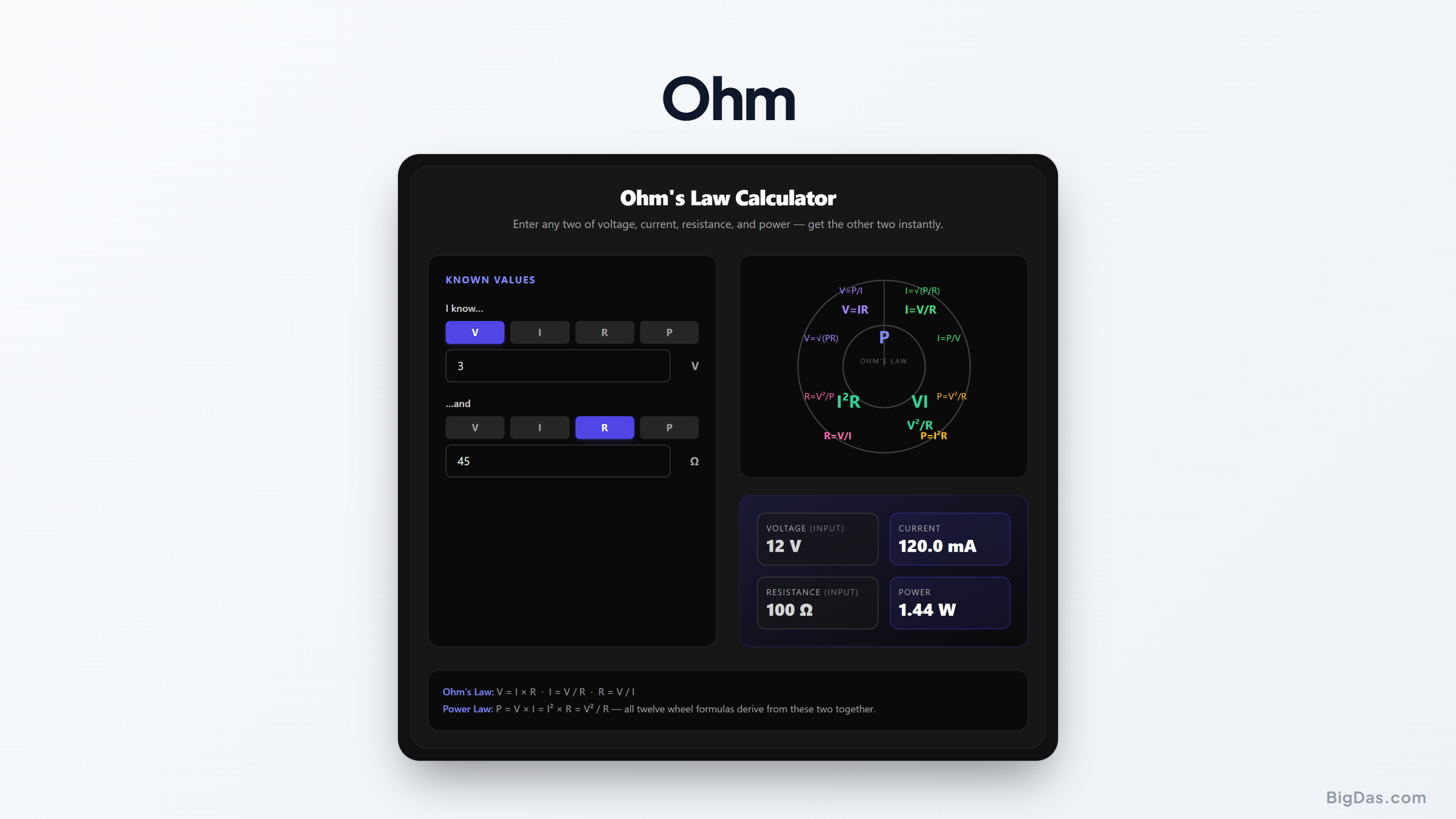
Ohm's Law Calculator
 Generated infographic and interface snapshot for Ohm's Law Calculator
Solve voltage, current, resistance, and power from any two values.
Free Ohm's Law Calculator Online — Big Das
A free Ohm's Law calculator that solves voltage, current, resistance, and power from any two known values. Instant results using V=IR and P=VI, with the full 12-equation power wheel built in.
What Is Ohm's Law?
Ohm's Law describes how voltage (V), current (I), and resistance (R) relate in a circuit: the current through a conductor is directly proportional to the voltage across it and inversely proportional to its resistance. Add the power equation, P = V × I, and the four quantities become locked together — know any two, and the other two are fixed.
This is the first equation every electronics student learns and the one working engineers reach for daily: sizing resistors, checking loads, and sanity-checking a design before anything gets powered.
The Power Wheel
Because the four quantities combine, the two base equations rearrange into exactly twelve formulas — three each for V, I, R, and P. Together they are called the power wheel, and they let you solve any quantity from whichever pair you already know.
How to Use the Ohm's Law Calculator
- Pick the two values you know — voltage, current, resistance, or power, in any combination.
- Enter the first value — for example 12 volts or 100 ohms. Plain decimal numbers are fine.
- Enter the second value — in any other quantity, even power.
- Read the results instantly — the solved voltage, current, resistance, and power display all at once.
- Tweak and explore — change any input and watch the remaining quantities update live.
The Formulas Used
The calculator applies the complete power wheel:
- Solve for voltage:
V = I × R,V = P ÷ I,V = √(P × R) - Solve for current:
I = V ÷ R,I = P ÷ V,I = √(P ÷ R) - Solve for resistance:
R = V ÷ I,R = P ÷ I²,R = V² ÷ P - Solve for power:
P = V × I,P = I² × R,P = V² ÷ R
No matter which pair you start with, everything else follows from these twelve equations.
Worked Example
Suppose a 12 V supply sits across a 100 Ω resistor:
Current:
I = V ÷ R= 12 ÷ 100 = 0.12 A (120 mA)Power:
P = V × I= 12 × 0.12 = *1.44 W
Check it with the wheel: P = V² ÷ R = 144 ÷ 100 = 1.44 W — the same answer, as it should be.
That 1.44 W matters more than the current does here: a common ¼ W resistor would cook almost instantly, and even a ½ W part is too small. You would reach for at least a 2 W resistor to keep temperatures sensible. This is exactly why current alone never tells the whole story.
Common Use Cases
- LED circuits: size the current-limiting resistor, then confirm its wattage rating.
- Power supplies: verify a supply can source the current your load actually demands.
- Fuse selection: estimate circuit current so the fuse blows before the wiring does.
- Heater and motor loads: convert nameplate volts and ohms into amps and watts.
- Learning and teaching: watch how V, I, R, and P trade off against each other in real time.
Frequently Asked Questions
What are the three forms of Ohm's Law?
V = I × R, I = V ÷ R, and R = V ÷ I. They are the same equation rearranged, so any two known quantities always determine the third — and adding P = V × I extends the set to the twelve formulas of the power wheel.
Does Ohm's
Law work for AC circuits?
Exactly, for purely resistive loads using RMS values. Once capacitors and inductors enter the picture you need impedance (Z) instead of resistance, but the same V = I × Z structure still holds.
Why did my resistor overheat when the current seemed fine?
Current is not what heats a resistor — power is, and P = I² × R climbs fast as current rises. Always check the wattage rating and leave at least a 50% safety margin, as the worked example above shows.
What is the difference between ohms, kilohms, and megohms?
Only scale: 1 kΩ = 1,000 Ω and 1 MΩ = 1,000,000 Ω. Enter values in plain units — volts, amps, ohms, watts — and let the tool handle the conversions.
Does Ohm's
Law apply to LEDs and diodes?
Not directly. Semiconductors are non-linear, so you subtract the diode's forward voltage drop first, then apply Ohm's Law to the remaining voltage across the series resistor.
Is my data sent anywhere?
No. The calculator is 100% client-side: every computation happens in your browser, and nothing you type is uploaded or stored.