Op-Amp Slew Rate Calculator
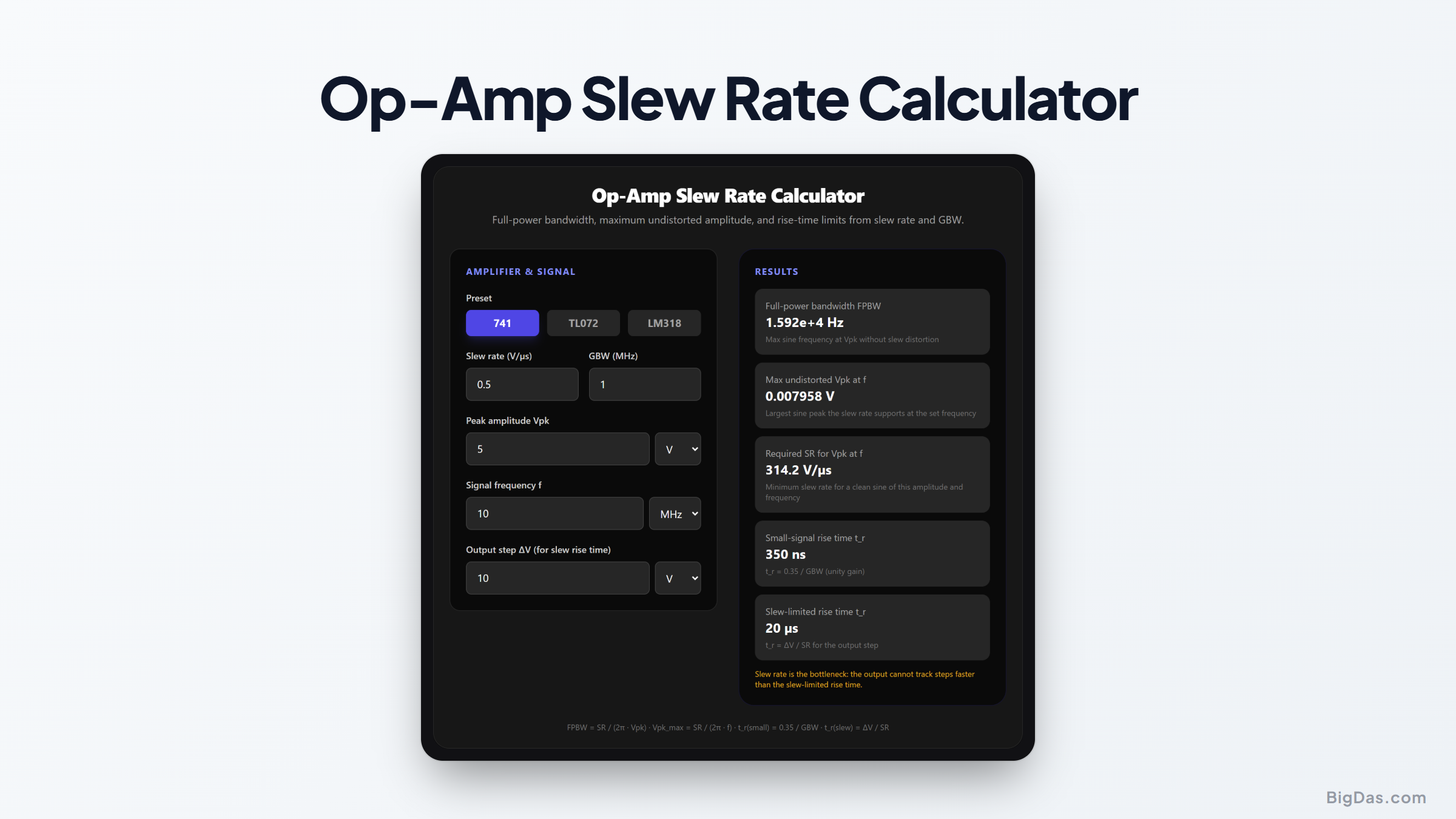
 Generated infographic and interface snapshot for Op-Amp Slew Rate Calculator
Will your op-amp keep up? Check slew rate against amplitude and frequency.
Free Op-Amp Slew Rate Calculator Online — Big Das
The Big Das Op-Amp Slew Rate Calculator finds full-power bandwidth, the largest undistorted sine amplitude at any frequency, and compares small-signal rise time against slew-limited rise time — with presets for the 741, TL072 and LM318.
What Is Slew Rate?
Slew rate is the fastest rate of change an op-amp's output can produce, in volts per microsecond. A sine wave that demands faster movement than the slew rate distorts into a triangle wave, no matter how generous the small-signal bandwidth is. The frequency where this happens for a given amplitude is the full-power bandwidth.
How to Use the Calculator
- Pick a preset (741, TL072, LM318) or enter the slew rate and GBW from your datasheet.
- Enter the peak amplitude you need (mV or V).
- Enter the signal frequency (Hz, kHz or MHz).
- Enter the output step ΔV for the rise-time comparison.
- Read FPBW, max undistorted Vpk, required slew rate, and both rise times; an inline note flags whether slew or bandwidth is the bottleneck.
Formulas Used
Full-power bandwidth:
FPBW = SR / (2π · Vpk)

Max undistorted amplitude at frequency f:
Vpk_max = SR / (2π · f)

Required slew rate for a sine of Vpk at f:
SR_min = 2π · Vpk · f

Small-signal rise time (unity gain):
tr = 0.35 / GBW

Slew-limited rise time for a step ΔV:
tr = ΔV / SR
Worked Example
A 741 (SR = 0.5 V/µs, GBW = 1 MHz) driving a ±5 V peak sine:
FPBW = 0.5×10⁶ / (2π × 5) ≈ 15.9 kHz — beyond that, full-swing output distorts.
At 10 kHz the maximum clean amplitude is 0.5×10⁶ / (2π × 10⁴) ≈ 7.96 V peak.
A 10 V output step takes 10 / 0.5 = 20 µs to slew, while the small-signal rise time is only 0.35 / 1 MHz = 0.35 µs — slew is the bottleneck by nearly 60×.
Swap in a TL072 (13 V/µs) and FPBW jumps past 400 kHz; an LM318 (70 V/µs) handles over 2 MHz at 5 Vpk.
Common Use Cases
Audio amplifier design: verifying full swing at 20 kHz
Signal-chain checks for ADC drivers and active filters
Choosing op-amps for square-wave or pulse outputs
Aliasing and distortion debugging in the lab
Teaching slew vs. bandwidth in analog electronics courses
Frequently Asked Questions
Why does my op-amp distort a high-frequency sine even at low gain?
Gain does not change slew rate. If 2π·f·Vpk exceeds the slew rate, the output lags into a triangle regardless of the gain setting. Reduce amplitude, lower frequency, or pick a faster part.
Where do the preset numbers come from?
From the manufacturers' datasheets: 0.5 V/µs and 1 MHz GBW for the µA741, 13 V/µs and 3 MHz for the TL072, and 70 V/µs with 15 MHz GBW for the LM318.
What is full-power bandwidth exactly?
The maximum frequency at which the op-amp can output its rated peak voltage without slew-induced distortion. It falls in proportion to amplitude — double the swing, halve the FPBW.
Why is small-signal rise time 0.35/GBW?
A single-pole amplifier behaves like an RC filter: rise time times bandwidth ≈ 0.35. This applies to small signals where the stage never slews.
When does slew limiting become the bottleneck?
When ΔV/SR exceeds 0.35/GBW. The calculator compares both and tells you which limit actually binds for your step size.