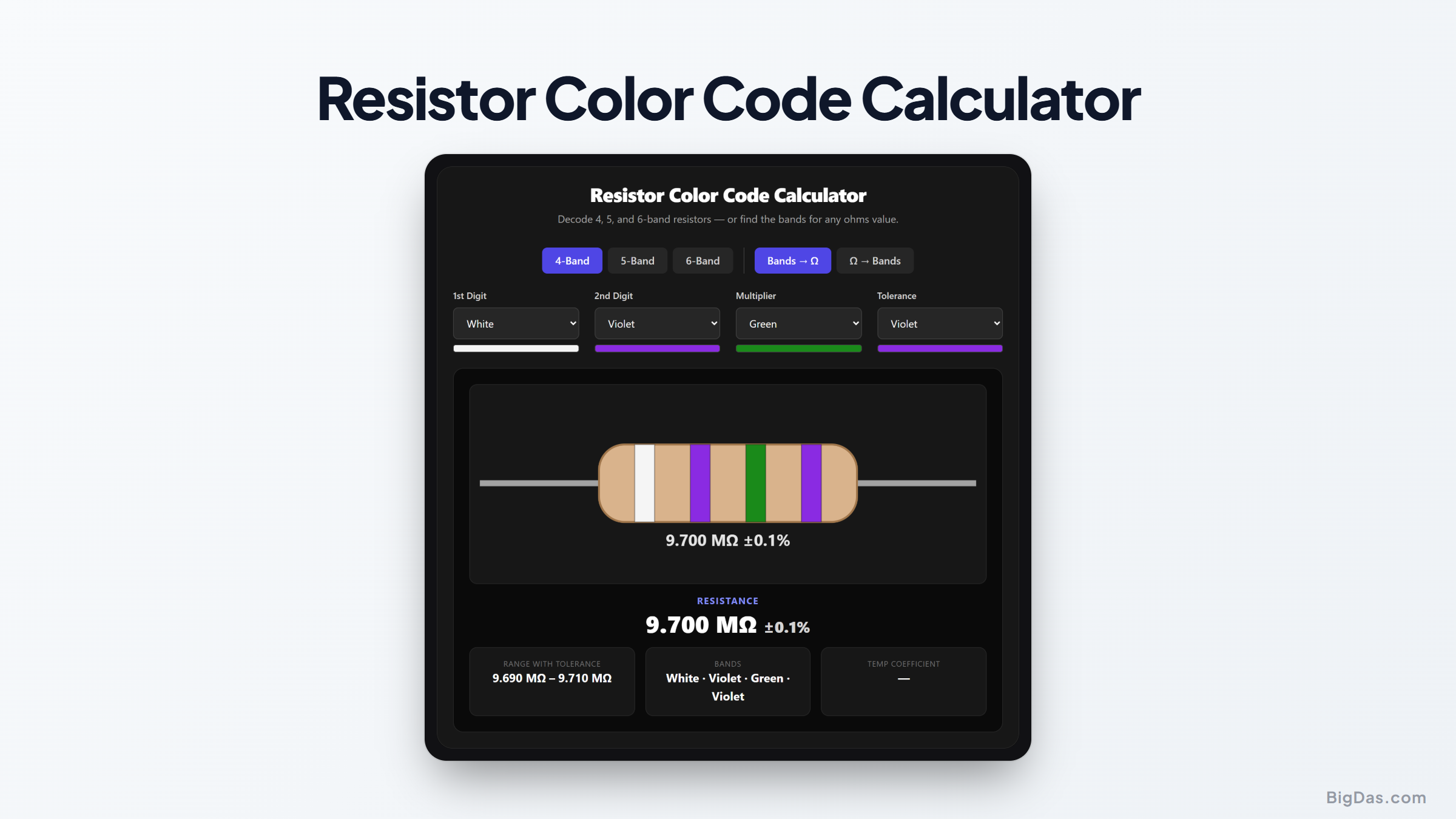
Resistor Color Code Calculator
 Generated infographic and interface snapshot for Resistor Color Code Calculator
Decode 4, 5, and 6-band resistors in seconds — or go from value to colors.
Free Resistor Color Code Calculator Online — Big Das
Struggling to read colored resistor bands? The Big Das resistor color code calculator converts 4, 5, and 6-band codes into resistance, and works in reverse — type 4.7 kΩ to see the exact band colors.
What Does the Calculator Do?
Every through-hole resistor is marked with colored bands that encode its value. The calculator handles the two directions you actually need:
- Colors to value — pick the bands and read off the resistance, tolerance, and (for 6-band parts) the temperature coefficient.
- Value to colors — enter a resistance and get back the band pattern.
How the bands work
A 4-band resistor uses two significant digits, a multiplier, and a tolerance band. 5-band adds a third digit for precision; 6-band adds a temperature coefficient band in ppm/°C. Digit colors run black 0 through white 9 (0 black, 1 brown, 2 red, 3 orange, 4 yellow, 5 green, 6 blue, 7 violet, 8 grey, 9 white); multipliers shift the decimal; tolerances use gold (±5%), silver (±10%), brown (±1%), red (±2%), green (±0.5%), blue (±0.25%), or violet (±0.1%).
How to Use the Resistor Color Code Calculator
- Choose the band count — select 4, 5, or 6 bands to match your component.
- Pick each band color — click through the colors, left to right.
- Read the result — value and tolerance appear, for example
1 kΩ ±5%. - Or enter a value — reverse lookup shows the band colors for a resistance.
- Check standard series — the tool flags the nearest E12/E24/E96 standard part.
The Formula Behind the Color Code
For a 4-band resistor:
value = (10 × band1 + band2) × 10^(multiplier) ohms
5-band uses three digits before the multiplier; 6-band adds a tempco band. Digits follow black=0 … white=9, and multipliers run from black ×1, brown ×10, red ×100, orange ×1k, yellow ×10k, green ×100k, blue ×1M, gold ×0.1, silver ×0.01.
Worked Example
Take a resistor with bands brown, black, red, gold:
Brown = 1, black = 0 → the digits are
10.Red multiplier = ×100 → value = 10 × 100 = 1000 Ω, i.e. 1 kΩ.
Gold tolerance = ±5%, so the real part lies between 950 Ω and 1050 Ω.
A 5-band example: yellow, violet, black, brown, brown gives digits 4-7-0, multiplier ×10 → 4.7 kΩ ±1%.
Watch for pitfalls: only gold, silver, brown, red, green, blue, and violet are valid tolerance colors — yellow-violet-orange is never a tolerance combination, and zeros (black) are perfectly valid digits even though they look like a missing stripe.
Common Use Cases
- Reading unmarked parts — identify salvaged or mixed-bin resistors before soldering.
- Reverse lookup — find the band pattern for the value you need from a parts kit.
- Teaching and learning — practice decoding without memorizing the full chart.
Frequently Asked Questions
How do I read a 4-band resistor color code?
Read the first two bands as digits, the third as the multiplier, and the fourth as tolerance. For brown-black-red-gold that's 1, 0, ×100, ±5% = 1 kΩ ±5%.
What's the difference between 4-band, 5-band, and 6-band resistors?
4-band has two significant digits, 5-band adds a third for tighter precision, and 6-band adds a temperature coefficient band in ppm/°C.
Which colors are valid as a tolerance band?
Gold (±5%), silver (±10%), brown (±1%), red (±2%), green (±0.5%), blue (±0.25%), and violet (±0.1%). Yellow or orange never appear there, which helps you tell which end to read from.
Can I use the calculator in reverse — value to colors?
Yes. Enter a resistance such as 4.7 kΩ and the tool returns the band pattern, including the nearest standard E-series value when your number isn't a standard part.
What does the temperature coefficient band mean?
On a 6-band resistor, the sixth band shows how the value changes with temperature, in parts per million per °C. A brown tempco band means 100 ppm/°C — a 1 kΩ resistor drifts about 0.1 Ω per degree.