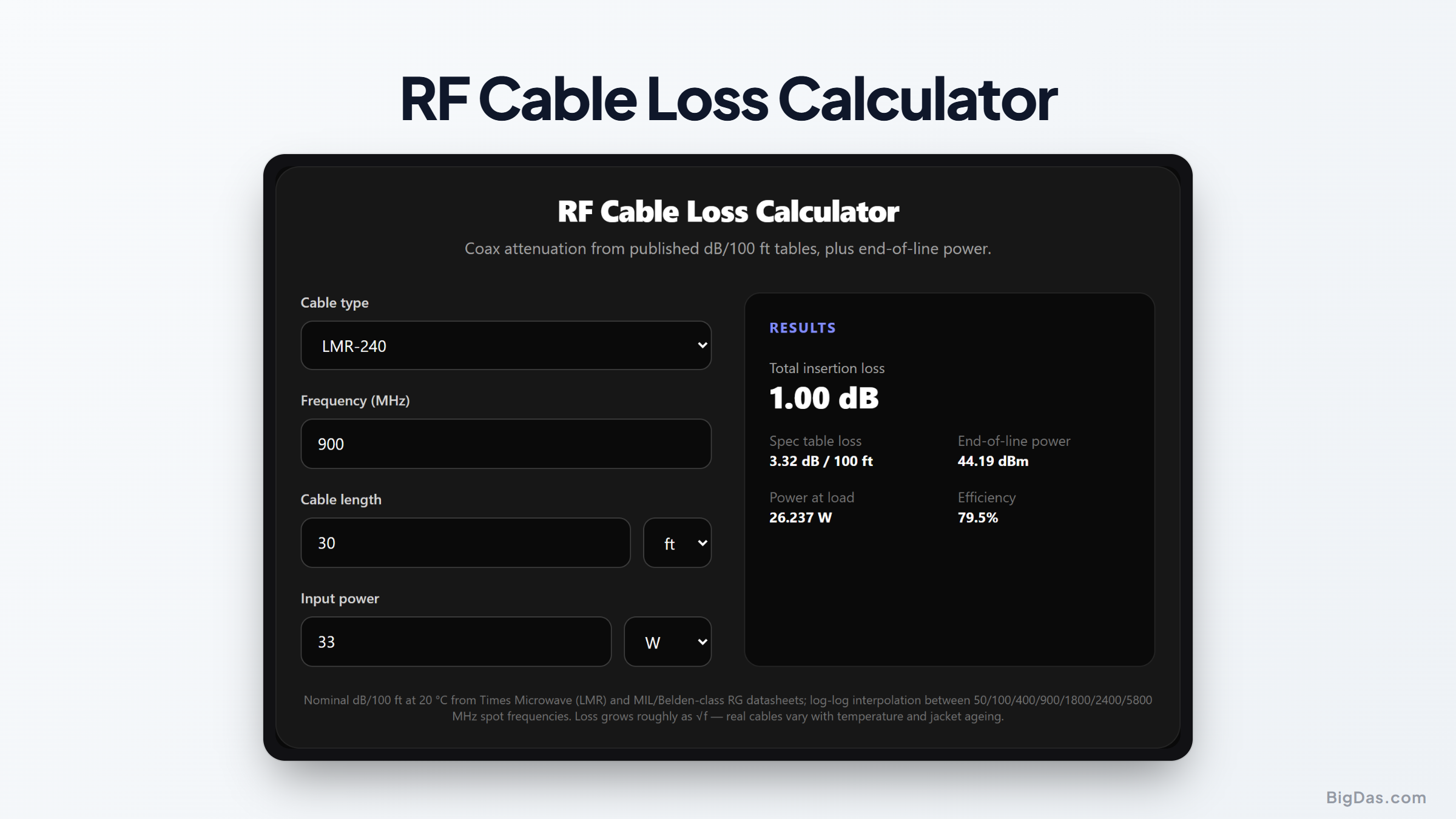
RF Cable Loss Calculator
 Generated infographic and interface snapshot for RF Cable Loss Calculator
How much of your transmitter's power actually reaches the antenna?
Free RF Cable Loss Calculator Online — Big Das
Coax eats signal, and it gets greedier with frequency. The Big Das RF Cable Loss Calculator looks up RG-58, RG-174, RG-316 and Times Microwave LMR-240/400/600 attenuation from published datasheet tables, interpolates on the √f curve, and shows both the dB lost and the power still arriving at the far end.
Why Cable Loss Matters
A 10 m run of thin cable at 2.4 GHz can quietly throw away half of a radio's output before a single photon leaves the antenna. Every wireless link budget — access point to roof antenna, GPS receiver, amateur repeater duplexer — needs this number before any antenna gain claims make sense.
- dB loss scales with length, so swapping units between metres and feet is the common arithmetic slip.
- Loss rises roughly as √frequency: going from 900 MHz to 5.8 GHz more than doubles the attenuation per metre.
- Cheap small coax is expensive signal: RG-174 is fine for a 30 cm jumper; at 20 m it can burn 15 dB at 900 MHz.
How to Use the Calculator
- Cable type — pick RG58, RG174, RG316, LMR-240, LMR-400, or LMR-600.
- Frequency (MHz) — anything up to 5.8 GHz; the table spots are 50/100/400/900/1800/2400/5800 MHz with log-log interpolation in between.
- Length — in metres or feet.
- Input power — in dBm or watts.
- Read the results — total insertion loss, the spec-table dB/100 ft figure used, power at the load end in dBm and W, and end-to-end efficiency.
The Math
Attenuation is tabulated per 100 ft at spot frequencies, then interpolated assuming loss ∝ √f (log-log linear):
L_100ft(f)  = L₁ + (L₂ − L₁) · ln(f/f₁) / ln(f₂/f₁)

L_total(dB) = L_100ft · length_ft / 100
P_out(dBm)  = P_in(dBm) − L_total
P_out(W)    = 10^((P_out(dBm) − 30)/10)
Below the lowest spot (50 MHz) and above 5800 MHz the tool extrapolates with √f scaling, the standard approximation for solid-dielectric coax at these frequencies.
Worked Example
A repeater feedpoint: 30 m of RG-58 at 900 MHz, 26 dBm (400 mW) transmitter output.
RG-58 is spec'd at 7.0 dB/100 ft at 900 MHz. Converting 30 m to feet: 30 × 3.28084 = 98.4 ft.
L_total = 7.0 × 98.4 / 100 = 6.89 dB
P_out   = 26 − 6.89 = 19.11 dBm ≈ 81 mW
Only 20% of the transmit power reaches the antenna. Swapping to LMR-400 (1.71 dB/100 ft at 900 MHz) drops the loss to 1.68 dB and delivers 331 mW instead — a bigger gain than most amplifiers.
The Cable Table
| Cable | dB/100 ft @ 900 MHz | Typical use | |
-|
--:|
-| | RG-174 | 15.9 | Short instrument jumpers | | RG-58 | 7.0 | Legacy lab / mobile | | RG-316 | 12.5 | PTFE, high-temp jumpers | | LMR-240 | 3.32 | Wi-Fi pigtails, drones | | LMR-400 | 1.71 | Rooftop runs to 50 ft | | LMR-600 | 1.09 | Long tower feeds, repeaters |
Use Cases
- AP-to-antenna links: budget dB loss before mounting outdoor Wi-Fi.
- Amateur radio: decide when a mast-mounted preamp actually pays.
- IoT installations: verify a LoRa or cellular modem still meets link margin after the feeder run.
- Bench work: compute end-of-cable power for calibration without a power meter round-trip.
Frequently Asked Questions
Why is the loss interpolated on a log-log scale?
Coax attenuation is dominated by conductor skin-effect (grows as √f) plus dielectric loss. Against a log-frequency/log-loss plot the datasheet spot frequencies fall nearly on straight lines, so log-log interpolation reproduces manufacturer curves within a few percent; simple linear interpolation in MHz overestimates mid-band loss.
Are these numbers exactly my cable's loss?
They're nominal datasheet values at 20 °C for representative constructions of each type. Different vendors vary ±10%, and solid polyethylene jackets age (loss climbs with moisture ingress and flex cycles). For certification-grade builds, use the exact part-number datasheet.
Why does efficiency matter more than dB?
Because 3 dB lost is half your power. When a run shows 6.9 dB, the antenna sees only 20% of the transmitter output. The efficiency figure makes that visceral — it's often more persuasive than dB when justifying a cable upgrade.
Can I use this for 75 Ω or hardline?
The math is identical — what changes are the per-cable attenuation numbers. Add that cable's dB/100 ft values mentally: the calculator's interpolation is type-agnostic, so a future version can absorb any table.
Does connector loss count?
No — connectors and lightning arrestors add their own insertion loss, typically 0.1–0.3 dB each below 1 GHz. Budget separately.