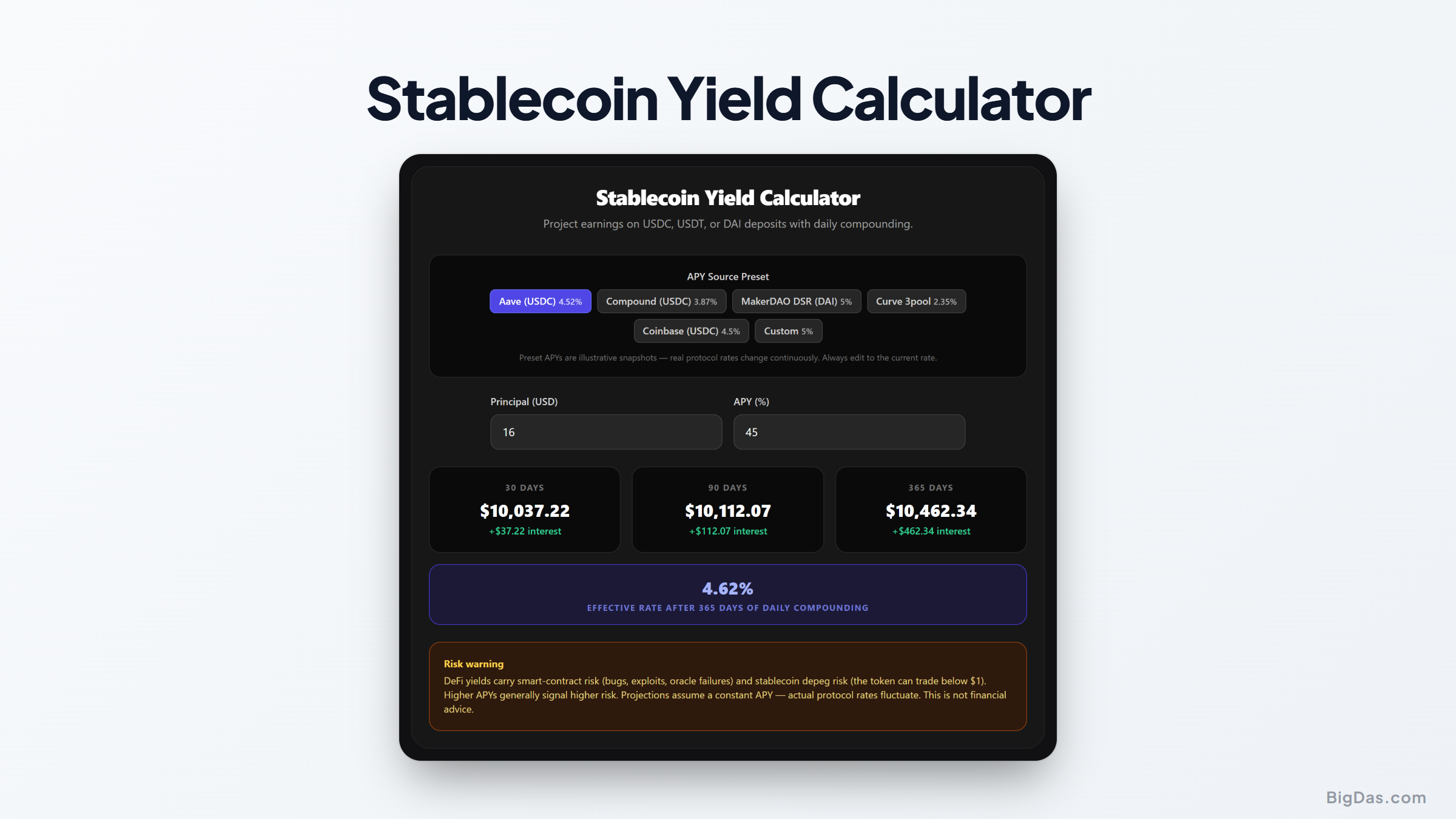
Stablecoin Yield Calculator
 Generated infographic and interface snapshot for Stablecoin Yield Calculator
Calculating Crypto Passive Income: How to Use a Stablecoin Yield Calculator for Accurate Projections
Earning interest on digital dollars has become a foundational strategy for investors looking to build crypto passive income. With traditional bank accounts offering yields that often lag behind inflation, decentralized finance protocols and crypto lending platforms provide attractive returns on dollar pegged assets like USDC, USDT, and DAI. Calculating your actual returns is not always straightforward. Compound interest, fluctuating rates, and varying time frames make quick estimates inaccurate. A dedicated stablecoin yield calculator solves this problem by providing precise projections based on daily compounding over thirty, ninety, and three hundred sixty five day periods. Beyond calculating raw profits, navigating crypto yields requires an understanding of underlying risks. Higher yields usually come with technical vulnerabilities, including smart contract bugs and asset depeg events. Here is a clear look at how to project your yield, evaluate risk, and optimize your portfolio strategy.
What is a Stablecoin Yield Calculator?
A stablecoin yield calculator is a financial tool designed to forecast earnings from holding and staking dollar backed crypto assets. Unlike volatile cryptocurrencies such as Bitcoin or Ethereum, stablecoins maintain a target value of one US dollar. Because the underlying asset price remains constant, your financial return depends almost entirely on yield generation, interest structure, and duration rather than market price moves. When you deposit funds into money markets, automated market makers, or centralized platforms, your earnings accumulate through an annual percentage rate or annual percentage yield. APY accounts for compounding, whereas APR does not. A stablecoin yield calculator translates these rates into clear dollar amounts across specific intervals, showing you exactly how much passive income you will earn over time.
Key Features and Benefits
Using a dedicated calculator brings precision to your financial planning. Here are the core features that help you evaluate potential returns.
Daily Compounding Math
Most decentralized finance protocols compound interest continuously or on a daily schedule. Simple interest calculations fail to show the true growth of your capital over long periods. The calculator factors in daily compounding, showing how reinvested interest accelerates your total payout over thirty, ninety, and three hundred sixty five days.
Multi Asset Projections
Different stablecoins carry different risk profiles and yield rates. Whether you are generating USDC interest through lending protocols or holding DAI in a savings vault, the calculator allows you to project return outcomes across various assets side by side.
Flexible Timeframes
Crypto yield opportunities change rapidly. Rates that are high today might compress next month. By viewing returns broken down by thirty days, ninety days, and full year periods, you can evaluate short term positions versus long term commitment strategies.
Integrated Risk Warnings
Yield is directly tied to risk. Higher rates usually indicate higher underlying exposure. Built in risk indicators highlight potential smart contract vulnerabilities and stablecoin depeg risks, helping you decide if a specific APY offers sufficient compensation for the risk involved.
Step by Step Guide: How to Calculate Your DeFi Yield
Getting an accurate earnings projection requires just a few simple inputs. Follow this process to analyze your prospective returns.
Step 1: Input Your Initial Principal
Enter the total amount of stablecoins you plan to deposit. For example, if you are allocating ten thousand USDC, type this as your starting capital.
Step 2: Enter the Protocol APY
Check the current yield offered by your chosen lending platform or liquidity pool. Input this rate as a percentage into the calculator. Make sure you enter the net yield after subtracting any platform fees.
Step 3: Select Your Timeframe
Choose the calculation window that matches your strategy. The tool projects your prospective earnings across three primary milestones:
30 Days: Useful for short term yield farming or liquidity management.
90 Days: Ideal for medium term positioning and seasonal protocol incentives.
365 Days: Shows the full annualized compound growth of your principal asset.
Step 4: Review Projections and Risk Alerts
Examine the output to see total interest earned and your final balance. Review the accompanying risk notes to evaluate protocol security, audit status, and historical stability before depositing capital.
Why You Need This Tool: Real World Use Cases An APY projection tool helps investors make rational, data backed choices instead of relying on optimistic marketing claims.
Comparing APR vs APY Across Protocols
A protocol offering an eight percent APR with daily compounding yields more over a year than a protocol offering an eight percent APY compounded annually. The calculator removes guesswork by reducing different compounding schedules to a single comparable metric.
Managing Cash
Reserves for Web3 Teams Crypto businesses, decentralized organizations, and startup treasuries hold significant balances in stablecoins. Using a calculator allows treasury managers to project operational runway and passive returns accurately while selecting appropriate risk tiers for capital preservation.
Evaluating Risk Reward Trade Offs
If Platform A offers four percent on USDC and Platform B offers twelve percent on an emerging algorithmic coin, the higher yield reflects higher risk. By calculating the absolute dollar difference between the two options over ninety days, you can decide whether the extra profit justifies taking on additional structural risk.
Understanding the Risks: Smart Contracts and Depeg Factors
High yield in digital asset markets never exists in a vacuum. To protect your principal, you must weigh projected returns against two primary risk vectors.
Smart Contract Vulnerabilities
Decentralized finance relies on self executing code called smart contracts. If a contract contains a bug, logic error, or exploit vulnerability, malicious actors can drain the underlying liquidity pool. Even protocols audited by top tier security firms carry residual risk. High APY projection numbers mean little if the underlying smart contract suffers a total loss exploit. Always look for protocols with long operational histories, high total value locked, and multiple independent audits.
Depeg Risk
Stablecoins aim to hold a constant one dollar value, but that peg can break. Depeg events happen for several reasons:
Reserve Shortfalls: Centralized issuers failing to prove full backing of fiat reserves.
Liquidation Cascades: Automated market mechanisms breaking down during high market volatility.
Banking Failures: Loss of access to underlying fiat bank accounts holding reserve assets. When a stablecoin drops below its target value, potential trading losses can rapidly erase months of earned interest. Using a tool that incorporates clear risk warnings ensures you account for token mechanics, reserve transparency, and historical peg stability before chasing maximum yields.
Frequently Asked Questions
What is the main difference between USDC interest and traditional savings interest?
USDC interest is generated through blockchain protocols, decentralized lending markets, or digital asset intermediaries rather than traditional banks. It is not insured by federal banking guarantees like FDIC insurance. However, it often provides higher yields due to lower overhead costs and high market demand for dollar liquidity in crypto markets.
How does daily compounding increase my total return?
Daily compounding means that the interest you earn each day is added to your principal balance. On the following day, you earn interest on both your original deposit and your previously accumulated interest. Over longer timeframes, this creates an accelerating growth curve compared to simple interest models.
Why do DeFi yield rates change so frequently?
DeFi yields depend on real time market demand for borrowing capital. When market activity rises, borrowing demand increases, pushing interest rates up. When market activity slows, yield rates fall. Rates can fluctuate daily based on protocol utilization and token reward distributions.
Can a stablecoin lose its value completely?
Yes. If an issuer lacks sufficient collateral, or if an algorithmic model fails to maintain equilibrium during market turbulence, a stablecoin can experience a permanent loss of its peg. Diversifying across well collateralized, highly liquid, and audited assets helps mitigate this hazard.
Final Thoughts A stablecoin yield calculator is a vital tool for anyone seeking predictable crypto passive income.
By modeling daily compound interest over thirty, ninety, and three hundred sixty five days, it transforms raw APY percentages into clear, actionable financial data. Remember that sustainable investing requires balancing yield potential with capital preservation. Use projection tools to calculate precise outcomes, but always weigh those numbers against smart contract security, platform reputation, and stablecoin peg stability before committing your funds.