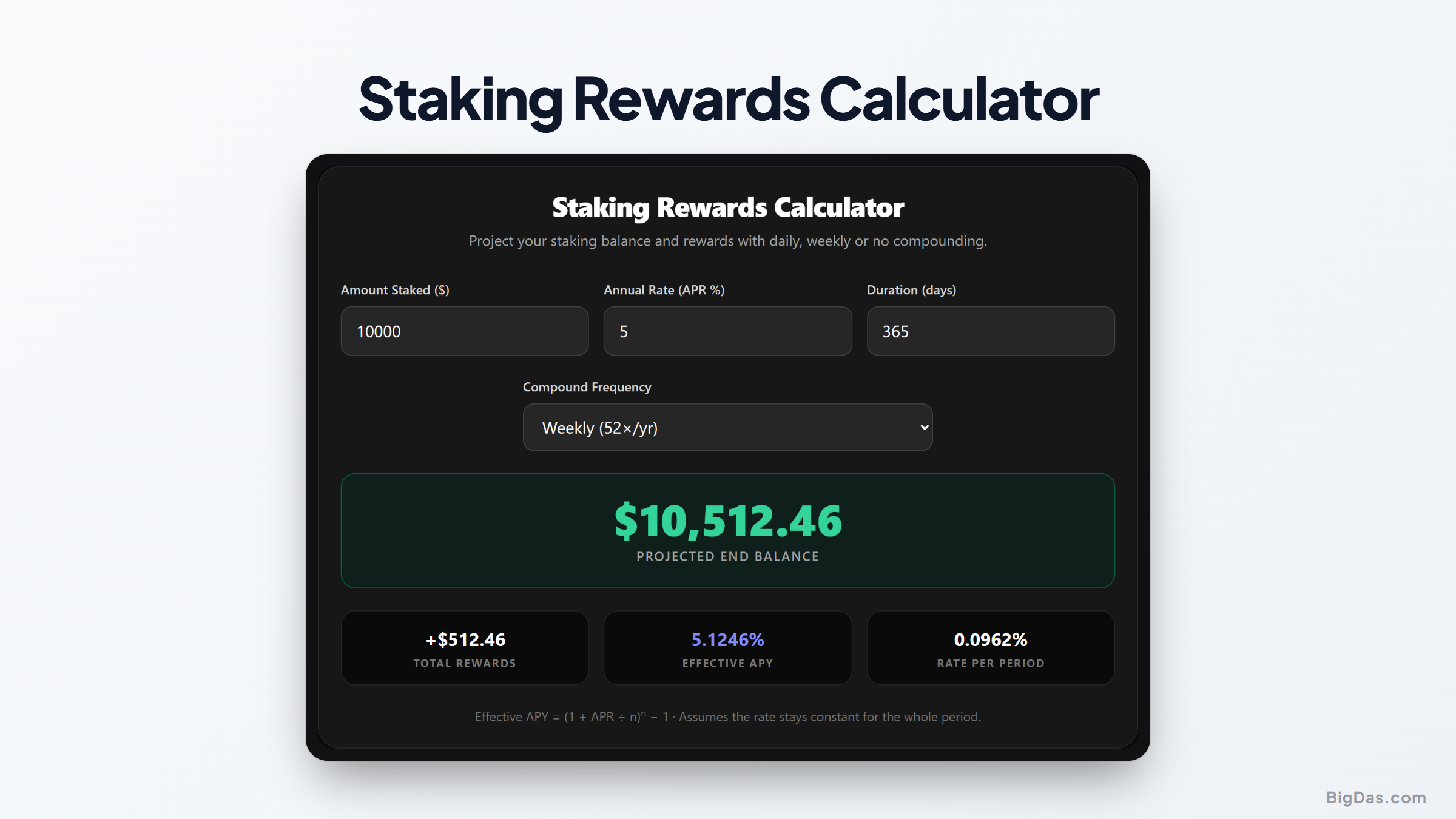
Staking Rewards Calculator
 Generated infographic and interface snapshot for Staking Rewards Calculator
Crypto Staking Rewards Calculator: Estimate Yields and Compound APY
Proof of stake blockchains allow cryptocurrency holders to earn yields by committing their assets to secure the network. While the concept sounds simple, calculating expected returns across various timeframes can quickly become complicated. Variable reward rates, differing payout frequencies, and the mathematical difference between base rate and compounded yield all influence your final earnings. A dedicated crypto staking rewards calculator simplifies these calculations. By plugging in your initial deposit, network rate, and restaking frequency, you get immediate clarity on expected returns. Understanding these metrics helps you make informed decisions when evaluating validator nodes, network lockup periods, and decentralized finance protocols.
What is a Staking Rewards Calculator?
A crypto staking rewards calculator is an analytical tool built to model earnings from participating in proof of stake networks. It takes base parameters provided by a user or a network protocol and applies financial formulas to project yield over time. When you stake cryptocurrency, you lock tokens to support transaction validation and consensus mechanisms. In return, the protocol distributes new tokens as incentives. However, these incentives are rarely paid out as a static sum at the end of the year. Instead, rewards accumulate on a daily, epoch, or block level. The calculator processes these variable parameters to reveal three critical metrics: 1. *Total Rewards Earned:
- The quantity of new tokens accumulated over the chosen duration.
- *Ending Principal Balance:
- The sum of your initial deposit plus all generated rewards.
- *Effective Annual Percentage Yield:
- The actual percentage return once compounding frequency is taken into account. Converting annual percentage rate (APR) to annual percentage yield (APY) is essential here. APR reflects simple interest without reinvestment, whereas APY accounts for the compounding effect of adding earned rewards back into your staked balance.
Key Features and Capabilities
An effective calculation tool offers several key parameters that mirror actual blockchain conditions: * Multiple Compounding Frequencies: Select between daily, weekly, monthly, or no compounding. Some networks auto compound rewards automatically on chain, while others require manual claims. Modeling different schedules lets you determine whether manual restaking is economically viable after network transaction fees.
- Flexible Time Horizons: Calculate projections for custom durations ranging from a single day up to several years. This functionality helps both short term traders planning liquid staking strategies and long term holders mapping out multi year growth.
- APR to APY Staking Conversion: Automatically calculate effective yield from base annual rates. Many platforms display gross APR on their dashboards, which can understate real returns if earnings are restaked frequently.
- Base Asset or Fiat Valuation: View earnings in terms of native network tokens as well as underlying fiat currency values. This dual perspective keeps your focus on token accumulation regardless of market price fluctuations.
Step by Step Guide to Using the Calculator
Using the calculator requires just a few basic inputs gathered from your staking provider or network validator documentation.
Step 1: Input Initial Stake Amount
Enter the total number of tokens you plan to lock or delegate. For instance, if you are staking 500 network tokens, enter that numerical value into the principal balance field.
Step 2: Enter Nominal APR or Base Reward Rate
Look up the current staking yield offered by the blockchain network or validator pool. Enter this base annual rate as a percentage.
Step 3: Select Compounding Frequency
Choose how often earned tokens are reinvested back into the staking deposit:
- Daily Compounding: Suitable for auto compounding vaults, liquid staking protocols, or automated smart contracts.
- Weekly or Monthly Compounding: Common for manual restaking where users periodically claim and delegate rewards to optimize gas costs.
- No Compounding (Simple Yield): Applies when rewards remain uncollected in a separate reward pool or when you choose to cash out earnings regularly.
Step 4: Define the Staking Horizon
Specify the exact period you plan to hold your stake, expressed in days, months, or years.
Step 5: Review Projected Output
Examine the calculated results to review your ending token balance, cumulative rewards earned, and the effective APY percentage.
Why You Need This Tool: Practical Use Cases
1. Evaluating Manual Restaking vs Gas Costs
On high throughput blockchains, restaking rewards daily might cost a fraction of a cent. On networks with higher gas costs, claiming and reinvesting rewards daily can consume more in fees than the compounded yield generates. Using a calculator allows you to model weekly or monthly reinvestment schedules to find the optimal restaking cadence that maximizes net return after network costs.
2. Comparing Validator Performance and Pool Fees
Different network validators charge varying commission rates, ranging from zero percent up to ten percent or higher. A calculator helps you analyze how commission deductions affect gross APR over time. You can adjust the base interest rate downward by the validator fee percentage to visualize true net earnings.
3. Forecasting Portfolio Compound Growth
Long term crypto investors often view staking as a way to grow token count during market downturns or sideways consolidation periods. Projecting returns over two to five years shows how compound growth accelerates exponentially, providing a clear quantitative benchmark for long term asset allocation.
4. Planning Income Strategies
If your goal is living off passive rewards or withdrawing earnings periodically, setting the compounding frequency to zero shows how much regular income your principal balance generates without degrading the base deposit.
Understanding the Math: APR versus APY in Crypto Staking
To use a staking rewards calculator effectively, it helps to understand the underlying mathematics governing yields. Annual Percentage Rate (APR) represents simple interest over a one year period. It assumes that earned tokens sit idle in a reward balance without contributing to future interest calculations. Annual Percentage Yield (APY) reflects compound interest. When earned rewards are added back to the principal stake, future reward calculations apply to a larger total balance. The general formula for compound interest applied in crypto yield calculation is: *Ending Balance = Principal × (1 + Rate / Compounding Periods)^Total Periods
- As compounding frequency increases, the effective APY rises above the baseline APR. For example, a 10 percent base APR compounded daily yields an effective APY of roughly 10.52 percent. Over large principal amounts or extended timeframes, this half a percentage point difference leads to substantial additional token accumulation.
Frequently Asked Questions
What is the difference between APR and APY in crypto staking?
APR is the base annual interest rate calculated without reinvesting earnings. APY is the effective annual yield that includes the effect of reinvesting earned rewards back into the staked principal balance over time.
How does compounding frequency change my total rewards?
More frequent compounding increases your effective yield because interest generates further interest. Daily compounding produces higher overall returns than monthly or yearly restaking, provided transaction fees do not offset those gains.
Does crypto staking guarantee risk free returns?
No, crypto staking carries market and protocol risks. Token prices fluctuate, smart contracts can encounter vulnerabilities, and network slashing penalties may apply if a validator misbehaves. While staking increases token quantity, total monetary value depends on asset market price.
Why do staking reward rates change over time?
Staking rates fluctuate based on network parameters, total protocol participation, and inflation models. When more users stake their tokens, overall rewards per user typically decrease as the fixed reward pool is split among more participants.
Is manual restaking better than automated compounding?
Automated compounding through smart contracts or liquid staking protocols eliminates manual effort and maintains consistent restaking schedules. Manual restaking allows greater control over cash flow and fee timing, but requires discipline and cost management.
To Wrap Up A crypto staking rewards calculator removes ambiguity from yield projections, allowing you to estimate compounded growth, total reward accumulation, and effective APY with precision.
By testing different restaking schedules and evaluating network variables, you can optimize your asset allocation and make data driven decisions across proof of stake networks.