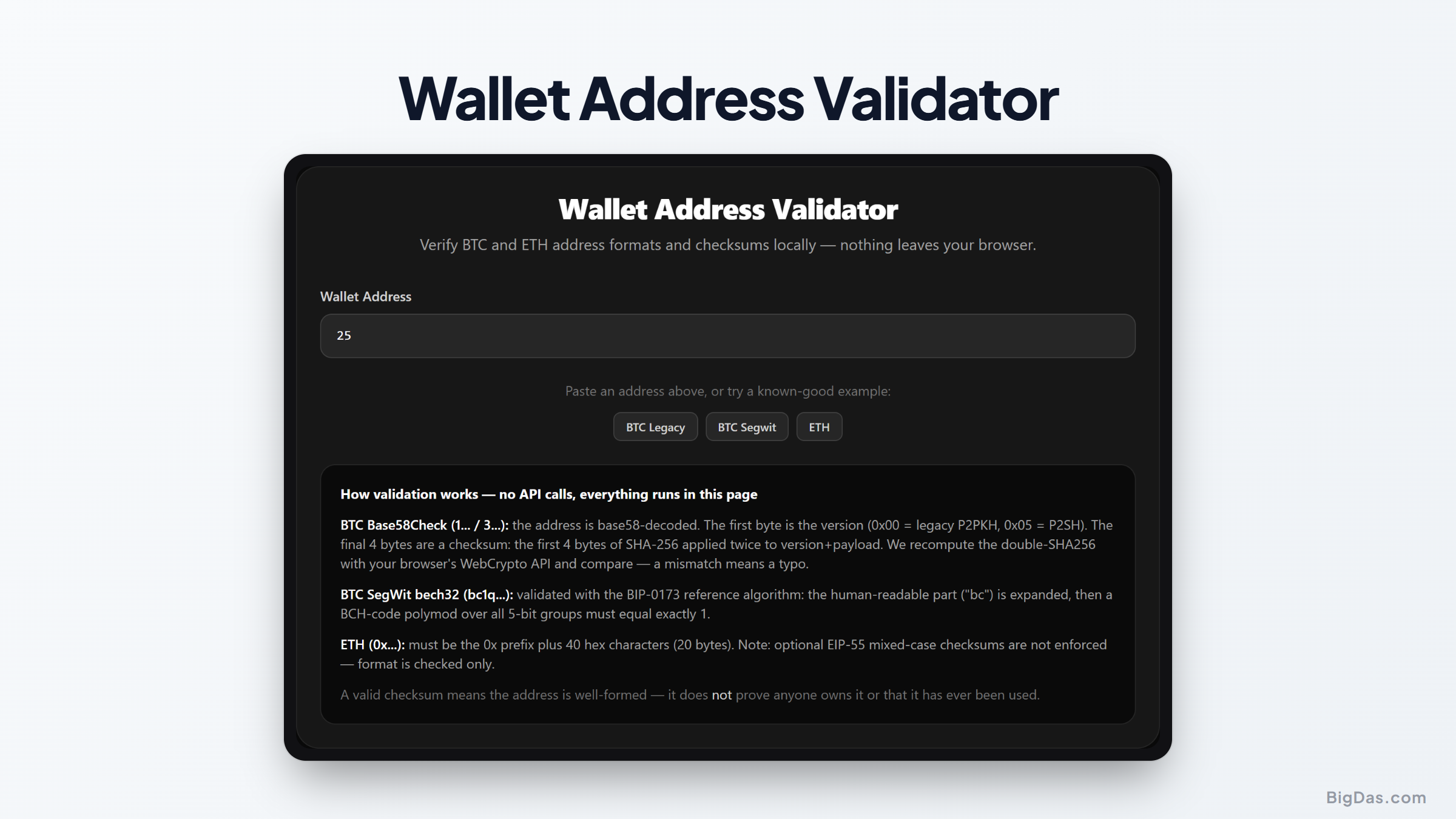
Wallet Address Validator
 Generated infographic and interface snapshot for Wallet Address Validator
Wallet Address Verification: Validating Bitcoin and Ethereum Formats Securely
Sending cryptocurrency comes with an unforgiving rule: once a transaction is broadcast to the network, it cannot be reversed. Unlike traditional banking where an incorrect account number triggers an immediate rejection, a flawed blockchain address might permanently swallow funds or send them into an inaccessible cryptographic void. A simple copy and paste error or a subtle character corruption caused by malicious clipboard software can result in total financial loss. Verifying the integrity of a destination hash before approving a transaction is standard security practice for developers, traders, and everyday cryptocurrency users. Checking an address manually by inspecting the first and last few characters is helpful, but human eyes cannot verify mathematical checksums. A dedicated bitcoin address validator and crypto address verifier solves this problem by performing cryptographic validation right inside your web browser.
What is Wallet Address Validator?
Wallet Address Validator is a browser based utility designed to check the syntax, encoding, and checksum integrity of Bitcoin and Ethereum destination strings. It operates entirely on your local machine, meaning your pasted addresses never travel over a network or get stored on remote servers. Cryptocurrency networks rely on specific encoding schemes to minimize human error and protect against accidental mistypes. Bitcoin utilizes multiple address standards, including legacy Base58Check strings starting with 1 or 3, and modern Bech32 or Bech32m strings starting with bc1. Ethereum relies on hexadecimal formatting with an optional mixed case checksum scheme defined under EIP 55. This validator analyzes the raw character sequence, decodes the underlying bytes, and recalculates the mathematical checksum to confirm whether the string represents a legitimately formatted address. By keeping all processing local, it provides instant verification while protecting user privacy.
Key Features and Benefits
Local Client Side Verification: All validation code runs inside your browser using standard JavaScript cryptographic functions. No data leaves your device, preventing potential tracking by remote servers.
Support for Multiple Bitcoin Formats: The tool parses legacy Pay to Public Key Hash addresses, Pay to Script Hash addresses, and Native SegWit Bech32 or Bech32m encodings.
Ethereum Checksum Validation: For ethereum address format validation, the tool checks both basic hexadecimal structure and EIP 55 mixed case checksums to flag potential character errors.
Real Time Feedback: Results appear immediately as you type or paste an address, showing clear status indicators without needing page reloads.
Zero Installation Required: Accessible from any modern browser on desktop or mobile devices without needing browser extensions, plugins, or third party dependencies.
Step by Step Guide on How to Use It
Using the validator is straightforward and requires no complex setup or technical expertise. 1. Access the Application: Open the validator page in your web browser of choice.
- Paste the Target Address: Copy the Bitcoin or Ethereum address you wish to verify and paste it into the primary input field.
- View Immediate Validation: The utility automatically identifies the network type and evaluates the structure. You will see a clear confirmation indicating whether the string is valid or invalid.
- Inspect Network Details: Review the generated metadata, which details the underlying format such as Base58Check legacy, Bech32 Native SegWit, or Ethereum EIP 55 checksum status.
- Verify Before Sending: Once the address passes verification, proceed with your wallet software with greater confidence.
Why You Need This Tool
Protecting Against Clipboard Hijackers
Clipboard hijacking malware active on desktop and mobile operating systems watches for cryptocurrency address formats in memory. When you copy a destination address, the malware replaces it with an attacker address. Comparing your target string against the output details in a clean validator browser tab gives you a clear second view of the cryptographic structure.
Validating Batch Withdrawal Lists
Organizations processing payroll, token distributions, or multi address payouts can quickly scan destination targets. Catching formatted errors early prevents broadcast failures and expensive network gas fee losses caused by invalid execution parameters.
Testing Decentralized Application Inputs
Web3 developers building wallet integrations, payment gateways, or smart contract interfaces can use the validator to verify sample addresses during software development and user interface design.
Confirming Network Compatibility
Different wallet applications support different Bitcoin standards. Verifying whether an address uses legacy Base58Check or Native SegWit Bech32 ensures compatibility across platforms before initializing cross wallet payments.
Technical Mechanics of Crypto Address Encoding
To understand why automated verification is necessary, it helps to examine how blockchain addresses are constructed under the hood.
Bitcoin Base58Check Encoding
Early Bitcoin addresses rely on Base58Check, an encoding scheme designed to make public key hashes shorter and easier to read. Base58 excludes visually ambiguous characters such as upper case O, number 0, upper case I, and lower case l to prevent human reading errors. To guard against mistypes, Base58Check appends a four byte checksum derived from running double SHA 256 hashes over the version byte and payload. If even a single character is mistyped, the recalculated checksum will not match, causing a base58check check to fail immediately.
Bitcoin Bech32 and Bech32m Validation
Modern Bitcoin transactions use Native SegWit addresses encoded in Bech32 or Bech32m formats. Unlike Base58Check, Bech32 uses a 32 character alphabet containing only lower case letters and numbers. It features a built in Bose Chaudhuri Hocquenghem error detecting code that mathematically guarantees detection of up to four character errors and locates character transpositions. A bech32 validation parser checks the human readable part (bc for mainnet), the separator character, the witness version, and the payload polynomial checksum.
Ethereum Address
Format and EIP 55 An Ethereum address is derived from the last 20 bytes of the Keccak 256 hash of a public key, represented as a 40 character hexadecimal string prefixed with 0x. Originally, Ethereum addresses were completely case insensitive and lacked an native checksum mechanism. EIP 55 introduced a backward compatible checksum scheme by capitalizing specific letters based on the Keccak 256 hash of the lowercase address string. Evaluating an ethereum address format against EIP 55 confirms whether upper and lower case letters match the expected cryptographic output, catching typographical errors before execution.
Frequently Asked Questions
How does a bitcoin address validator detect typos?
Bitcoin addresses contain cryptographic checksums generated when the address is created. When you paste an address into a verifier, the utility decodes the string and runs identical hashing algorithms on the payload. If the result does not match the trailing checksum bytes, the tool marks the address as invalid.
What is the primary difference between Base58Check and Bech32 validation?
Base58Check is used for older Bitcoin formats starting with 1 or 3 and uses double SHA 256 hashing for its four byte checksum. Bech32 is used for newer Native SegWit addresses starting with bc1 and relies on a polynomial checksum that can detect and locate multiple character transposition errors.
Can an address be valid structurally but not exist on the blockchain?
Yes. Address validation confirms that a string satisfies all structural, cryptographic, and checksum rules required by the network protocol. It does not check whether the address has ever held funds or been active on chain. Anyone can generate a mathematically valid public key and address offline without broadcasting it to the network.
Does validating an address leak my activity or IP address?
No. This tool processes all data locally within your browser using JavaScript. No network requests are sent to external servers, API endpoints, or blockchain nodes when you evaluate an address string.
Why is my
Ethereum address flagged as unchecksummed?
An Ethereum address made entirely of lower case or upper case letters after the 0x prefix is valid structurally, but lacks EIP 55 checksum metadata. Using a mixed case EIP 55 address adds protection by ensuring case sensitive checksum algorithms verify letter placement.
Summary
Verifying crypto destination strings before executing transactions is an essential defensive habit when interacting with public blockchain networks. By performing base58check and bech32 validation for Bitcoin alongside EIP 55 checks for Ethereum locally, this utility offers fast structural feedback without exposing your activity to remote servers. Incorporating automated cryptographic validation into your workflow helps eliminate transfer errors and keeps your transaction process accurate.