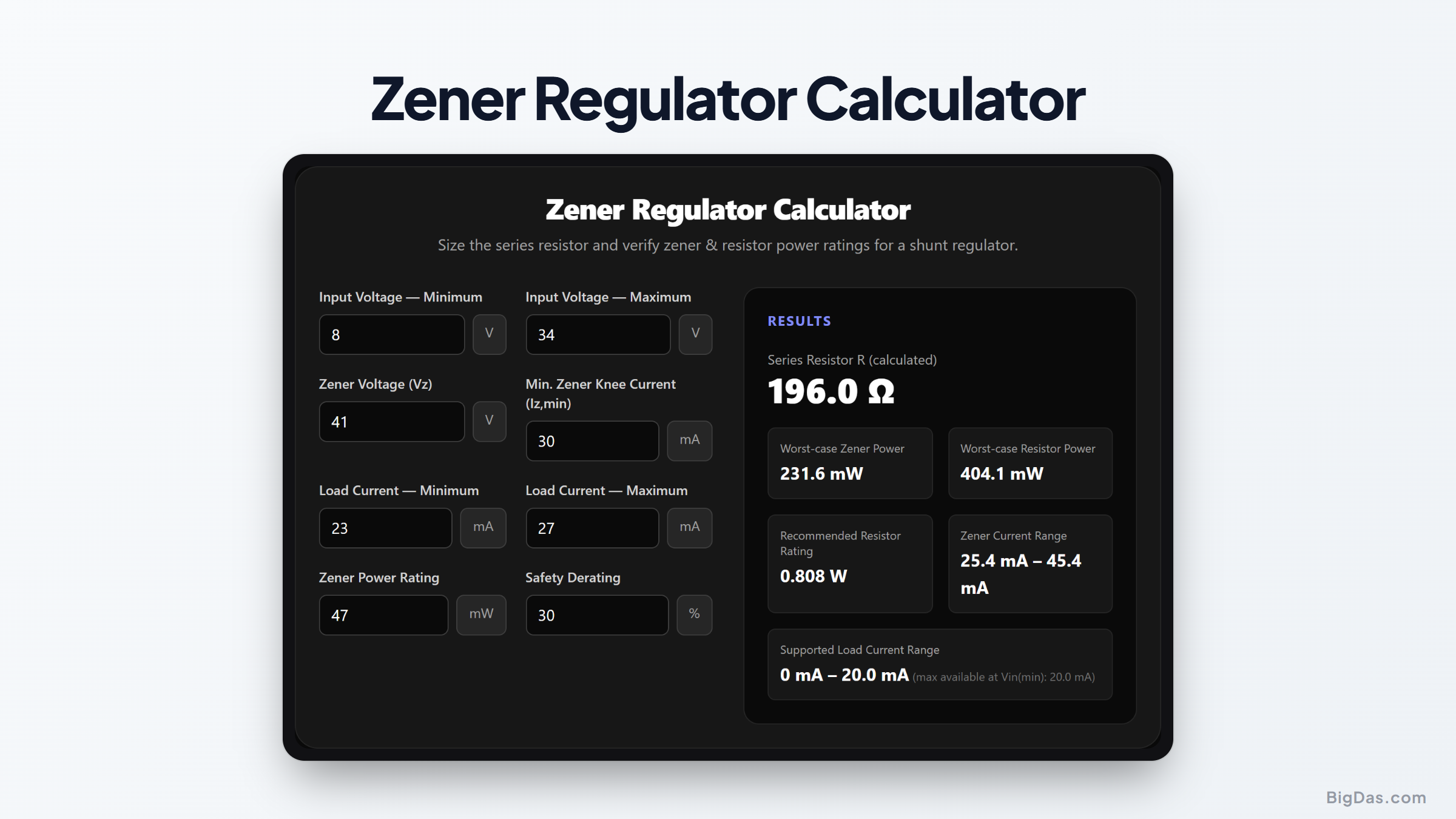
Zener Regulator Calculator
 Generated infographic and interface snapshot for Zener Regulator Calculator
Design a safe shunt voltage regulator around a zener diode.
Free Zener Regulator Calculator Online — Big Das
Need a cheap, bulletproof low-current voltage reference or regulator? A single zener diode and one resistor is often all it takes — but only if the resistor is sized correctly. Too small and the diode overheats at light loads; too large and regulation collapses at full load. Our free Zener Regulator Calculator finds the exact series resistance and the worst-case power dissipation for both components.
What Is a Zener Shunt Regulator?
A zener diode operated in reverse breakdown holds a nearly constant voltage (Vz) across itself. In a shunt regulator, a series resistor R connects an unregulated input Vin to the zener, and the load is wired in parallel with the zener. The resistor drops the excess voltage, while the zener "soaks up" whatever current the load does not use. It is the simplest possible linear regulator — ideal for sensor references, MCU supply rails, and overvoltage clamps.
How to Use the Tool
- Enter the input voltage range (minimum and maximum Vin).
- Enter the zener voltage Vz and its power rating from the datasheet.
- Enter the minimum zener knee current (Iz,min, typically 1–10 mA) and the load current range.
- Set a safety derating (50% means components run at half their rated power).
- Read the exact series resistor, worst-case dissipations, and the supported load range — all computed live.
The Formulas
The resistor must pass enough current at the lowest input voltage to feed the full load plus keep the zener in regulation:
- Series resistor:
R = (Vin(min) − Vz) / (Iz,min + IL,max) - Max resistor current (at Vin max):
IR,max = (Vin(max) − Vz) / R - Max zener current (at Vin max, load min):
IZ,max = IR,max − IL,min - Worst-case zener power:
PZ = Vz × IZ,max - Worst-case resistor power:
PR = IR,max² × R - Recommended ratings: worst-case power ÷ derating (e.g., ÷ 0.5 for 50%)
The absolute condition: Vin > Vz — below Vz the diode never enters breakdown and the output simply follows the input. The tool validates this for you.
Worked Example
Regulate 12 V (10–14 V variation) down to 5.1 V for a load drawing 0–20 mA, with a 500 mW zener and Iz,min = 5 mA:
R = (10 − 5.1) / (0.005 + 0.020) = 196 Ω (pick the next lower standard value, 180 Ω, and re-verify)
At Vin = 14 V: IR,max = (14 − 5.1) / 196 ≈ 45.4 mA
IZ,max = 45.4 − 0 ≈ 45.4 mA → PZ = 5.1 × 0.0454 ≈ 231 mW (fine for 500 mW)
PR = 0.0454² × 196 ≈ 478 mW → use at least a 1 W resistor
Common Use Cases
- MCU and sensor rails: derive a quiet 3.3 V or 5.1 V reference from a noisy 12 V rail.
- Overvoltage protection: clamp inputs to a safe ceiling for ADC pins.
- Voltage references: bias op-amps and comparators with a stable few-millivolt-accurate reference.
- Education: the classic first linear-regulator exercise in every electronics lab.
Frequently Asked Questions
Why must
Vin be greater than Vz?
A zener only clamps in reverse breakdown, which starts when the reverse voltage reaches Vz. If Vin never exceeds Vz, the diode stays off and no regulation or clamping occurs — the output simply tracks the input through the resistor.
What happens if the load draws more current than the design allows?
The resistor can only supply (Vin − Vz) / R. Once the load takes all of it, the zener current falls below Iz,min, the diode leaves breakdown, and the output voltage sags toward the input's thevenin voltage — hence the tool's max-available-load warning.
Why 50% derating?
Component power ratings assume ideal conditions (25 °C, free convection). Real enclosures get hotter and every watt dissipated raises junction temperature further. Running at half rating roughly doubles lifetime and covers tolerance spread.
Can I put resistors or zeners in series/parallel?
Series zeners add their voltages (handy for odd rails). Never parallel zeners — slight voltage differences make one hog the current until it fails. Resistors may be paralleled to share power if they are equal values.
When should I use a linear regulator IC instead?
Above roughly 100 mA of load current, or when efficiency matters (battery power), a 78xx or LDO regulator beats a zener shunt on both regulation quality and wasted heat. The zener still wins for references and few-milliamp rails.