Memory Game
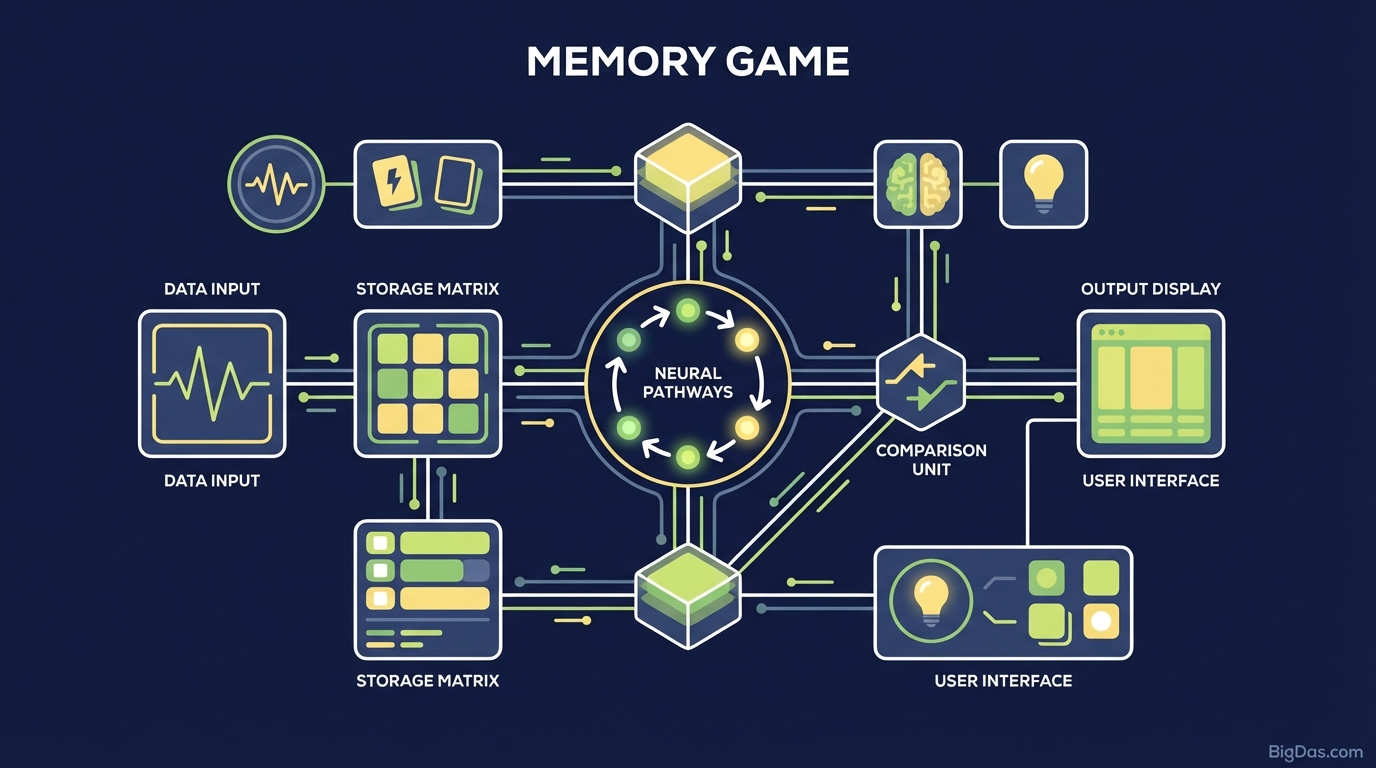
 Modern scientific illustration of Memory Game
Master Your Mind: The Online Memory Game for Cognitive Enhancement
Constant scrolling, short videos, and push notifications fragment attention. Many people experience "digital fog," where focus slips and short-term memory feels unreliable. You walk into a room and forget why. You open a browser tab and lose your train of thought.
The fix does not require medication or expensive courses. Sometimes the simplest remedy works best: targeted cognitive play.
This guide covers the Memory Game, an online card-matching tool that exercises concentration and working memory. It works for students, hobbyists, and anyone who wants to keep their mind sharp.
What is the Memory Game?
The Memory Game (also called Concentration, Pelmanism, or Pairs) is a card-matching exercise that tests your ability to hold visual information across short intervals.
A grid of cards sits face down. You flip two cards at a time. Matching pairs stay revealed or disappear. Non-matching pairs flip back, and you must remember their positions to match them later.
The Science Beneath the Surface
Each round is a workout for your Working Memory, the cognitive system that holds information temporarily for processing. Working memory drives decision-making, reasoning, and learning.
Playing the game activates the Hippocampus (memory) and the Prefrontal Cortex (focus and decisions). The grid forces you to build rapid, temporary neural maps of card positions.
Why This Tool Stands Out
Most matching games on the web are generic. This one is built for training.
- Zero Latency: Lightweight code delivers instant flip responses, so timing matches your brain's processing speed.
- Distraction-Free UI: A minimal interface removes flashing graphics that would otherwise steal focus.
- Adaptive Algorithms: Randomized layouts prevent you from falling into fixed patterns and force active recall each session.
Key Features & Benefits
1. Enhanced Visual Memory
Visual memory helps you recall faces, navigate new places, and read data charts. Regular play trains the brain to take sharper "mental snapshots" with longer retention.
2. Improved Concentration and Focus
Success requires singular focus. This trains the brain to ignore external distractions, a skill that transfers directly to deep work, study sessions, and complex professional tasks.
3. Faster Cognitive Processing Speed
The goal is not just to find the pairs but to retrieve their locations quickly. As you play, you will notice the gap between seeing a card and recalling its match shrink. This is processing speed, a key marker of cognitive health.
4. Stress Reduction via Gamification
High cortisol impairs memory. The game offers a structured, low-stakes task that lets the brain switch gears. Completing a grid releases dopamine and acts as a constructive break from stressful work.
5. Neuroplasticity Support
Neuroplasticity is the brain's ability to form new neural connections. Challenging mental tasks, like fast-paced memory matching, encourage this growth and can help delay age-related cognitive decline.
Step-by-Step Guide: How to Use the Memory Game
The tool is accessible immediately. Playing it well takes method.
Step 1: Launch and Preparation
Open the tool in your desktop or mobile browser. Pick an environment where you can focus for 3 to 5 minutes without interruption.
- Pro Tip: Silence notifications before starting. Treat the round as a gym set for your mind.
Step 2: The Initial Scan
When the grid appears, do not click randomly. Pick your first card from the top-left corner to anchor a structured mental grid.
Step 3: The Discovery Phase
Click a second card.
- If it matches: Those cards stay locked.
- If it does not match: Pause for one second. Practice active encoding by mentally labeling the cards (for example, "Row 1 to Col 1 is a Star, Row 3 to Col 2 is a Square").
Step 4: Methodical Flipping
Continue flipping pairs in a systematic order, such as row by row. A structured approach prevents the chaos of forgetting which cards you have already checked.
Step 5: Completion and Review
Once all pairs are matched, the game shows your metrics: time taken and moves used.
- Analyze your score: Did you use fewer moves than last time? Did you finish faster?
- The Goal: Lower the moves count toward the mathematical minimum, not just the clock.
Advanced Strategies: How to Get the Most Out of This Tool
To move from casual play to memory athlete, apply these techniques.
The "Chunking" Technique
Do not try to memorize the full grid at once. Break the board into smaller zones (for example, quadrants) and memorize one zone at a time.
Visualization and Association
When you flip a card, link the image to its location.
- Example: If an apple appears in the top-right corner, picture the sun (top-right) shining on the apple. Unusual associations stick better than raw data.
The Rehearsal Loop
After every non-matching pair, mentally replay the location of the last 3 to 4 cards you saw. This strengthens the visuospatial sketchpad component of your working memory.
Who Benefits From the Memory Game
For Students and Academics
Recall drives exam success. Playing a quick round before studying primes the neural pathways used to absorb textbook material.
For High-Performance Professionals
Coders, writers, strategists, and data analysts all hit cognitive fatigue. One round of the Memory Game resets attention more effectively than scrolling social media, which drains focus.
For Seniors and Aging Adults
Regular mental activity helps maintain synaptic density. The game offers a low-pressure way to monitor memory health daily.
For Parents and Children
The game is safe, educational, and good for developing minds. It teaches patience, pattern recognition, and delayed gratification.
Frequently Asked Questions (FAQ)
1. Is playing the Memory Game better than just reading?
Reading and memory games serve different functions. Reading builds vocabulary and crystallized intelligence. Memory games train fluid intelligence, your ability to reason and solve new problems without relying on prior knowledge. A balanced brain needs both.
2. How often should I play to see results?
Consistency beats intensity. Aim for 3 to 5 rounds daily (around 10 minutes total). Short daily sessions reinforce neural pathways more effectively than a single weekly binge.
3. Is there a "perfect" score?
A perfect score means reaching the minimum number of moves. For 20 cards (10 pairs), the mathematical minimum is 10 moves. In practice, a perfect game means never flipping a card you have already seen and forgotten. Focus on reducing your move count rather than only your time.
4. Can this help with ADHD?
The tool is not a medical treatment. That said, concentration games are often used as supplemental exercises for people with attention deficits. The game's closed action-reward loop can help train sustained attention.
5. Does the game get harder?
The difficulty scales with you. As you improve, set personal speed targets to keep the challenge level high.
Conclusion
The brain works like a muscle: unused capacity fades. Taking control of your cognitive health is a practical form of self-care.
The Memory Game is a grounded, technically sound platform for sharpening concentration, expanding working memory, and improving visual recall. It serves students preparing for exams, professionals protecting their focus, and anyone who wants to keep their mind sharp.
Stop letting digital fog cloud your thinking. Time to focus.