
Master the Snake Game: The Ultimate Guide to the World’s Most Iconic Arcade Classic

Snake Game

Snake Game Header Image Modern scientific illustration of Snake Game

Master the Snake Game: The Ultimate Guide to the World’s Most Iconic Arcade Classic

Category: Gaming & Cognitive Tools | Read Time: 8 Minutes

In an era defined by high-definition graphics, complex narratives, and massive multiplayer worlds, there remains a singular, minimalist tool that continues to dominate the landscape of casual gaming and cognitive refinement: the Snake Game.

We have all experienced the "digital fog"—that moment in the workday when productivity stalls, focus fractures, and the brain demands a reset. While many turn to social media (which often increases fatigue), the most effective solution is a micro-engagement activity that stimulates reflex loops and induces a state of "flow."

Welcome to the definitive interface for the Snake Game. This is not merely a nostalgic throwback to the Nokia era; it is a high-performance, best-in-class implementation of the classic logic puzzle designed to test your reflexes, improve spatial awareness, and provide the ultimate digital palate cleanser.

In this guide, we will dissect the mechanics of the game, explore the cognitive benefits of this specific tool, and provide expert strategies to help you master the grid.


What is the Snake Game? A Deep Dive into the Classic

At its core, the Snake Game is a linear video game concept where the player maneuvers a growing line that becomes a primary obstacle to itself.

The History of the Serpent

The concept originated in the 1976 arcade game Blockade, but it achieved cultural immortality in the late 1990s as a preloaded utility on mobile phones. It bridged the gap between utility and entertainment, teaching a generation how to interact with digital interfaces using cardinal directions.

The Mechanics of Our Tool

While the premise is simple, our iteration of the Snake Game is built on a sophisticated, lag-free engine designed for precision. Here is the technical breakdown of the gameplay loop:

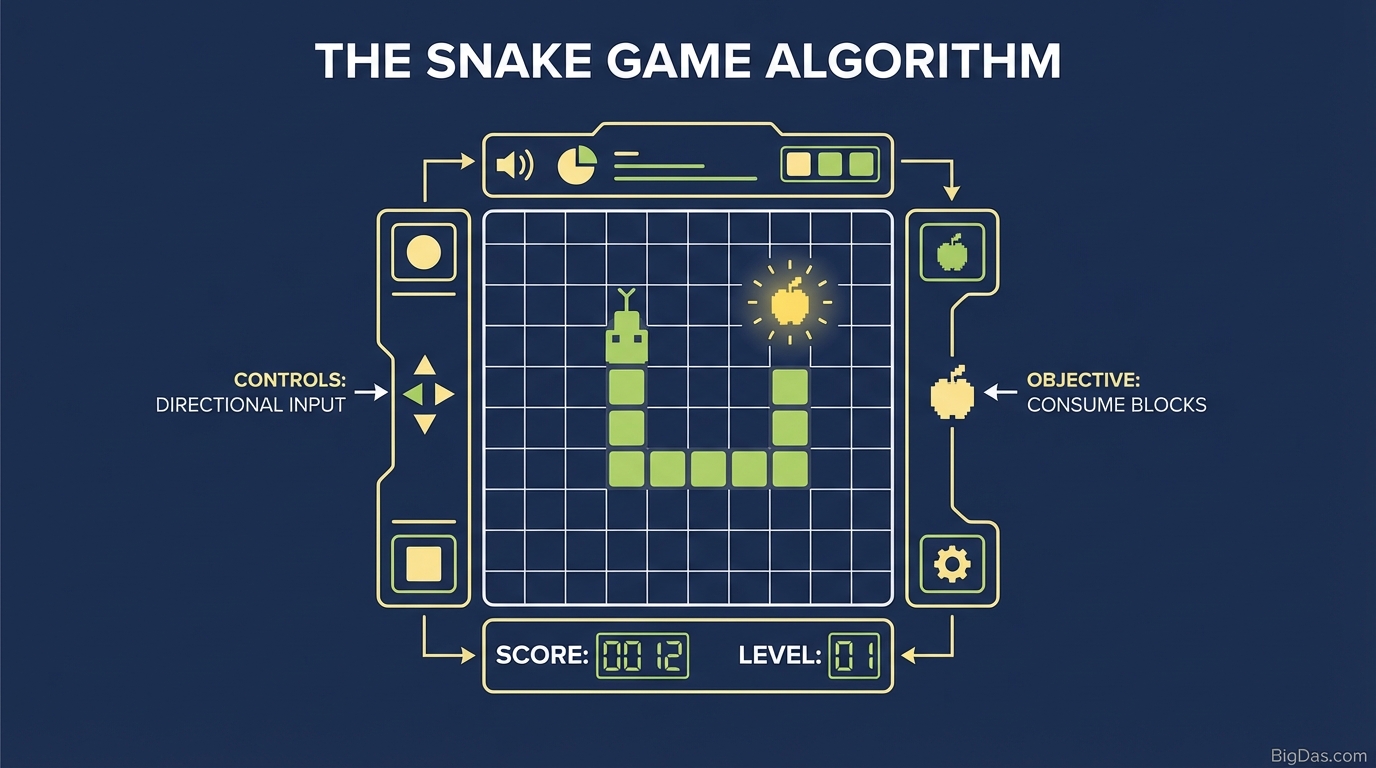
  1. ** The Avatar:** You control a "snake" (a moving array of coordinate blocks) that travels continuously in a specific direction.
  2. The Objective: Consume "food" (pellets) that spawn at random coordinates on the grid.
  3. The Consequence:
    • Growth: Every piece of food eaten adds one unit to the snake's length.
    • Velocity: In many iterations, the speed increases relative to the score.
    • Collision: The game terminates if the head coordinate overlaps with a wall coordinate or any coordinate currently occupied by the snake’s own body.

This creates a dynamic difficulty curve. The better you perform, the more hazardous the environment becomes, as your own tail essentially reduces the available safe space on the grid.


Key Features & Benefits of Our Snake Game Tool

Why play this version? Because we have optimized the code to strip away bloat, resulting in the purest, most responsive gameplay experience available on the web.

1. Precision Input Handling

Lag is the enemy of high scores. Our Snake Game utilizes low-latency input listening. Whether you are using mechanical arrow keys, WASD, or touch gestures on a tablet, the turn occurs exactly when you execute it. This precision is vital for high-level maneuvers like the "last-second pivot."

2. High-Contrast Visibility

Visual clutter causes eye strain. We utilize a clean, high-contrast aesthetic that allows players to easily distinguish the snake’s head from the tail and the target food, even at high speeds. This design choice minimizes cognitive load, allowing you to focus purely on pathfinding.

3. Adaptive Responsiveness

This tool is built for ubiquity. It scales perfectly from 4K desktop monitors to mobile viewports without sacrificing the grid aspect ratio, ensuring the difficulty remains consistent regardless of the device.

4. Cognitive Benefits

Beyond entertainment, this tool serves as a mental exercise:

  • Spatial Reasoning: You must constantly calculate the volume of the snake against the remaining area of the grid.
  • Impulse Control: It forces you to delay gratification (taking the direct route) in favor of survival (taking the safe route).
  • Reflex Sharpening: As speed increases, reaction times must decrease, firing up your neural pathways.

Step-by-Step Guide: How to Use the Snake Game

Ready to play? Follow this guide to ensure you aren't just playing, but playing optimally.

Step 1: Launch and Orientation

Upon loading the tool, you will see the game grid. Take a moment to orient yourself. Identify the boundaries (walls). The snake usually starts in the center.

  • Desktop: Place your fingers on the Arrow Keys or WASD.
  • Mobile: Prepare to swipe in the cardinal directions (Up, Down, Left, Right).

Step 2: The Early Game (Accumulation)

When the game starts, the snake is short and slow.

  • Action: Move directly toward the food.
  • Strategy: Use this time to get a feel for the input sensitivity. Don't worry about grid management yet; just eat.

Step 3: The Mid-Game (pathfinding)

Once the snake creates a shape (roughly 10-15% of the grid filled), you can no longer move in straight lines without risk.

  • Action: Avoid the center of the map.
  • Strategy: Start keeping your tail tidy. Don't leave "air pockets" (empty spaces surrounded by your body) that you can't access.

Step 4: The End-Game (Survival)

When the snake occupies 50%+ of the grid, the game changes from "hunting" to "surviving."

  • Action: Focus on the tail.
  • Strategy: You must ensure that every move you make leaves a path open to where your tail will move next. If you cut off your path to your tail, you will eventually run out of space and crash.

Advanced Strategy: How to Get the Most Out of This Tool

To transition from a casual player to a master of the Snake Game, you must adopt algorithmic thinking. Here are the expert techniques used by top-ranking players.

The "Wall Hugging" Technique

The safest place on the grid is the perimeter. By running your snake along the walls, you maximize the open space in the center of the board.

  • Why it works: It keeps the center uncluttered for when food spawns there, allowing for easy entry and exit maneuvers.

The "Zig-Zag" Pattern

When the snake is long, moving in a straight line is dangerous. Instead, move in a tight zig-zag pattern (e.g., Up one unit, Right all the way, Down one unit, Left all the way).

  • Why it works: This compresses the snake's body into a compact rectangle, essentially "packing" the grid efficiently like a hard drive defragmentation process.

The "Chasing the Tail" Safety Loop

If you are waiting for a path to open or need to recalculate your strategy, enter a loop where you simply follow your own tail.

  • Why it works: Since your tail moves forward every time you move forward, you will never collide with it as long as you follow its exact path. This is a holding pattern that buys you time.

Why You Need This Tool (Use Cases)

You might ask, "Why should I keep a tab open for the Snake Game?" This tool is more than a distraction; it is a utility for mental regulation.

1. The "Pomodoro" Reset

Productivity techniques like the Pomodoro method suggest 5-minute breaks after 25 minutes of deep work. doom-scrolling news feeds creates anxiety. Playing Snake requires total focus but utilizes a different part of the brain than creative or analytical work, providing a true "reset."

2. Anxiety Anchoring

The repetitive, rhythmic nature of the Snake Game can act as a grounding technique. When feeling overwhelmed, the binary nature of the game (turn left/turn right) simplifies the world into manageable decisions, lowering cortisol levels.

3. Pre-Game Warmup

For competitive gamers (FPS or MOBA players), the Snake Game is an excellent warm-up tool. It activates hand-eye coordination and fine motor skills without the stress of ranked gameplay.


Frequently Asked Questions (FAQ)

1. Is there a way to pause the game?

Yes. In most desktop versions, pressing the Spacebar or clicking outside the game window will pause the action. On mobile, tapping a specific pause icon or minimizing the browser usually halts the game state, allowing you to resume later.

2. Is there a "win" screen in Snake?

Technically, yes. If you fill every single coordinate on the grid with your snake's body, the game has nowhere to spawn new food. This is known as a "Perfect Game." It is incredibly rare and considered the holy grail of Snake mastery.

3. Does the snake speed up indefinitely?

Our tool is balanced. The speed increases at specific score thresholds to maintain a challenge, but it caps at a "Maximum Human Reflex" limit. This ensures the game remains a test of skill and strategy, rather than becoming physically impossible due to frame rates.

4. Why did I crash when I didn't hit the wall?

You likely hit yourself. As the snake grows, it is easy to lose track of where your tail is, especially if it is just off-screen or coiled tightly. Always keep a mental map of your tail's location.


Conclusion

The Snake Game is a testament to the idea that gameplay does not need to be complex to be profound. It is a battle of geometry, patience, and foresight. Whether you are looking to kill ten minutes, warm up your reflexes, or achieve the elusive "Perfect Game," our tool offers the smoothest, most reliable experience on the web.

Don't let the simplicity fool you. Mastering this grid requires a sharp mind and steady hands. Are you ready to test your limits?