Tetris
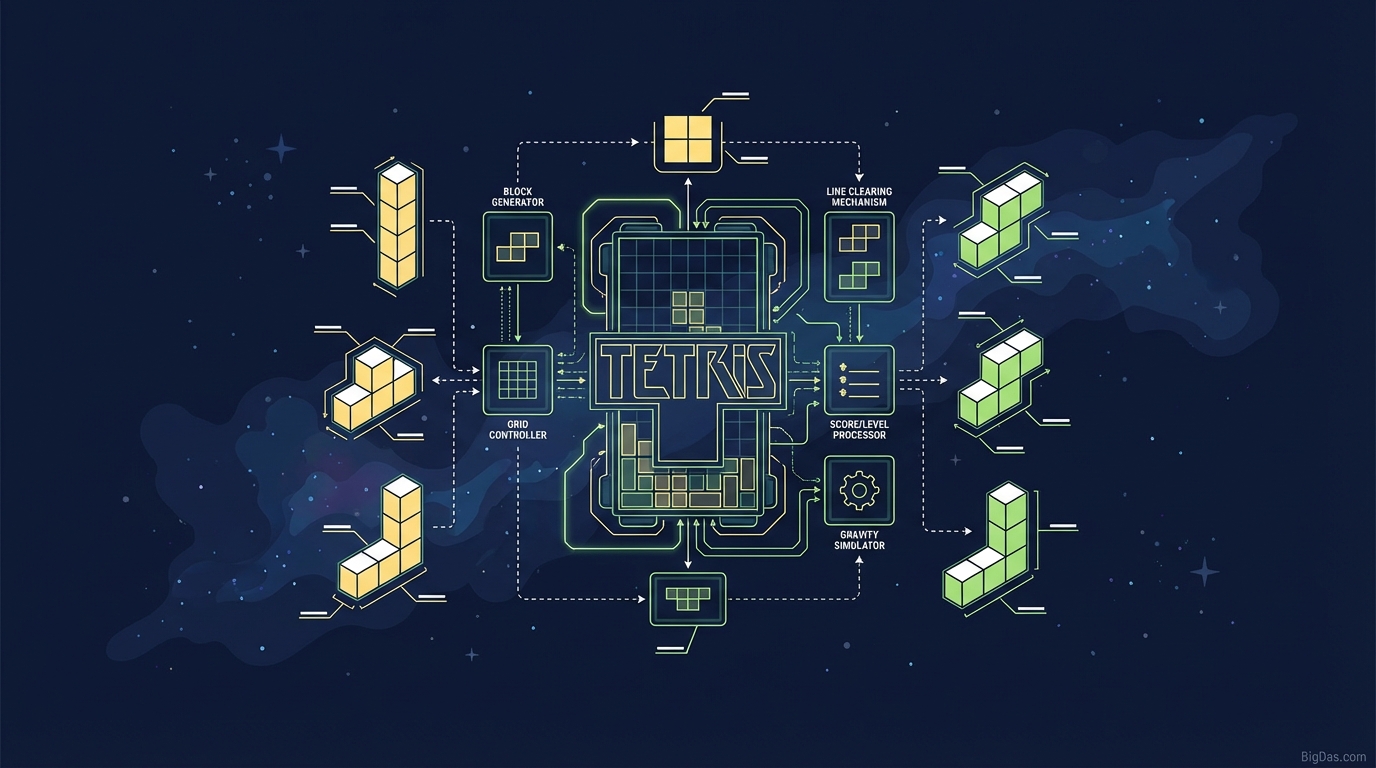
 Modern scientific illustration of Tetris
Master the Matrix: A Practical Guide to Tetris
Tetris is a falling-block puzzle game. The goal is to rotate and place seven distinct shapes to complete horizontal lines. The game has been used in cognitive research because it requires fast spatial decisions under time pressure.
This guide covers the mechanics, controls, and strategies of the tool.
What Is Tetris?
Tetris is a tile-matching puzzle game designed by Alexey Pajitnov in 1984. The play area is the Matrix, a grid 10 cells wide and 20 cells high. The shapes you manipulate are called Tetrominoes, and each one consists of four square blocks.
The Seven Tetrominoes
The game uses seven pieces, each named after the letter it resembles:
- I-Piece (Cyan): A 1x4 line. The only piece that can clear four lines at once (a "Tetris").
- O-Piece (Yellow): A 2x2 square. It fills corners but cannot close small gaps.
- T-Piece (Purple): A versatile shape used for advanced moves like T-Spins.
- S-Piece (Green) & Z-Piece (Red): The hardest pieces to place cleanly. Poor handling creates buried holes.
- J-Piece (Blue) & L-Piece (Orange): L-shaped blocks used to fill corners and level uneven stacks.
The Objective
Rotate pieces 90 degrees and slide them left or right to form a solid horizontal row. Completed rows vanish, and the blocks above drop down to fill the gap.
Gravity increases as the game progresses, giving you less time per piece. The game ends when a new piece cannot enter the Matrix. This is called a "Top Out."
Key Features
1. The Ghost Piece
A translucent outline shows where the current piece will land.
- Benefit: Eliminates guesswork and allows confident Hard Drops.
2. The Hold Queue
You can store the current piece and swap it for the next one.
- Benefit: Save an I-Piece for a four-line clear, or set aside an S/Z-Piece until the surface is flat.
3. The Next Queue
Displays the next 5 incoming pieces.
- Benefit: Enables look-ahead strategy. You build the stack to fit the pieces you haven't placed yet.
4. 7-Bag Randomizer
The game deals one of each of the 7 pieces before reshuffling.
- Benefit: Prevents long droughts of a single piece and keeps stacking patterns consistent.
5. Cognitive Benefits
Research on the "Tetris Effect" shows that regular play increases cortical thickness and improves pattern recognition. The game has also been studied as a way to reduce intrusive memories by occupying the brain's visual-spatial processing center.
How to Use Tetris
Step 1: Interface Calibration
Learn the layout before starting:
- Center: The Matrix.
- Top Left: Hold Queue.
- Right Side: Next Queue.
- Controls: Arrow keys move pieces. Space Bar triggers a Hard Drop.
Step 2: Build a Flat Foundation
Keep the stack low and flat. Leave one column empty on the far left or right. This is the Tetris Well.
- Tip: Avoid tall spires. They force you to wait for specific pieces.
Step 3: Manage the Queue
- If the current piece does not fit, press Hold to swap it.
- When the Next Queue shows an I-Piece, make sure your Well is open.
Step 4: Clear Four Lines
Single and double line clears are low value. Save them for emergencies.
- Wait until your stack is at least four rows high.
- Drop the I-Piece vertically into the open Well.
- This clears four lines and gives the highest score multiplier.
Step 5: Recover From Holes
A "hole" is an empty cell buried under a block. To fix it:
- Stop scoring and switch to Downstacking.
- Clear the rows above the hole using J and L pieces.
- Continue until the hole is exposed and filled.
Use Cases
1. Mental Reset
A 10-minute session shifts brain activity and reduces cognitive fatigue. It works as a break between focused tasks.
2. Flow State
Tetris matches difficulty to skill through increasing speed. This balance makes it a reliable trigger for flow, a state of full absorption that reduces perceived stress.
3. Spatial Reasoning
Rotating and placing pieces under time pressure exercises the same neural pathways used in 3D visualization. Useful for designers, engineers, and architects.
4. Decision Speed
The game requires fast, low-cost decisions. Regular play trains the brain to commit to choices rather than hesitate.
Advanced Strategy
- Finesse: Use the minimum keystrokes to place a piece. Each wasted input costs time at high gravity. Memorize the key counts for standard placements.
- T-Spins: Rotating a T-piece into a tight T-shaped slot at the last second scores a bonus equal to a Tetris. This generates points without raising the stack height.
- 6-3 Stacking: Leave the Well in the 7th column instead of the edge. This splits the board into a 6-wide section and a 3-wide section, which uses T, J, and L pieces more efficiently.
Frequently Asked Questions (FAQ)
1. Is there an end to Tetris?
The game ends when you Top Out. Gravity caps at a maximum level (usually 15 or 20), after which the game becomes a test of endurance. Classic NES versions crash at level 29 due to an integer overflow, but this tool has no kill screen.
2. What is the difference between "Hard Drop" and "Soft Drop"?
A Soft Drop (Down Arrow) speeds up the descent but allows last-second side movement. A Hard Drop (Space Bar) locks the piece instantly at its current position.
3. Can Tetris help with anxiety?
Studies on trauma suggest that playing Tetris shortly after a distressing event can reduce intrusive memories. The visual load competes with the brain's resources for forming mental images.
4. Why do the pieces speed up?
Speed is the difficulty curve. A constant pace would not force you to optimize your decisions. Gravity ramps up to test your efficiency under pressure.
Conclusion
Tetris is a closed system with a clear goal, immediate feedback, and a difficulty curve that scales with the player. It is a direct test of spatial reasoning and decision speed.
Use it to warm up before focused work, decompress afterward, or practice high-level stacking. The Matrix is ready.