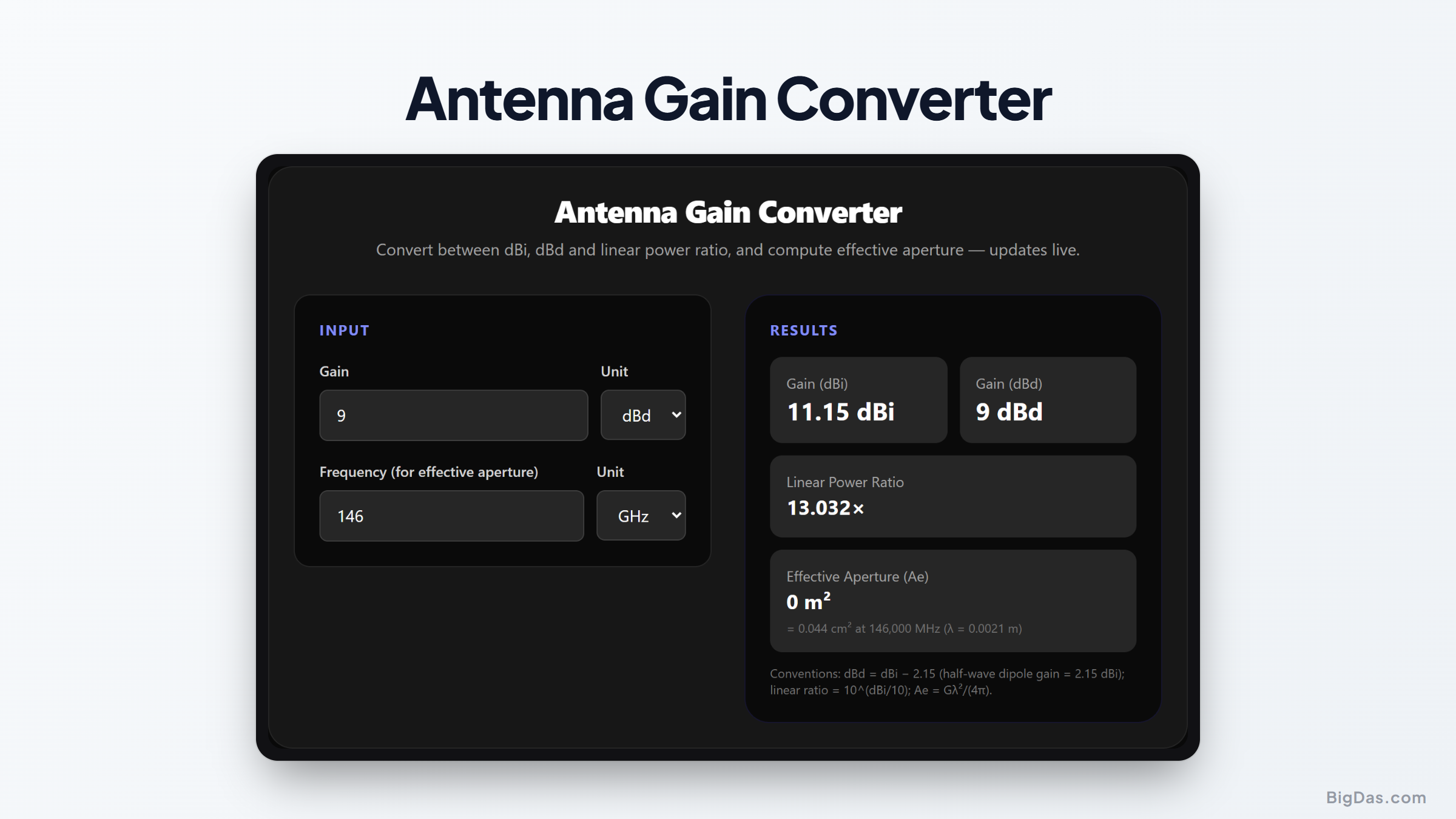
Antenna Gain Converter
 Interface snapshot for Antenna Gain Converter
Translate dBi, dBd, and linear ratio before the spec sheet fools you.
Free Antenna Gain Converter Online. Big Das
Antenna datasheets mix units constantly. One vendor quotes dBi, another dBd, a physics text gives the linear ratio. The Big Das Antenna Gain Converter switches between the two decibel scales, derives the power ratio, and computes effective aperture at any frequency, all client-side and live.
What Is Antenna Gain?
Antenna gain measures how much an antenna focuses radio energy in a given direction relative to a benchmark. Two benchmarks dominate:
- dBi: decibels relative to a perfect isotropic radiator, a theoretical point source radiating equally in all directions. Real antennas concentrate energy into beams, so dBi values are almost always above 0.
- dBd: decibels relative to a half-wave dipole. A dipole itself concentrates power slightly (2.15 dBi), so dBd values are 2.15 lower numerically than dBi for the same antenna.
Spec sheets exploit this gap. A "7 dBd" yagi sounds modest but equals 9.15 dBi. The linear ratio shows how many times more power actually reaches the target.
How to Use the Antenna Gain Converter
- Enter the gain value: negative values are allowed (a lossy small antenna can sit below isotropic).
- Pick the unit: dBi or dBd.
- Enter a frequency (kHz, MHz, or GHz) to enable effective-aperture calculations.
- Read the results: dBi, dBd, linear ratio, wavelength, and effective aperture in m² and cm² update live.
The Formulas Used
dBd = dBi − 2.15
dBi = dBd + 2.15
G(lin) = 10^(G(dBi) / 10)
λ = c / f (c = 299 792 458 m/s)
Ae = G · λ² / (4π)
The constant 2.15 dB is the free-space directivity of a half-wave dipole. Effective aperture links gain to physical size, think of Ae as the area of radio wave the antenna can collect.
Worked Example
A handheld antenna is rated 7 dBd at the 2 m amateur band (146 MHz):
- In dBi: 7 + 2.15 = 9.15 dBi
- Linear ratio: 10^(9.15/10) ≈ 8.22×, roughly eight times more power in its best direction compared with an isotropic antenna fed the same power.
- Wavelength at 146 MHz: λ ≈ 299.79 / 146 ≈ 2.05 m
- Effective aperture: 8.22 × (2.05²) / (4π) ≈ 2.75 m²
That aperture means the antenna "catches" the radio energy crossing a patch of about 2.7 m², a useful picture of why higher gain corresponds to a larger capture area.
Common Use Cases
- Comparing vendor specs before an RF purchase.
- Link-budget work where the path math wants dBi but the antenna is rated in dBd.
- Ham radio antenna design: converting gains from modeling software to datasheet language.
- Radar and RFID reading range estimates that call for the linear ratio or aperture.
Frequently Asked Questions
Why is a dipole already 2.15 dBi?
A dipole radiates more power broadside-on and almost none off its ends. That concentration is worth 2.15 dB over a point source that radiates uniformly in every direction.
Can antenna gain be negative (below 0 dBi)?
Yes. Any antenna less directional than isotropic, such as a lossy electrically-small whip or a highly mismatched stub, has dBi below zero. The linear ratio then sits between 0 and 1.
Are dBi and dBd interchangeable?
No. Always check which scale a datasheet uses. dBd figures are 2.15 lower numerically than dBi, so comparing a 9 dBi omni with a 7 dBd dipole array is really comparing 9.0 vs 9.15 dBi, much closer than they first appear.
Why is effective aperture frequency-dependent?
Longer wavelengths mean a larger patch of wavefront to capture for the same gain, so Ae scales with λ². Doubling frequency quarters the aperture unless gain rises to compensate.
Can I use this for receive gain?
Yes. Reciprocity says receive gain equals transmit gain for the same antenna, so Ae also tells you how much incident power a receiving antenna can collect.
Where does the constant 2.15 come from exactly?
It is 10·log10(1.64): the free-space directivity of a half-wave dipole derived from classical antenna theory (Harrington, Balanis).