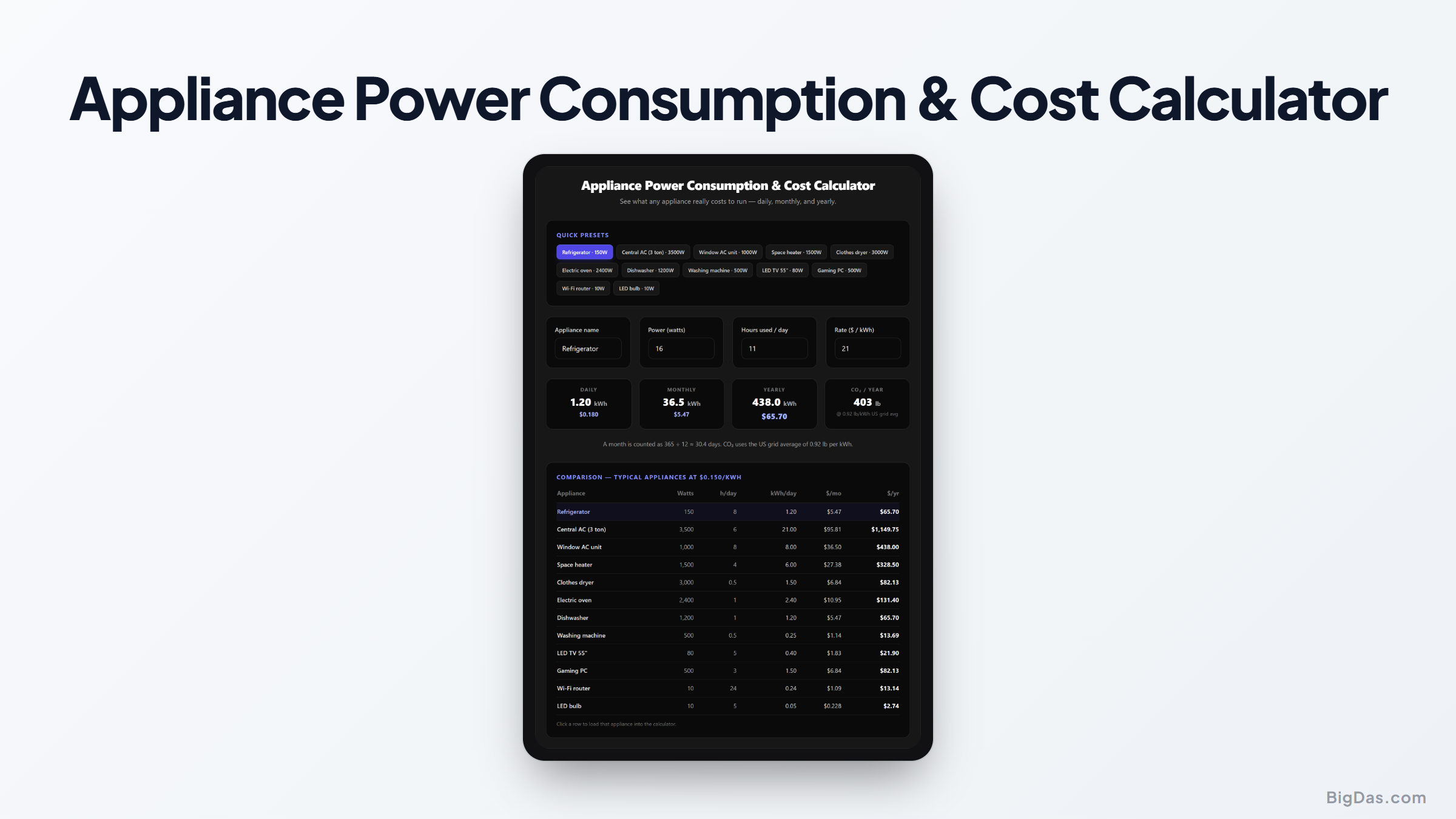
Appliance Power Consumption & Cost Calculator
 Generated infographic and interface snapshot for Appliance Power Consumption & Cost Calculator
How to Calculate Appliance Power Consumption and Estimate Your Electricity Cost
Household energy bills can feel like a monthly mystery. You open the envelope or email, look at the total, and wonder how it got so high. You know major systems like your air conditioner or water heater use a lot of energy, but it is hard to see how individual devices contribute to that number.
Calculating these costs is the first step to lowering them. An appliance power calculator translates the wattage printed on the back of your devices into actual dollar amounts. Once you know how much each appliance costs to run, you can make better choices about when and how to use it.
What is the Appliance Power Consumption & Cost Calculator?
The calculator estimates the electricity cost of running any household device. It converts the technical numbers on your appliances into the financial numbers on your utility bill.
To find the cost of running a device, the tool needs three inputs: the appliance wattage, the number of hours it runs per day, and your local electricity rate per kilowatt hour. It combines these values to show what the device costs over daily, monthly, and yearly periods.
Small habits add up. A television left on in the background or a space heater running in a spare bedroom can quietly add dozens of dollars to your monthly expenses. The calculator surfaces these hidden costs so you can see exactly where your money goes.
Key Features & Benefits
Using a dedicated calculator offers several practical advantages for managing your home budget.
Multi-Timeframe Projections: The tool calculates cost across daily, monthly, and yearly intervals, so you can see both short-term impact and long-term expense.
Customizable Electricity Rates: Utility prices vary by location and provider. The calculator lets you enter your exact rate per kilowatt hour for accurate results.
Accurate Wattage Cost Estimation: It handles anything from a low-power phone charger to a high-power clothes dryer.
Simple Interface: Results are shown in clear monetary terms. You do not need any electrical knowledge to use it.
Support for Smart Budgeting: By identifying your most expensive appliances, you can target specific devices to reduce usage and lower your bill.
Step by Step Guide on How to Use It
Using the power consumption calculator takes only a few moments. Here is how to find the cost of any device in your home.
First, locate the wattage of your appliance. This number is usually printed on a metal plate or sticker on the back or bottom of the device. Look for a number followed by a capital W. If the label only lists amps and volts, multiply them together to get the wattage.
Second, estimate how many hours per day you use the appliance. For a coffee maker, this might be fifteen minutes, or 0.25 hours. For a refrigerator or a router, it is 24 hours.
Third, find your electricity rate. This is on your most recent utility bill, expressed as a price per kilowatt hour, such as $0.14.
Once you have these three numbers, enter them into the calculator:
- Input the appliance wattage.
- Enter the average number of hours the device is active each day.
- Input your specific kilowatt hour rate.
The calculator displays your daily, monthly, and yearly costs instantly.
To understand the math behind it, the calculator uses a simple two-part formula.
First, it converts watts to kilowatt hours:
Kilowatt hours = (Wattage × Hours of use) ÷ 1000
Next, it multiplies the kilowatt hours by your electricity rate:
Total cost = Kilowatt hours × Electricity rate
The tool performs this calculation automatically.
Why You Need This Tool (Use Cases)
There are several practical scenarios where measuring your wattage cost leads to better household decisions.
Evaluating Older Appliances: Older refrigerators, washing machines, and air conditioners often use significantly more electricity than modern models. Calculating the yearly cost of an old appliance helps you decide if an energy-efficient replacement will actually pay for itself.
Managing Seasonal Energy Spikes: Space heaters in winter and portable air conditioners in summer can drive up utility bills. Calculating the hourly cost of these devices helps you set limits on their use.
Identifying Vampire Draw: Game consoles, television boxes, and chargers draw a small amount of standby power even when turned off. Calculating this baseline consumption helps you decide which devices belong on smart power strips.
Sizing Alternative Energy Systems: If you are considering solar panels or a portable generator, knowing your daily kilowatt hour needs is essential for sizing the system correctly.
Teaching Energy Awareness: The tool is useful for showing family members or students how everyday habits translate into financial costs.
FAQ Section
How do I find the wattage of an appliance if it is not listed?
If the label does not list watts directly, it will list voltage and amperage. Multiply these two numbers to get the wattage. For example, a device running on 120 volts and using 2 amps consumes 120 × 2 = 240 watts.
Why does my calculated cost differ slightly from my actual utility bill?
The calculator assumes steady usage. Many appliances do not draw maximum power constantly. A refrigerator cycles on and off throughout the day, and a microwave only runs in short bursts. Some utility companies also charge different rates based on the time of day or your total monthly usage.
What is a kilowatt hour?
A kilowatt hour is the standard unit utility companies use to measure electricity. It equals the energy consumed by a 1,000-watt appliance running for one hour. For example, a 10-watt LED bulb running for 100 hours uses 1 kilowatt hour.
Which household appliances typically use the most power?
Devices that generate heat or cooling use the most energy. This includes central air conditioners, space heaters, water heaters, clothes dryers, and electric ovens. Electronics like laptops, phone chargers, and LED light bulbs use far less.
Is it worth unplugging appliances when they are not in use?
For certain devices, yes. Items with external power bricks, continuous displays, or instant-on features continue to draw electricity when turned off. The standby cost per device is small, but multiplied across dozens of items in a household, it can add up over a year.
Summary of Value
Controlling your energy expenses does not require drastic lifestyle changes. It starts with clear information and small, deliberate adjustments.
Using an appliance power calculator removes the guesswork from your utility bills. Knowing the relationship between wattage, active hours, and your electricity rate lets you identify which devices are driving up your costs. From there, you can make practical changes, compare appliances accurately, and keep more money in your pocket.