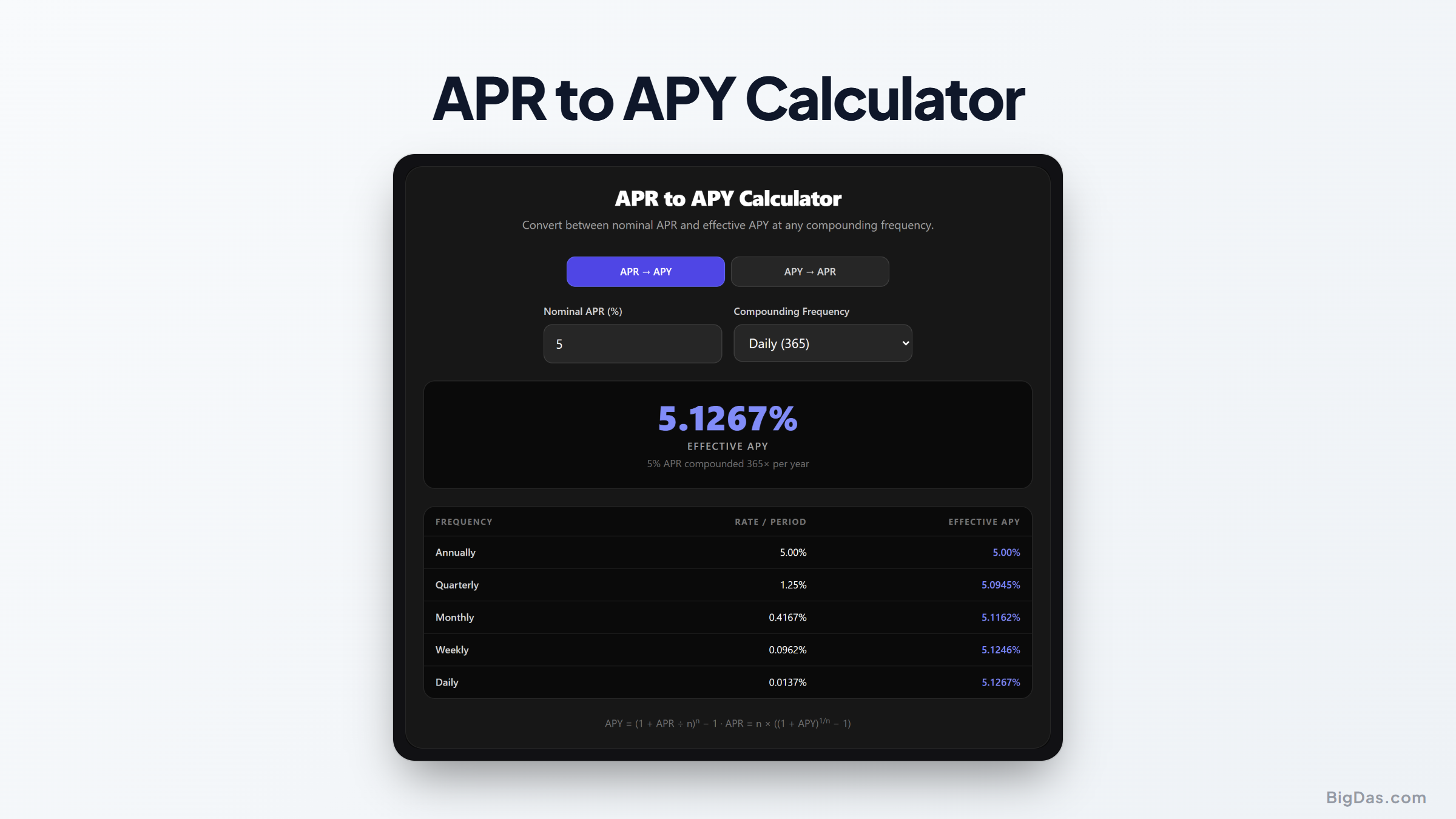
APR to APY Calculator
 Generated infographic and interface snapshot for APR to APY Calculator
APR to APY Calculator: How to Compare Interest Rates Accurately
Financial products advertise rates in different formats. A credit card statement shows a low Annual Percentage Rate (APR) to make borrowing look cheap. A high yield savings account promotes a high Annual Percentage Yield (APY) to make earnings look large. Both numbers describe a one year interest figure, but they are not the same metric.
APR is the simple annual interest rate. It ignores compounding. APY is the effective annual rate and includes the effect of compound interest. When interest compounds daily, weekly, or monthly, the real cost of a loan goes up and the real earnings on a deposit go up. Comparing these figures without conversion produces bad numbers. An APR to APY calculator converts simple interest into effective interest and back, so you know exactly what a product pays or costs.
What is the APR to APY Calculator?
The APR to APY calculator converts a nominal annual percentage rate into an effective yield rate based on a chosen compounding schedule. It also works in reverse as an APY to APR converter for analyzing savings accounts, CDs, and investment products. The core terms:
- Annual Percentage Rate (APR): The nominal interest rate on a loan or investment over one year. It does not include compounding.
- Annual Percentage Yield (APY): The effective annual rate, including the effect of compounding.
- Compounding Frequency: How often interest is added back to the principal. Common values are daily, monthly, quarterly, semiannually, and annually.
- Periodic Interest Rate: The nominal rate divided by the number of compounding periods per year. A 12% annual rate with monthly compounding is a 1% rate per month.
The calculator takes your base rate and compounding interval and returns the effective total rate. It also outputs a nominal to periodic rate conversion table showing the rate applied at each step of the timeline.
Key Features and Benefits
Working out interest math by hand is slow. The calculator handles the standard cases:
- Two Way Conversion: Convert APR to APY, or convert an advertised APY back to a nominal APR.
- Multiple Compounding Options: Daily, weekly, monthly, quarterly, semiannual, and annual frequencies.
- Periodic Rate Breakdowns: A table that shows the exact percentage applied per period.
- Accurate Comparisons: Compare loans or investments on the same basis by normalizing rate formats.
- Instant Results: No manual algebra. You get the numbers immediately.
Step by Step Guide on How to Use the Calculator
- Select Your Conversion Mode: Pick APR to APY or APY to APR.
- Enter the Base Interest Rate: Type the percentage from your bank, lender, or platform.
- Choose the Compounding Frequency: Select how often interest is applied. Daily is 365 periods per year, annual is 1.
- Review the Output: The converted rate appears immediately. APR in gives a higher APY out. APY in gives a lower nominal APR out.
- Examine the Conversion Table: Look at the periodic rate per period and the total annual compounding effect.
Why You Need This Tool: Real World Use Cases
Lenders and platforms pick whichever rate makes their product look better. A conversion tool lets you check the actual cost or return.
Evaluating Credit Cards and Personal Loans
Credit cards quote an APR but usually compound interest daily. A 20% APR with daily compounding produces an effective annual rate above 22%. The calculator shows the real annual cost of carrying a balance.
Comparing Savings Accounts and Certificates of Deposit
Banks advertise APY because the compounding makes the number larger. To compare a 5.00% APY with daily compounding against a 4.95% APR with monthly compounding, convert both to the same rate and pick the higher one.
Analyzing Crypto Staking and DeFi Products
DeFi platforms and crypto exchanges mix APR and APY in their marketing. Some pay simple daily rewards, others auto compound. Converting to a common standard gives a reliable one year projection.
Evaluating Mortgage and Business Financing
Different lenders use different accrual schedules. Converting periodic interest into one annual figure lets buyers and business owners rank offers by true cost.
Frequently Asked Questions
What is the primary difference between APR and APY?
APR is the simple annual rate without compounding. APY is the effective annual rate including compounding.
Why is APY always higher than APR when interest compounds?
APY includes interest earned on previously accumulated interest. When compounding happens more than once per year, APY exceeds APR.
How does compounding frequency impact the final yield?
More compounding periods per year produce a higher APY for the same nominal rate. Daily compounding beats monthly and quarterly.
Can APY and APR ever be equal?
Yes. When interest compounds once per year, no intermediate compounding happens and APR equals APY.
How do you convert APY back into APR manually?
You need the number of compounding periods per year. The formula derives the periodic rate from the effective rate, then multiplies by the number of periods. An online converter runs the same formula.
Summary of Key Value Points
APR and APY describe different things. APR ignores compounding. APY includes it. Converting between the two is required when you compare loans, savings products, or investments. An APR to APY calculator does the conversion in one step and gives you a clean periodic rate table. Use it every time you evaluate a financial offer so your decision is based on the actual rate, not the marketed one.