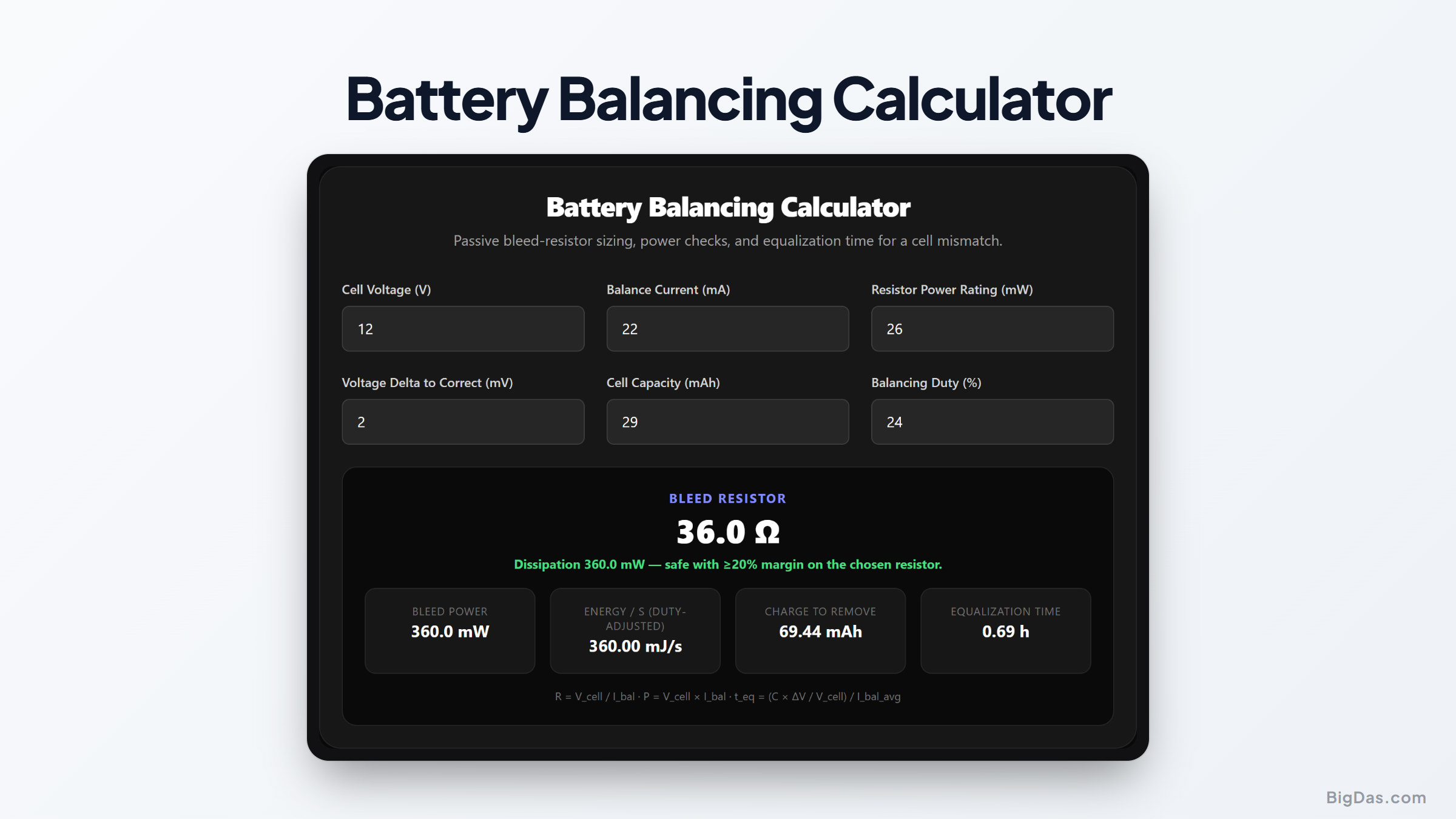
Battery Balancing Calculator
 Generated infographic and interface snapshot for Battery Balancing Calculator
Size the bleed resistor and estimate how long a mismatched pack takes to equalize.
Passive Balancing Basics
A passive balancer places a resistor across each cell and switches it on when the cell leads the pack. The bleed current burns the excess charge as heat.
Resistor value (Ohm's law across the cell):
$$R_{bleed} = V_{cell} / I_{balance}$$
Power dissipation, worst case:
$$P = V_{cell} \times I_{balance} = V_{cell}^2 / R_{bleed}$$
A resistor should run below 80 % of its rating, common choices are ¼ W (250 mW) and ½ W (500 mW) parts; the typical ½ W rating supports roughly 400 mW with margin.
Equalization time for a cell-voltage mismatch ΔV: the charge to remove is approximately
$$\Delta Q = C_{cell} \times \Delta V / V_{cell} \quad \text{(charge proportional to OCV difference)}$$
$$t_{eq} = \Delta Q / I_{balance_avg} \quad \text{where } I_{balance_avg} = I_{balance} \times \text{duty}$$
This assumes the cell's open-circuit voltage tracks its charge linearly over the imbalance region, accurate on the Li-ion voltage plateau; near full or empty, the slope is steeper and equalization is faster.
How to Use the Battery Balancing Calculator
- Cell voltage: nominal or present cell voltage (e.g. 3.6 V for Li-ion, 3.2 V for LiFePO₄).
- Balance current: the target bleed current in mA (typical 50 to 200 mA).
- Resistor power rating: the rating of the part you intend to use (mW).
- Voltage delta: the highest-minus-lowest cell voltage to correct (mV).
- Cell capacity: capacity of the imbalanced cell (mAh).
- Balancing duty: percent of time the bleed FET conducts; 100 % if continuous.
- Read the results: resistor value, dissipation check against the rating, charge to remove, and equalization time.
Worked Example
A 3.6 V cell is 100 mV ahead of the pack. The BMS can source 100 mA continuously (100 % duty), and the cell is 2500 mAh.
- R_bleed = 3.6 V / 0.100 A = 36 Ω
- Power = 3.6 × 0.1 = 0.36 W = 360 mW → a ½ W resistor gives a 28 % margin; the calculator confirms the choice is safe.
- Charge to remove = 2500 × (100/3600) ≈ 69.4 mAh
- t_eq = 69.4 mAh / 100 mA ≈ 0.694 h ≈ 42 min
If the BMS balances at a 50 % duty cycle top-of-charge, double the estimate to ≈ 1.4 h.
Common Use Cases
- DIY BMS and battery rebuilds: size one bleed resistor per cell.
- E-bike and power-tool packs: understand why balancing takes days on heavily drifted packs.
- RC LiPo maintenance: check balance-board bleed current against cell capacity.
- Energy-storage commissioning: plan the initial top-balance duration.
- Choosing between ¼ W and ½ W resistors: the power check flags undersized parts.
Frequently Asked Questions
Why must the resistor be derated?
A resistor run at 100 % of its rating climbs toward its maximum surface temperature, which ages the film and shifts its value. Keeping dissipation under ~80 % adds thermal margin and long-term stability.
Is equalization really linear in ΔV?
Approximately, on the flat middle of a Li-ion discharge curve. Near 4.2 V or 3.0 V, small charge changes move voltage far more, so equalization completes faster there, the linear estimate is conservative.
My pack only balances while charging. What duty should I use?
Estimate how many minutes per hour the charger sits in the constant-voltage phase (that is when the BMS bleeds). 30 % duty is typical for a charger that tops off quickly and idles.
Can I balance at the bottom of discharge?
Top balancing is preferred: bottom voltages are steep, so a small tolerated charge difference looks like a large voltage difference, wasting energy. Most BMS firmware balances near full charge.
What current is typical for BMS bleed paths?
From tens of mA on small packs to 100 to 200 mA on e-bike batteries and up to 1 to 2 A on large EV modules. Above ~200 mA, the heat and the wasted charge push designs toward active balancing.
Why does the calculator ask for cell capacity for equalization time?
The charge that must be removed to shift the OCV by ΔV scales with capacity: a 100 mV mismatch on a 100 mAh button cell is 2.8 mAh of charge, on a 2500 mAh cell it is 69 mAh, 25× longer equalization time.