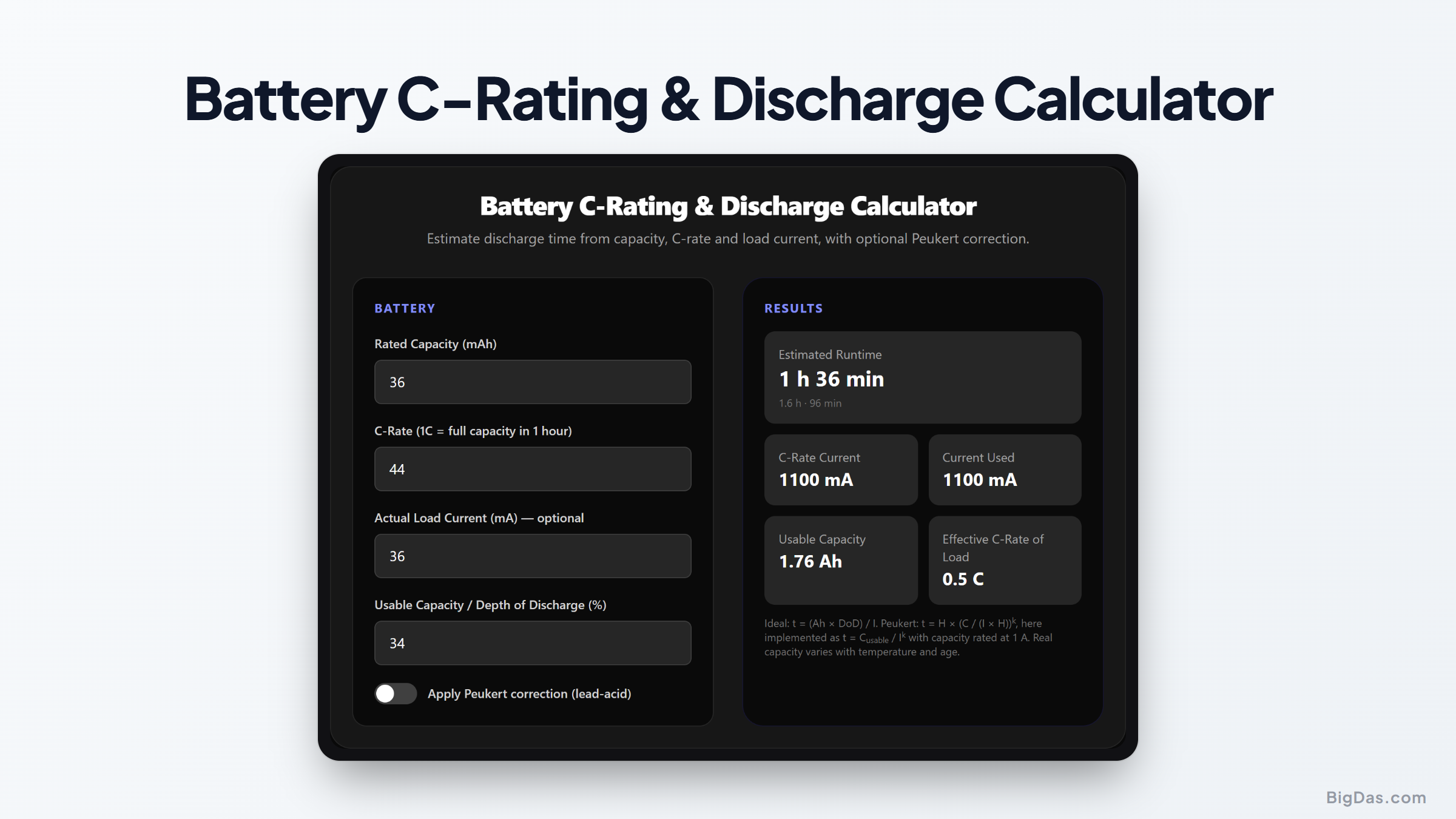
Battery C-Rating & Discharge Calculator
 Generated infographic and interface snapshot for Battery C-Rating & Discharge Calculator
Predict runtime from capacity, C-rate and load, with an optional Peukert correction.
Free Battery C-Rating & Discharge Calculator Online. Big Das
"How long will this battery last?" is the first question in every portable project. The honest answer requires more than dividing amp-hours by amps. Discharge rate, usable depth of discharge, and (for lead-acid chemistry) the Peukert effect all move the real number. The Big Das Battery C-Rating & Discharge Calculator converts capacity, C-rate, and your actual load current into an estimated runtime, with an optional Peukert exponent for lead-acid predictions.
What Is a C-Rating?
A battery's C-rate expresses charge or discharge current relative to its capacity. A 2.2 Ah pack at 1C delivers 2.2 A for one hour; at 0.5C it delivers 1.1 A for two hours; at 2C it delivers 4.4 A for half an hour. The rating scales with the battery, which makes it a convenient universal way to describe how hard any pack is being pushed.
How to Use the Calculator
- Enter the rated capacity in mAh: from the pack label or datasheet.
- Enter the C-rate: this sets the reference current (C-rate × capacity).
- Enter your actual load current: or leave it blank to compute runtime at exactly the C-rate current.
- Set usable capacity / DoD: 100% for full discharge, 80% for typical Li-ion longevity, 50% if you never want to drop below half an SLA's charge.
- Toggle Peukert correction for lead-acid batteries and enter the exponent k from the datasheet (1.1 to 1.3 typical).
- Read the runtime live, plus the C-rate current, load's effective C-rate, and usable amp-hours.
The Formulas
- C-rate current:
I = C_rate × Capacity(Ah) - Ideal runtime:
t = (Ah × DoD) / I - Peukert runtime:
t = H × (C / (I × H))^k
Here H is the rating reference hours, C the rated capacity, I the discharge current, and k the Peukert exponent (1.0 = ideal battery). Peukert's law captures how lead-acid capacity shrinks when you drain it fast; Li-ion is much flatter (k ≈ 1.02 to 1.08).
Worked Examples
- RC drone pack: 2200 mAh LiPo at a 10 A draw → 2.2 Ah / 10 A = 13.2 minutes of full-throttle flight.
- Backup router: a 12 V 7 Ah SLA powering a 0.5 A router at 80% DoD → 5.6 Ah / 0.5 A = 11.2 hours ideal; with k = 1.15 the Peukert law nudges it slightly lower because the draw is gentler than the 1 A convention.
- 18650 flashlight: a 3.4 Ah cell at 1.5 A and 90% DoD lasts 3.06 / 1.5 ≈ 2.04 hours.
Common Use Cases
- Sizing battery packs for drones, robots, and portable instruments.
- Estimating UPS and emergency-lighting runtime from nameplate specs.
- Comparing nominal marketing capacity against a realistic, rate-corrected figure.
- Checking whether a high-drain device respects your cell's maximum continuous C-rating.
Frequently Asked Questions
Why is my measured runtime shorter than the ideal formula predicts?
The ideal t = Ah/I assumes the full rated capacity is available at any discharge rate. Internal resistance wastes energy as heat, voltage cutoffs stop discharge early, cold weather slashes capacity, and aged cells hold less than their label claims. Realistic runtimes are commonly 80 to 95% of the ideal figure.
When should I enable the Peukert correction?
Use it for lead-acid batteries (car, SLA, deep-cycle) being discharged at rates well above or below their rating reference, typically the 1 A or 20-hour convention. Skip it for lithium; at k = 1.0 the formula reduces to the ideal equation anyway.
What is depth of discharge (DoD) and why limit it?
DoD is the fraction of capacity you actually use. Deep discharges stress chemistry: routinely draining Li-ion to 0% or lead-acid below 50% dramatically shortens cycle life. Limiting DoD to 50 to 80% multiplies the number of charge cycles a pack survives.
Does a higher C-rate always mean shorter total energy?
For total runtime, yes, double the current and the clock time roughly halves. But energy delivered (Wh) also falls at high rates because voltage sags and losses grow, which is exactly what Peukert's exponent models.
Can I use this calculator for charging instead of discharging?
The C-rate current and time relationships work the same way in reverse, a 1C charge ideally refills a pack in an hour. Real chargers add a constant-voltage taper phase, so practical charge times run 1.5 to 2× the ideal figure.