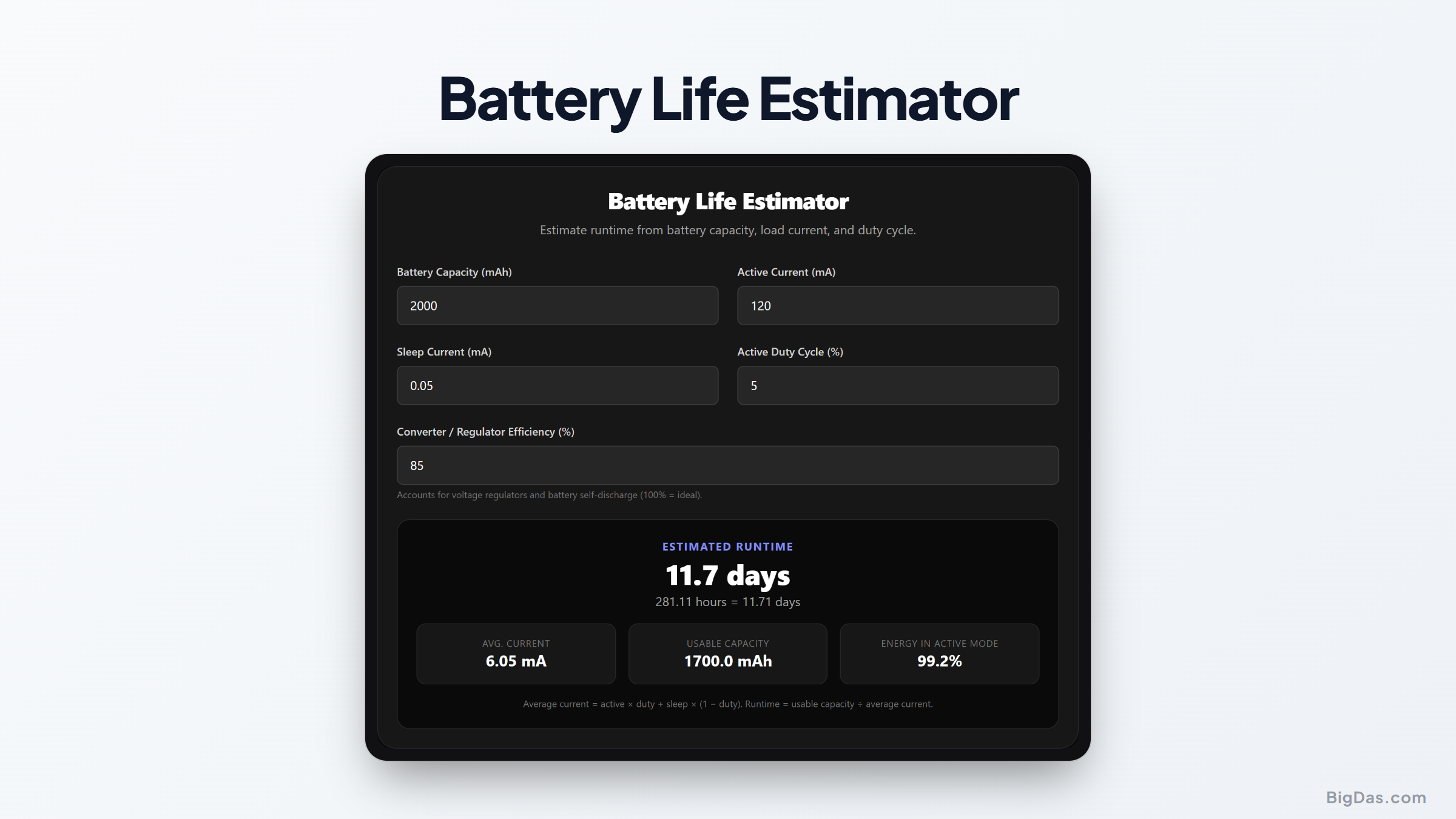
Battery Life Estimator
 Generated infographic and interface snapshot for Battery Life Estimator
Estimate how long your battery will really last.
Free Battery Life Estimator Online. Big Das
Knowing how long a battery will power your circuit matters for everything from IoT sensors to portable gadgets. The Big Das Battery Life Estimator takes capacity, load current, and duty cycle and returns a runtime prediction in your browser.
If you're sizing a coin cell for a BLE beacon or checking whether a power bank can run a Raspberry Pi over a weekend, this tool gives you the answer directly.
What Is a Battery Life Estimator?
A Battery Life Estimator computes the expected operating time of a battery-powered device. Batteries are rated in milliamp-hours (mAh), which describes how much current they can supply over time. Divide capacity by the device's average current draw to get a realistic runtime.
Real devices rarely draw a constant current. Microcontrollers sleep most of the time and wake briefly to transmit data. This tool accepts a duty cycle input so the estimate reflects actual behavior instead of the best-case continuous-load number.
Why Include Efficiency?
Voltage regulators, boost converters, and the battery's own self-discharge all waste a fraction of the stored energy. The efficiency input models those losses. A value of 85 to 90% is typical for a switching regulator; use 100% only for a direct connection with no regulation.
How to Use the Battery Life Estimator
- Enter Battery Capacity (mAh): Check the battery label or datasheet. A typical AA alkaline is ~2000 to 3000 mAh; a CR2032 coin cell is ~220 mAh.
- Enter Active Current (mA): The current your device draws while running. Measure it with a multimeter when possible.
- Enter Sleep Current (mA): The current drawn in standby or deep-sleep mode (often in the µA range, so enter 0.05 for 50 µA).
- Enter Active Duty Cycle (%): The percentage of time the device spends awake. A sensor that wakes for 1 second every minute has a duty cycle of about 1.7%.
- Enter Efficiency (%): Estimate your regulator's efficiency, or leave it at 85% as a default.
- Read the Results: The tool shows average current, usable capacity, and estimated runtime in hours and days.
The Formula Used
The calculation is straightforward:
- Average current = (Active current × Duty cycle) + (Sleep current × (1 − Duty cycle))
- Usable capacity = Battery capacity × (Efficiency ÷ 100)
- Runtime (hours) = Usable capacity ÷ Average current
- Runtime (days) = Runtime (hours) ÷ 24
Average current is the key insight: a device that sleeps 99% of the time draws far less current than one that runs continuously.
Worked Example
A wireless temperature sensor built around an ESP32:
- Battery: 2000 mAh Li-ion
- Active current: 120 mA (Wi-Fi transmission)
- Sleep current: 0.05 mA (deep sleep)
- Duty cycle: 5% (wakes 3 seconds every minute)
- Efficiency: 85%
Average current = (120 × 0.05) + (0.05 × 0.95) = 6 + 0.0475 ≈ 6.05 mA
Usable capacity = 2000 × 0.85 = 1700 mAh
Runtime = 1700 ÷ 6.05 ≈ 281 hours ≈ 11.7 days
If the duty cycle drops to 1%, average current falls to about 1.25 mA, stretching runtime to roughly 56 days.
Common Use Cases
- IoT sensors: Size batteries for remote temperature, humidity, or motion sensors.
- Wearables: Estimate how long a fitness tracker or smartwatch will run between charges.
- RC hobbies: Check flight time for drones or runtime for RC cars.
- Emergency lighting: Verify how long a backup battery will keep LEDs lit.
- Prototyping: Compare battery options before committing to hardware.
Frequently Asked Questions
What is milliamp-hour (mAh)?
mAh measures electric charge. A 1000 mAh battery can theoretically supply 1000 mA for one hour, 100 mA for ten hours, or 10 mA for one hundred hours. Real capacity varies with temperature, discharge rate, and battery age.
Why is my calculated runtime longer than reality?
Real batteries lose capacity at high discharge rates, in cold temperatures, and as they age. The efficiency input helps, but treat the result as a best-case estimate. Build in a safety margin of 20 to 30%.
How do I measure my device's current draw?
Use a digital multimeter in series with the battery. For very low sleep currents, use a µA meter or a tool like the Nordic Power Profiler Kit. Measurements beat datasheet guesses.
Does the duty cycle include startup time?
Yes. If your device takes extra time to boot or transmit, that time belongs in the active portion. Overestimating duty cycle slightly is the conservative approach.
Can I use this for LiPo, AA, and coin cells?
Yes. The math is chemistry-agnostic as long as you enter the correct capacity in mAh. Note that LiPo cells have a nominal 3.7 V while alkaline AAs are 1.5 V, which affects regulator efficiency.
What duty cycle should I use for a device that never sleeps?
Use 100%. The estimator then treats the active current as the average current, giving the standard "capacity ÷ load" runtime.