Bitcoin Halving Countdown
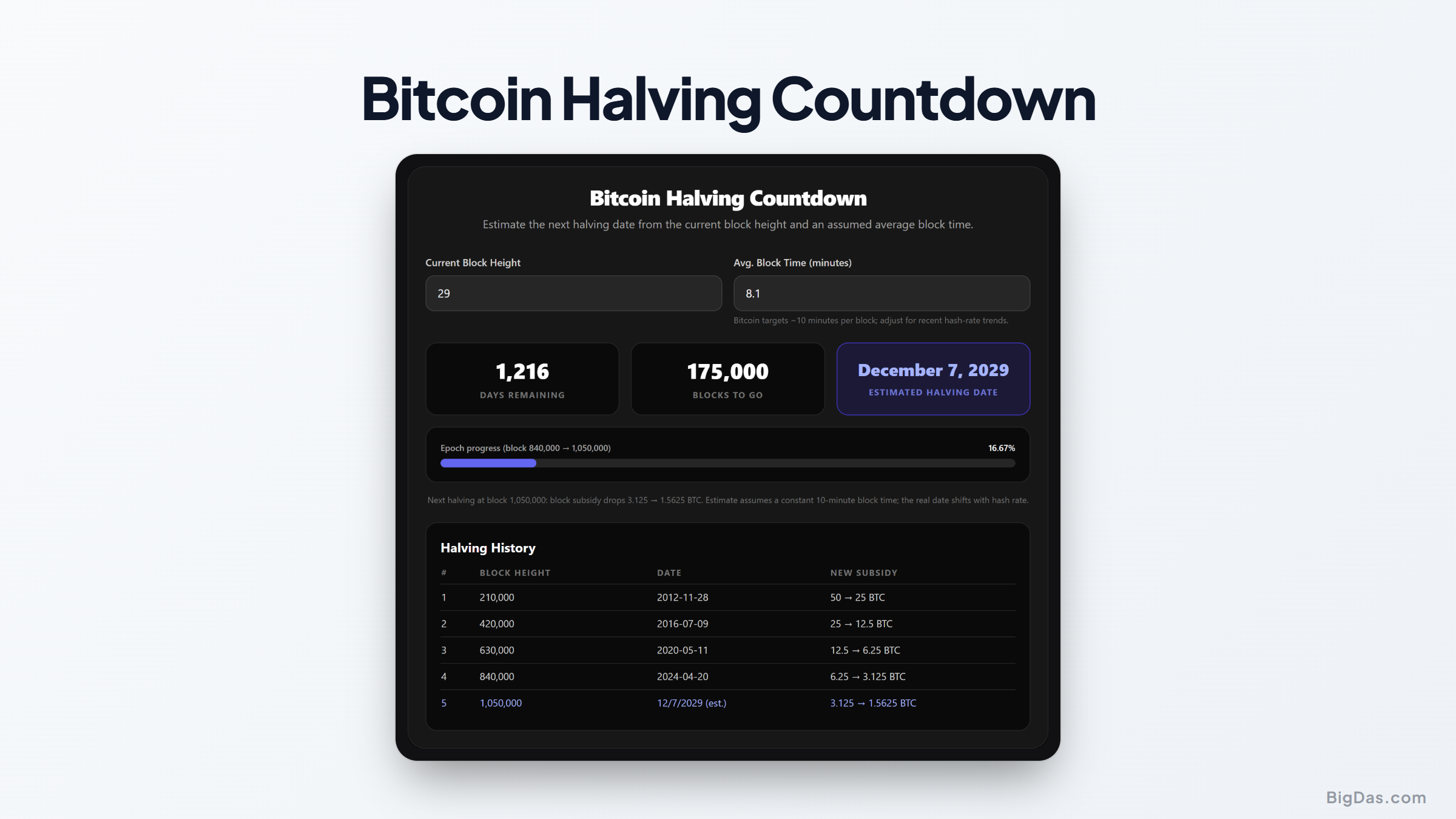
 Generated infographic and interface snapshot for Bitcoin Halving Countdown
Bitcoin Halving Countdown: Estimate Block Subsidy Cuts and Arrival Timelines
Every 210,000 blocks, the Bitcoin protocol halves the block subsidy, reducing newly minted coin issuance by 50%. This rule is hardcoded to enforce a predictable supply schedule and a maximum cap of 21 million coins. Because Bitcoin relies on decentralized consensus rather than a central calendar, the exact halving time must be calculated from real-time block height and current mining speeds. Standard date estimates often miss the effect of changing hash rate and difficulty. When computational power shifts, block times move above or below the ten-minute target. The Bitcoin Halving Countdown processes live blockchain stats, accepts custom inputs, and produces a halving estimate based on current network conditions.
What is the Bitcoin Halving Countdown Tool?
The Bitcoin Halving Countdown forecasts future block subsidy reduction events. It calculates projected dates from current block height and a custom average block time input. In Bitcoin, time is measured in block discovery, not seconds. Miners produce blocks roughly every ten minutes, and each 210,000-block cycle forms an issuance epoch. The first epoch paid 50 BTC per block. Subsequent halvings reduced the reward to 25, 12.5, 6.25, and 3.125 BTC. The tool computes the distance between the current block height and the next epoch boundary, then displays the result as days until halving. Because average block time shifts with mining activity, the block time field is adjustable so users can model different hash rate scenarios.
Key Features and Benefits
To evaluate coming changes in issuance schedules, analysts need tools that go past a simple clock.
Adjustable Bitcoin Block Time
Ten minutes is the long-term protocol target, but actual discovery speeds vary. During mining expansion, block times may average 9.5 minutes. During hash rate declines, they can stretch past 10.5 minutes. The calculator exposes this variable so you can see how network performance shifts the target date.
Live Height Tracking and Remaining Block Math
The tool cross-references the current block height against the next epoch milestone and shows exactly how many blocks remain before the subsidy drop.
Comprehensive Historical Epoch Table
The built-in table lists data from previous halvings: target heights, starting and ending subsidies, execution timestamps, and cumulative inflation rate drops across each era.
Flexible Arrival Projections
The tool recalculates arrival projections instantly when you change inputs. Dates appear in standard calendar format alongside countdown metrics in days, hours, and remaining blocks.
Step by Step Guide on How to Use It
Observe Default Network Height: Open the tool and check the current block height in the main stats module. The app automatically calculates blocks remaining until the next 210,000-block mark.
Review Default Time Settings: Check the default block time, which usually starts at the protocol target of ten minutes.
Simulate Custom Network Conditions: Find the block duration input. If you expect hash rate to rise from new hardware, lower the block time to 9.7 or 9.8 minutes. If you expect slowdowns, raise it.
Analyze the Recalculated Halving Estimate: Watch the projected date update on screen. Review the estimated days until halving for your scenario.
Inspect Historical Records: Scroll to the history table to review past subsidy cuts. Compare previous epoch lengths and issuance shifts against current progress.
Why You Need This Tool (Use Cases)
Accurate issuance modeling matters across the digital asset industry.
Mining Operations and Capital Expenditure
The block subsidy is the primary revenue stream for miners. A halving cuts per-block revenue in half while electricity and infrastructure costs stay the same. Mining companies use this tool to plan hardware upgrades, renegotiate power contracts, and maintain liquidity before subsidy cuts.
Portfolio Managers and Financial Analysts
Institutional funds and independent investors track the supply issuance curve to build long-term allocation models. Supply changes affect the daily flow of new coins, so analysts use halving estimates to structure risk management, schedule rebalances, and evaluate macro cycles.
Hardware Manufacturers and Data Center Logistics
ASIC designers and hosting providers align production runs with difficulty cycles. A reliable halving timeline helps them manage inventory, schedule shipments, and anticipate demand for efficient rigs.
Academic Researchers and Protocol Developers
Researchers studying proof of work need configurable models. Adjusting block time lets them test difficulty adjustment responsiveness, evaluate security across issuance eras, and track the long-term shift to a fee-based security budget.
Frequently Asked Questions
Why does the projected halving date keep changing?
Blocks are found through probabilistic proof of work. The protocol adjusts difficulty every 2,016 blocks to target a ten-minute average, but total hash rate fluctuates. When miners connect or disconnect, blocks are found faster or slower, which moves the projected date.
What is the difference between the block subsidy and transaction fees?
The block reward has two parts: the subsidy and transaction fees. The subsidy is newly minted BTC created with each valid block. Fees are paid by users to have transactions included. The subsidy halves every 210,000 blocks. Fees fluctuate with demand for block space.
How often does a Bitcoin halving occur?
A halving occurs every 210,000 blocks. At ten minutes per block, that is roughly four years per epoch. Exact duration depends on hash rate growth and difficulty adjustments during that period.
Will the total supply of Bitcoin ever go above 21 million?
No. The schedule continues halving the subsidy every 210,000 blocks until it reaches zero around 2140. At that point, no new BTC is created, and total supply stays capped just below 21 million.
Why is an adjustable block duration feature necessary?
Static tools assume every future block takes exactly 600 seconds. In practice, sustained hash rate growth has pushed multi-year averages slightly under ten minutes. Letting users set the average block time allows realistic scenario testing and range forecasting.
Summary
Tracking Bitcoin's monetary policy requires tools that reflect on-chain reality, not fixed calendar dates. The Bitcoin Halving Countdown calculates remaining blocks, gives direct control over average block timing, and provides historical epoch records. It delivers a data-driven view of network issuance for mining operators, protocol researchers, and market analysts who need projections that stay accurate as the network advances block by block.