BMI Calculator
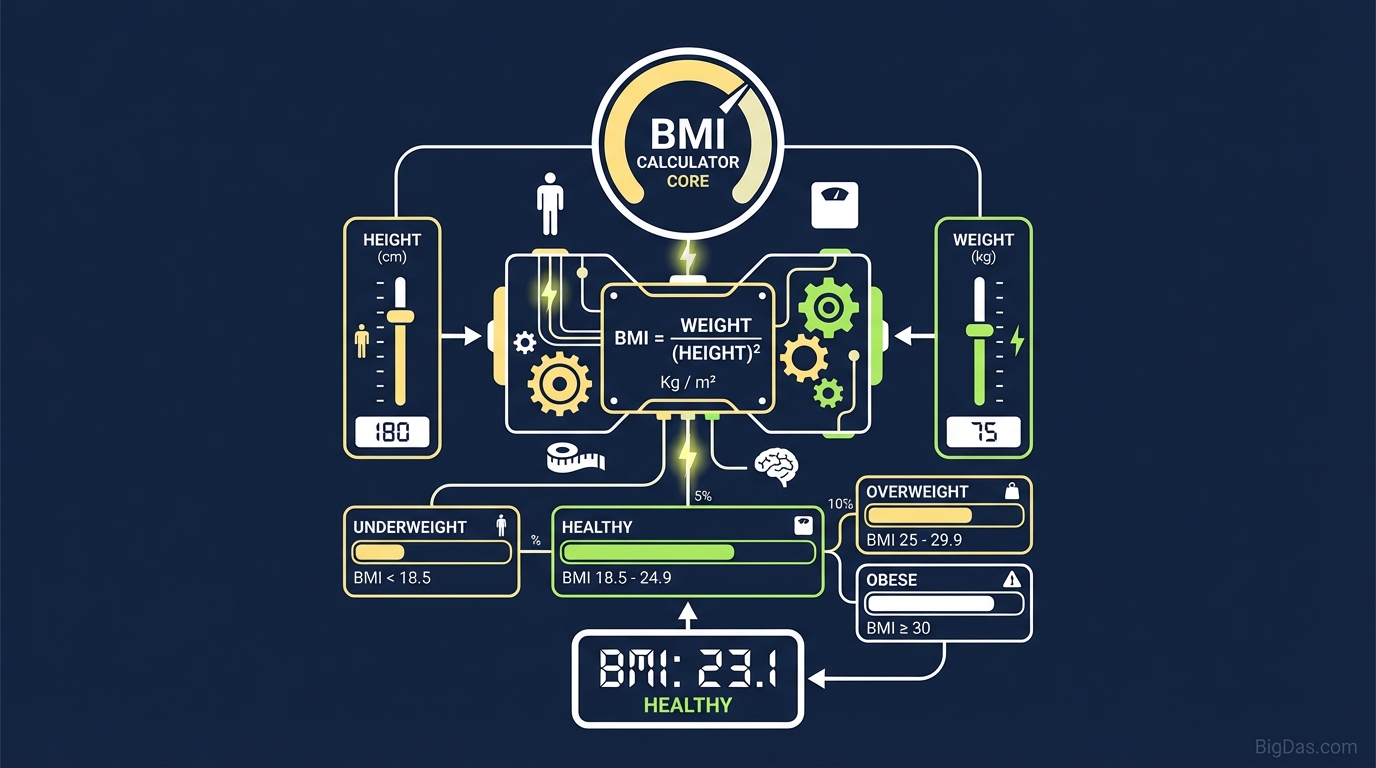
 Modern scientific illustration of BMI Calculator
Free BMI Calculator: Check Your Body Mass Index & Ideal Weight
A standard bathroom scale shows your weight, but it doesn't show whether that weight is healthy for your height. A BMI calculator fills in that gap by estimating your Body Mass Index, a number correlated with body fat and associated health risks.
Below is a breakdown of how the tool works, the math behind it, and how to interpret the result.
What is a BMI Calculator?
A BMI Calculator computes your Body Mass Index from two inputs: height and weight. BMI was developed in the 19th century by Belgian statistician Adolphe Quetelet and is used by the World Health Organization (WHO), the CDC, and most medical professionals as a screening tool for weight categories linked to health problems.
How It Works
The calculator applies a fixed formula and returns a single number.
- Metric formula: $BMI = \frac{weight \ (kg)}{[height \ (m)]^2}$
- Imperial formula: $BMI = \frac{703 \times weight \ (lbs)}{[height \ (in)]^2}$
The result falls into one of four standard categories:
| BMI Range | Category |
|---|---|
| Below 18.5 | Underweight |
| 18.5 to 24.9 | Normal Weight |
| 25.0 to 29.9 | Overweight |
| 30.0 and above | Obesity |
BMI is not a direct body fat measurement, but it correlates reasonably well with skinfold thickness and dual-energy x-ray absorptiometry (DXA) results in the general population.
Key Features
1. Metric and Imperial Inputs
Enter kilograms and centimeters, or pounds and feet/inches. The tool handles the conversion internally.
2. Instant Calculation
The result appears as soon as you enter your data. No page reload, no submit delay.
3. Mobile-Friendly Layout
The interface works on phones, tablets, and desktop browsers.
4. Local Processing
All calculations run in your browser. No weight or height data is sent to a server or stored.
5. WHO-Aligned Cutoffs
Category boundaries match the current WHO and CDC thresholds.
Step-by-Step Usage
Step 1: Select Your Unit System
Toggle between Metric (kg/cm) and Imperial (lbs/ft/in).
Step 2: Select Gender (Optional)
The BMI formula is identical for men and women. Gender is only used to contextualize some health risk ranges.
Step 3: Enter Your Height
Stand flat against a wall without shoes. Have someone help if possible.
- Imperial users: Enter feet and inches as separate fields.
Step 4: Enter Your Weight
For the most consistent readings, weigh yourself in the morning after using the restroom and before eating.
Step 5: Calculate
Click the button. The result and category appear immediately.
Step 6: Read the Result
The tool returns a number and a label (for example, 24.5. Normal Weight). A color-coded chart below the result shows where you sit relative to the full BMI range.
Common Use Cases
1. Screening for Health Risks
Elevated BMI is a known risk factor for:
- Type 2 Diabetes
- Hypertension
- Cardiovascular Disease
- Sleep Apnea
- Joint Pain and Osteoarthritis
A very low BMI can indicate malnutrition, osteoporosis, or anemia.
2. Tracking Long-Term Progress
Daily weight fluctuates from water retention and food volume. Checking BMI monthly smooths out that noise and shows whether you're moving between categories.
3. Medical and Insurance Screenings
Many life insurance applications and pre-employment physicals require a BMI value. You can estimate yours before the official exam.
4. Goal Setting
A target BMI range gives you a medically grounded window rather than a single weight number to chase.
Interpreting the Result Correctly
The Athlete Limitation
BMI does not separate muscle from fat. Bodybuilders and strength athletes often score "Overweight" or "Obese" while carrying very little body fat. Pair BMI with waist-to-hip ratio or a body fat measurement if you train heavily.
Trends Over Snapshots
Weigh daily changes in BMI are mostly noise. Once a month is enough for most people.
Combine with Waist Circumference
Waist size adds information that BMI alone misses.
- Men: More than 40 inches indicates elevated risk.
- Women: More than 35 inches indicates elevated risk.
High BMI plus high waist circumference is a stronger signal than either alone.
Frequently Asked Questions (FAQ)
1. Is BMI accurate for everyone?
BMI works well as a general screening tool. It is less reliable for high-muscle athletes, pregnant women, the elderly, and very young children. It is a starting point, not a diagnosis.
2. What is the healthy BMI range?
The standard range is 18.5 to 24.9. Values in this band are associated with the lowest rate of weight-related chronic disease in population studies.
3. How often should I check my BMI?
Every two to four weeks is enough for most people. Daily checking adds stress without adding useful information.
4. Why does the calculator ask for age?
The BMI formula itself doesn't change for adults, but interpretation does. For children and teens (ages 2 to 19), BMI is plotted on age-and-sex percentile charts (BMI-for-age). For older adults, a slightly higher BMI is sometimes considered protective against bone density loss.
5. Can I lower my BMI quickly?
A safe rate is 1 to 2 pounds per week through a moderate caloric deficit and regular activity. Crash diets usually cost you muscle along with fat, which slows your metabolism and often leads to regain.
Summary
BMI is a quick, cheap screening number based on two measurements you already know. It is not a diagnosis and it doesn't distinguish muscle from fat, but it is useful as a baseline and a trend tracker.
Enter your height and weight above to get your number.