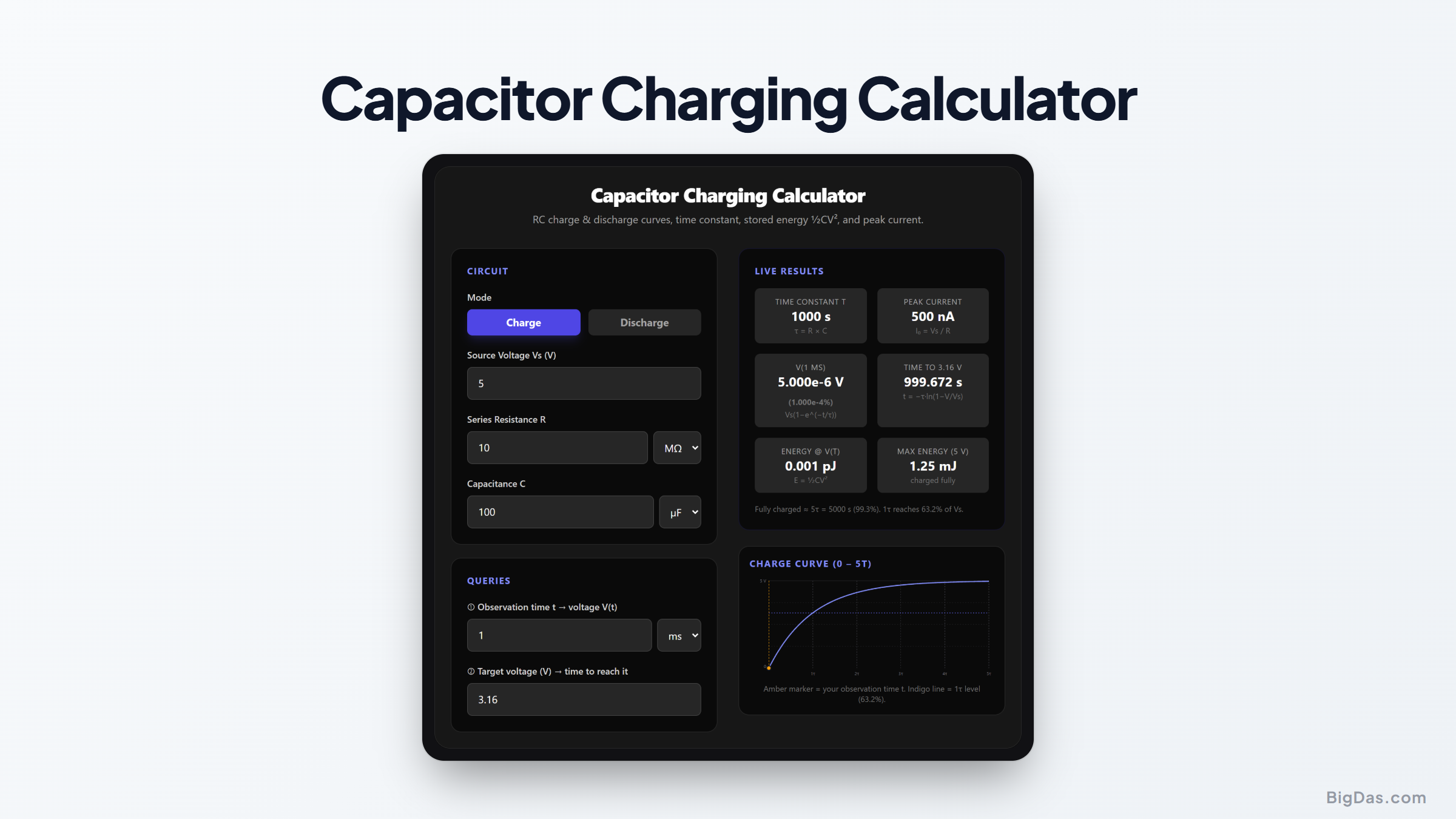
Capacitor Charging Calculator
 Generated infographic and interface snapshot for Capacitor Charging Calculator
From τ to time-to-threshold. RC math without the ln() key hunt.
Free Capacitor Charging Calculator Online. Big Das
Every decoupling network, debounce filter, timing circuit, and soft-start ramp is a resistor charging a capacitor. The Big Das Capacitor Charging Calculator solves both directions of the exponential, voltage at a given time, and the time to reach a given voltage, for charging and discharging alike, plus the time constant, peak current, and stored energy ½CV². A live curve shows where your observation point sits over five time constants.
Enter R and C with unit selectors (Ω/kΩ/MΩ, pF/nF/µF) and everything recomputes as you type.
What Is RC Charging?
When a voltage step is applied to a resistor in series with a discharged capacitor, the capacitor voltage does not jump, it follows an exponential approach toward the source. The speed of that approach is set by a single number, the time constant τ = R × C:
- After 1τ the capacitor reaches 63.2% of the source (or falls to 36.8% when discharging).
- After 5τ it is within 0.7%, for practical purposes, fully charged.
- The current starts at its peak, Vs/R, and decays with the same τ.
Discharge is the mirror image: the initial voltage decays exponentially through the same τ.
How to Use the Capacitor Charging Calculator
- Choose Charge or Discharge mode.
- Enter the source voltage Vs, or the initial capacitor voltage V₀ for discharge.
- Enter R and C with their unit selectors.
- Query ①, enter an observation time (µs/ms/s) to get V(t).
- Query ②, enter a target voltage to get the time to reach it.
- Read the panel: τ, peak current, energy at V(t), and the full-charge energy, all live, with a 0 to 5τ SVG curve marking your time point.
The Formulas Used
Time constant: τ = R × C
Charging: V(t) = Vs × (1 − e^(−t/τ))
Discharging: V(t) = V₀ × e^(−t/τ)
Time to voltage: t = −τ × ln(1 − V/Vs) (charge)
 t = τ × ln(V₀/V) (discharge)
Peak current: I₀ = Vs / R (decays as e^(−t/τ))
Stored energy: E = ½ × C × V²
Fully charged: t ≈ 5τ (99.3%)
All values are converted to ohms, farads, volts, and seconds before evaluation.
Worked Example
A 5 V logic supply charging a 100 µF capacitor through 10 kΩ:
- τ = 10,000 × 0.0001 = 1 second
- V(1 s) = 5 × (1 − e^(−1)) = 3.16 V, exactly the 63.2% point
- Time to 3.16 V: t = −1 × ln(1 − 3.16/5) = 1.00 s, confirming τ
- Peak current = 5 / 10,000 = 0.5 mA, safe for any GPIO
- Max stored energy = ½ × 100 µF × 5² = 1.25 mJ
- Full charge ≈ 5τ = 5 seconds
The curve highlights 1τ at the 63.2% line so these landmark values are visible at a glance.
Common Use Cases
- Timing circuits: how long until a comparator or Schmitt trigger trips.
- Debounce filters: pick R and C so switch bounce dies inside one τ.
- Power-on-reset delays: guarantee the supervisor holds reset long enough.
- Capacitor dropper / hold-up: discharge mode answers "how long does my rail survive a brown-out?"
- Camera flashes and pulsers: size C for the energy a pulse needs.
Frequently Asked Questions
Why does the capacitor never quite reach the source voltage?
The exponential only approaches asymptotically, mathematically it never arrives. In practice the difference drops below measurement noise after 5τ (99.3%), which is why "fully charged = 5τ" is the engineering convention. The calculator flags asking for a target voltage ≥ Vs for this reason.
The initial current is Vs/R, is that dangerous?
It can be. A large capacitor charged directly from a low-impedance supply can demand huge peak current, welding relay contacts or tripping protections. Inrush-limiting resistors, NTC thermistors, or soft-start circuits exist precisely to tame I₀.
Can I use this for a Thevenin source driving a capacitor?
Yes, use the open-circuit voltage as Vs and the Thevenin resistance as R. A voltage divider feeding a capacitor is exactly this case.
Why is resistor tolerance relevant?
A 10% resistor and a ±20% electrolytic capacitor move τ by up to 30% combined. For precision timing use film capacitors and 1% resistors, or measure the built circuit.
What happens in discharge mode if my target voltage is above V₀?
Nothing physical, a discharging capacitor starts at V₀ and only falls, so the target must be below it. The tool shows an inline warning instead of a nonsense negative time.