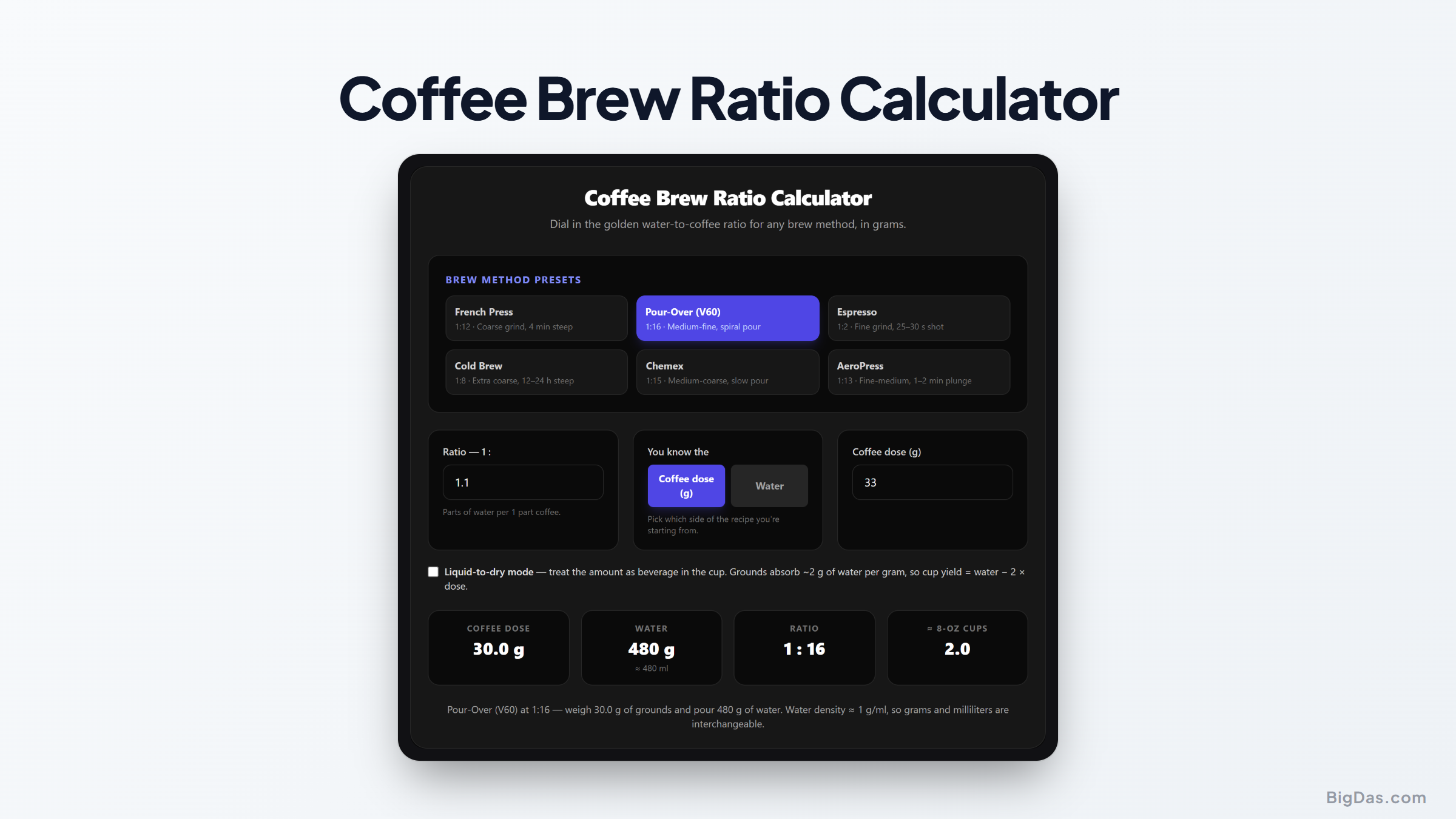
Coffee Brew Ratio Calculator
 Generated infographic and interface snapshot for Coffee Brew Ratio Calculator
A Complete Guide to the Coffee Brew Ratio Calculator
Brewing good coffee at home depends on balanced extraction. Many home brewers deal with unpredictable cups: one pot tastes bright and sweet, the next tastes hollow, sour, or bitter. The main cause is usually the water-to-coffee proportion. Measuring by volume with scoops or mugs introduces too much variance because beans differ in density by roast level, bean size, and origin. Measuring by mass turns brewing into a repeatable process. By weighing everything in grams, you control exactly how much flavor dissolves out of the grounds. A coffee ratio calculator handles the math for any brew method and keeps your results consistent.
What is the Coffee Brew Ratio Calculator?
A coffee brew ratio calculator determines the exact weight of coffee and water needed to hit a target strength and flavor profile. It uses brew ratios expressed as a comparison of coffee mass to water mass, like 1:15 or 1:16. The first number is the coffee; the second is the water. A 1:16 ratio means 1 gram of coffee for every 16 grams of water. Since 1 mL of water weighs 1 gram, weighing water on a kitchen scale is simple. The calculator adapts to specific brew methods. Pour over, Chemex, French press, AeroPress, espresso, and cold brew each use a different target ratio based on grind size, contact time, and filtration. The tool skips the manual math: enter the coffee you have or the cup size you want, and it returns exact gram targets.
Key Features
- Device presets: Built-in defaults for French press, pour over, espresso, and other popular methods. You don't need to memorize target numbers.
- Bidirectional input: Start with the amount of coffee you have to find the water weight, or start with your target cup size to find the coffee weight.
- Gram-level accuracy: Converts inputs to exact mass, so your coffee to water ratio stays precise.
- Consistent scaling: Works the same for a single cup or a large batch.
- Custom ratios: Override the presets to match a specific roast or personal taste.
How to Use It
Step 1: Choose Your Brew Method
Pick your equipment (Chemex, AeroPress, espresso, French press, etc.). The calculator loads a standard starting ratio for that style.
Step 2: Enter Your Known Variable
Decide which value you have on hand. If you have 22 g of beans left, type 22 into the coffee field. If you want to fill a 350 g travel mug, type 350 into the water field.
Step 3: Adjust the Ratio
Use the preset, or change the ratio to taste. A lower second number (e.g. 1:14) produces a stronger, heavier cup. A higher second number (e.g. 1:17) produces a lighter, cleaner cup.
Step 4: Read the Output
The calculator shows the target weights in grams. Place your vessel on a scale, tare it, add the exact grams of coffee, then pour the exact grams of water per your brew recipe.
When to Use It
Light vs. Dark Roasts
Light roasts are denser and harder to extract. They usually need a higher ratio (1:16 to 1:17) and hotter water. Dark roasts release solubles quickly and turn bitter with over-extraction, so a tighter ratio like 1:14 works better. The calculator makes it easy to switch between roast profiles.
Scaling Recipes
A standard single-cup pour over might use 15 g of coffee to 240 g of water. Doubling that for guests without doing the math leads to mistakes. Enter the larger target volume and the calculator gives you the exact scale numbers, keeping flavor consistent across batch sizes.
Switching Equipment
Each brew method extracts differently. French press uses a coarse grind and a specific ratio to handle long steep times. Espresso uses pressure and a tight ratio around 1:2. Pour over falls in the middle and highlights clean acidity. The calculator adjusts your coffee to water ratio for each method.
Frequently Asked Questions
What is the ideal coffee to water ratio for filter coffee?
A common starting point is 1:16. It gives balanced extraction with clear flavor and good mouthfeel. Acceptable ranges usually fall between 1:15 and 1:17, depending on grind size, brew method, and personal taste.
Why measure in grams instead of scoops?
Scoops measure volume, not mass. Bean density changes with roast level, bean size, and origin. Dark roasts are puffed up and light; light roasts are small and dense. A scoop of light roast weighs more than a scoop of dark roast, so volumetric measuring produces inconsistent results.
How is the espresso ratio different from filter coffee?
Espresso uses high pressure pushed through finely ground coffee over a short time, so it needs a concentrated ratio between 1:1.5 and 1:2.5. Filter methods like pour over or Chemex rely on gravity and longer contact times, so they use wider ratios between 1:15 and 1:17.
Does the calculator account for water absorbed by the grounds?
Coffee grounds absorb about twice their weight in water during brewing. Pouring 300 g of water over 20 g of coffee yields roughly 260 g of finished drink. The calculator works from the total water poured in, since that's what drives extraction.
Can I use the same ratio for cold brew?
No. Cold brew uses cold water and long steep times without heat to drive extraction, so it needs a much lower ratio. Typical cold brew concentrate ranges from 1:4 to 1:8, and the concentrate gets diluted with water or milk before drinking.
Summary
Precision removes the variables that cause inconsistent coffee. A coffee ratio calculator keeps your water and coffee measurements proportional whether you brew a delicate pour over, a heavy French press, or a dense espresso.