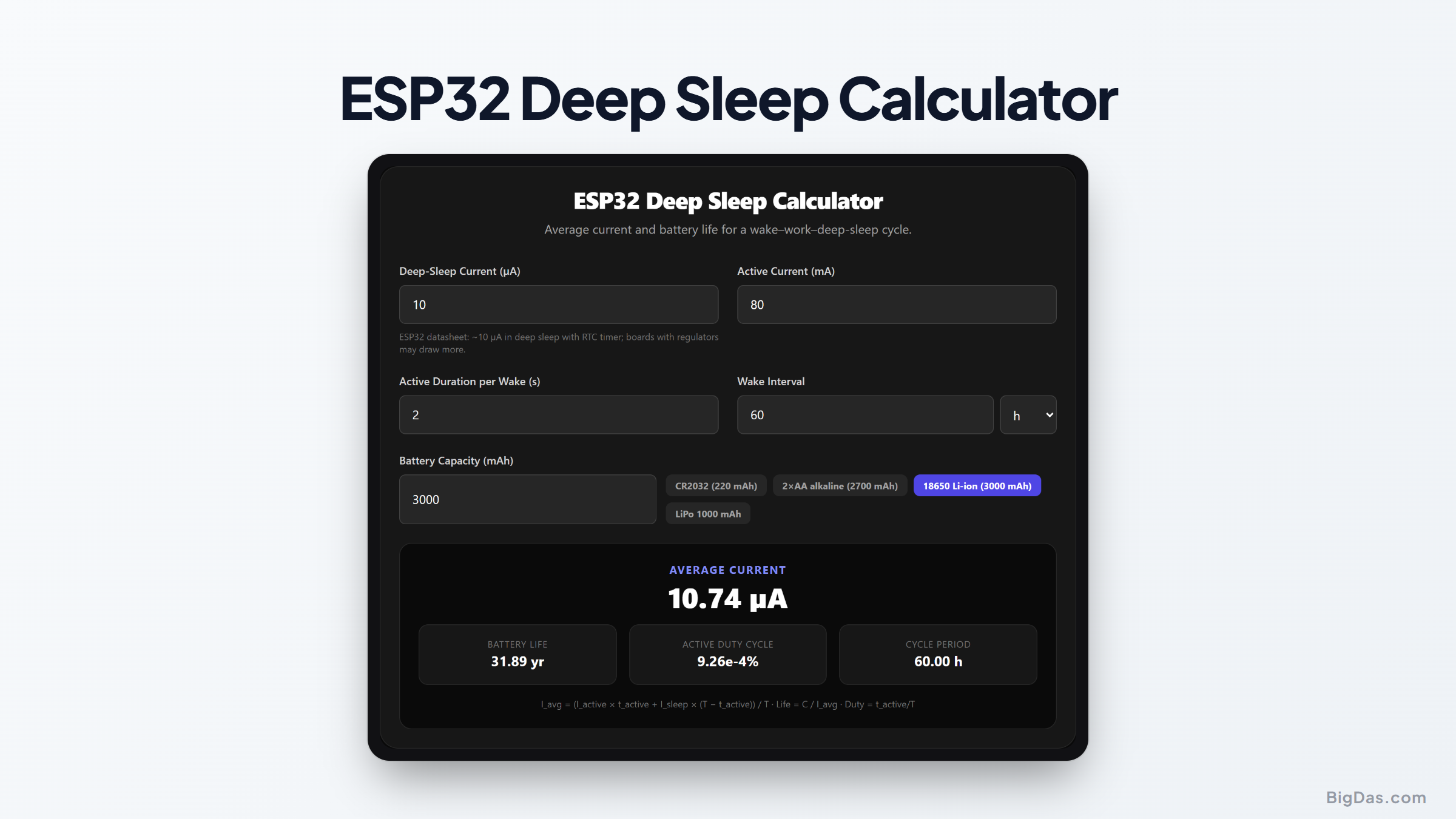
ESP32 Deep Sleep Calculator
 Generated infographic and interface snapshot for ESP32 Deep Sleep Calculator
Make a battery-powered ESP32 node last months, not days.
Free ESP32 Deep Sleep Calculator Online. Big Das
An ESP32 idling at full tilt drains a coin cell in hours; sleeping properly, it can run for years. The Big Das ESP32 Deep Sleep Calculator combines your deep-sleep current, wake interval, active current, and active duration into one average current, then projects the battery life for your chosen cell.
The Deep-Sleep Duty Cycle
An ESP32 in a sensing loop alternates between two states:
- Deep sleep: typically ~10 µA with the RTC timer keeping time (per the ESP32 datasheet; boards with voltage regulators and pull-ups often draw more).
- Active: CPU running, Wi-Fi transmitting; tens to hundreds of mA for a fraction of a second.
The average current over one full cycle of period T is the charge-weighted mean:
I_avg = ( I_active × t_active + I_sleep × (T − t_active) ) / T
With t_active / T often under 0.1 %, the sleep term dominates, every second of Wi-Fi activity is expensive, every hour of extra sleep nearly free.
Battery life follows directly:
Life (h) = Capacity (mAh) / I_avg (mA)
Active duty = t_active / T × 100%
How to Use the ESP32 Deep Sleep Calculator
- Deep-sleep current: enter your measured µA (datasheet typical ≈ 10 µA; dev boards often 1 to 10 mA unless the regulator is bypassed).
- Active current: the average mA drawn while the chip is awake, including any sensors and Wi-Fi pulses.
- Active duration per wake: seconds spent awake each cycle (boot + sensor read + transmit + shutdown).
- Wake interval: how often it wakes; choose seconds, minutes, or hours.
- Battery capacity: enter mAh or tap a chemistry preset (CR2032, AA pair, 18650, LiPo).
- Read the results: average current, battery life, active duty cycle, and cycle period update live.
Worked Example
A soil-moisture node wakes every 60 s, stays awake 2 s at 80 mA (boot + Wi-Fi publish), and sleeps at 10 µA, powered by a 3000 mAh 18650.
- Cycle period T = 60 s; asleep 58 s.
- I_avg = (80 × 2 + 0.010 × 58) / 60 = (160 + 0.58) / 60 ≈ 2.68 mA
- Battery life = 3000 / 2.68 ≈ 1119 h ≈ 46 days
- Active duty = 2/60 ≈ 3.3 %
Snap the wake interval to 10 minutes and I_avg falls to ≈ 0.28 mA, roughly 15 months. The calculator makes the trade-off explicit before you flash firmware.
Common Use Cases
- Battery life estimation for ESP32 sensor nodes and data loggers.
- Interval tuning: find a wake period that meets a target run-time.
- Board selection: see why dev-board quiescent loads kill battery life.
- Energy budgeting for solar-assisted or energy-harvesting designs.
- Firmware what-ifs: compare 1 s vs 5 s active windows instantly.
Frequently Asked Questions
Why is 10 µA called "typical" for deep sleep?
The ESP32 datasheet specifies roughly 10 µA for deep sleep with the RTC timer and RTC memories powered (ULP co-processor off; RTC slow memory retained). Exact current varies with chip revision, temperature, and which RTC domains you keep alive.
Is my dev board really drawing mA in deep sleep?
Often, yes. USB-uart bridges, power LEDs, and inefficient regulators on boards like the ESP32 DevKit keep quiescent current in the 1 to 10 mA range. Measure with a µCurrent or shunt resistor, do not trust the datasheet value for a bare module.
Does wake-from-deep-sleep reset lose my variables?
Most SRAM is powered down; only the RTC FAST and SLOW memories survive. Store state in RTC memory or NVS/flash before calling esp_deep_sleep_start().
How accurate is the capacity-to-life conversion?
Idealized. Real cells lose effective capacity at low discharge rates is minor, but temperature, cutoff voltage, and regulator dropout matter. Planning with 70 to 80 % of the nominal mAh is a safe rule of thumb.
Should I include Wi-Fi connection time in t_active?
Absolutely. Wi-Fi join plus DHCP can dominate the active window. Measure a real cycle: a fixed 2 s estimate may swell to 6 to 10 s on a cold network and change your battery life by 3×.
What about using the ULP co-processor?
The ULP can sample simple sensors while the main CPU sleeps, adding ~25 to 150 µA. Enter that as your "deep-sleep" current and keep t_active for the occasions the main CPU must wake.