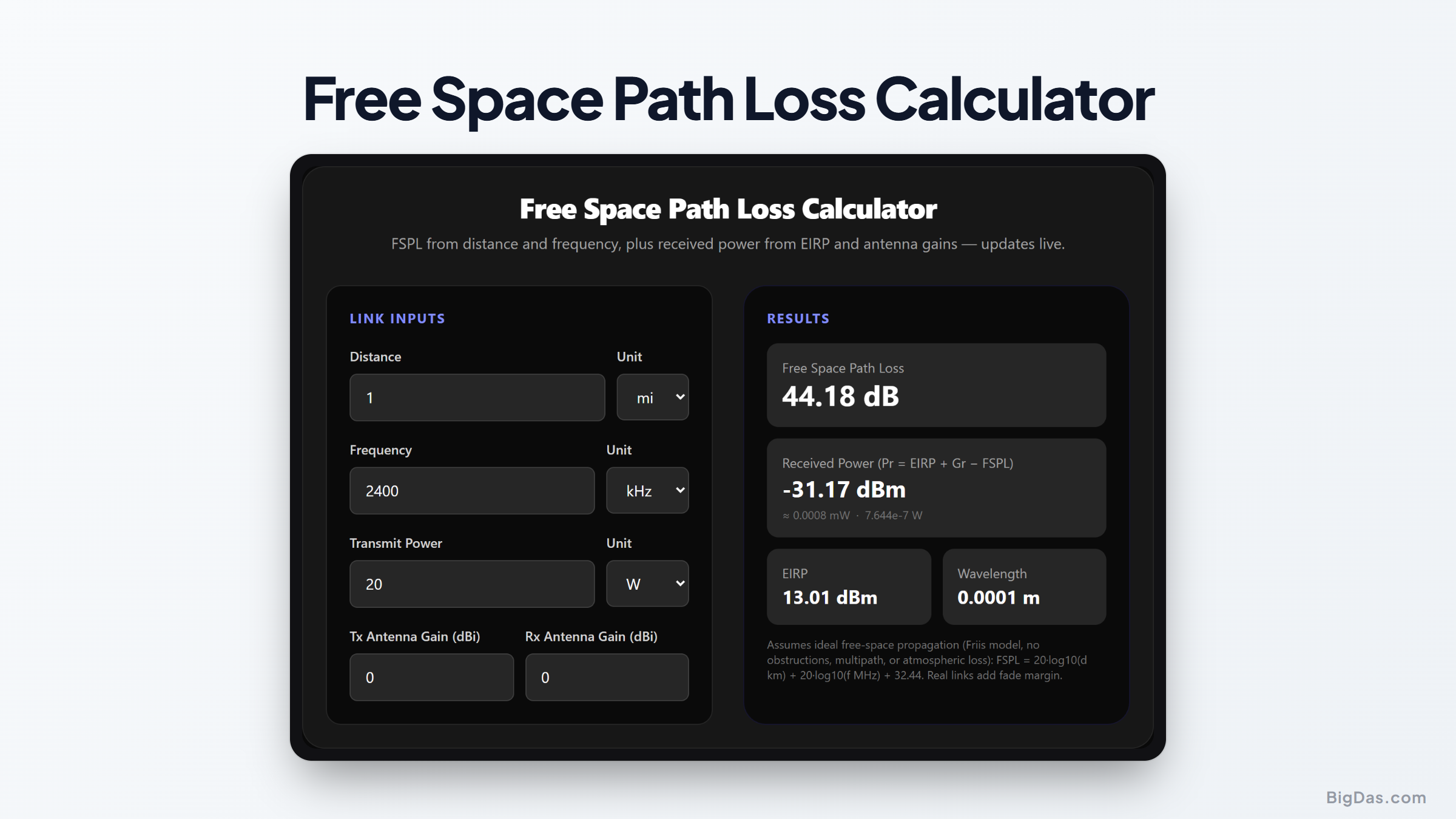
Free Space Path Loss Calculator
 Generated infographic and interface snapshot for Free Space Path Loss Calculator
Estimate RF coverage without touching a field meter.
Free Space Path Loss Calculator Online. Big Das
RF signals spreading through empty space lose strength with distance and frequency. The Big Das Free Space Path Loss Calculator turns that decay into a hard number in dB and folds in EIRP and antenna gains to predict the power arriving at the receiver, instantly, in your browser.
No spreadsheets, no log tables: enter distance and frequency, and the path loss and received power update live.
What Is FSPL?
Free Space Path Loss (FSPL) is the amount of signal power lost when a radio wave spreads out as it travels between two antennas in a clear, unobstructed environment, no reflections, no absorption, no multipath. It assumes the free-space model: an idealized vacuum between isotropic antennas, described by the Friis transmission equation.
FSPL is the foundation of every link budget: it climbs 6 dB every time distance doubles, and a further 6 dB every time frequency doubles for the same distance.
How to Use the Free Space Path Loss Calculator
- Enter the distance between antennas, choosing m, km, or miles.
- Enter the frequency in Hz, kHz, MHz, or GHz.
- Enter the transmit power (dBm, W, or mW), plus the Tx and Rx antenna gains in dBi.
- Read the results: FSPL in dB, EIRP, wavelength, and the received power in dBm, mW, and W appear live.
The Formulas Used
FSPL(dB) = 20·log10(d_km) + 20·log10(f_MHz) + 32.44
Pr(dBm) = EIRP + Gr − FSPL
EIRP(dBm) = Pt + Gt
Here Pt is transmit power, Gt / Gr are Tx/Rx antenna gains (dBi), and the constant 32.44 dB is the standard value for distance in km and frequency in MHz (32.45 if computed from precise constants, a 0.01 dB difference).
Worked Example
A 2.4 GHz Wi-Fi link over 1 km:
- FSPL = 20·log10(1) + 20·log10(2400) + 32.44
- = 0 + 20 × 3.3802 + 32.44 = 100.04 dB
With 20 dBm (100 mW) transmit power and 0 dBi antennas, EIRP = 20 dBm, so:
- Pr = 20 + 0 − 100.04 = −80.04 dBm
That is about 9.9 × 10⁻⁹ mW, weak, but a −105 dBm-sensitive receiver still has comfortable margin.
Common Use Cases
- Wi-Fi / Bluetooth range checks: sanity-check coverage before buying or pointing antennas.
- FPV and drone links: estimate when video will drop at a given power and frequency.
- Ham / LoRa links: plan repeater paths and handheld range.
- Satellite & deep-space uplinks: FSPL is the dominant term (free space really is empty up there).
- ISM band comparisons: see instantly why 2.4 GHz travels further than 5.8 GHz at the same power.
Frequently Asked Questions
Why do distance and frequency both add 20·log10?
An isotropic source spreads power over the surface of a growing sphere (area ∝ d²), giving a d² loss. The receiving antenna collects only a patch of that sphere proportional to λ², adding an f² factor. Combined: (4πdf/c)², whose log form produces both 20-log terms.
Is FSPL the same as total path loss?
No. Free-space loss is the minimum possible loss with a clear line of sight. Real environments add absorption, diffraction, foliage, and multipath, the reason link budgets add a fade margin on top.
What is the 32.44 dB constant?
It is 20·log10(4π×1000 / c) collapsed into units of km and MHz, where c is the speed of light. Using GHz and km instead, the constant becomes 92.45 dB.
Can I use this for indoor Wi-Fi?
Only as a best-case starting point. Indoors you must add wall and floor attenuation; real indoor paths typically lose 30 to 80 dB more than free space at a few meters to tens of meters.
Why does the calculator show received power in mW as well as dBm?
dBm is handy for link math, but translating −80 dBm into ~9.9 nW helps build intuition for just how little energy survives long paths, and why receiver sensitivity matters.